Loading...
Done
Museum assistant and former Soviet soldier, Sheikh Abdullah looks at a display in the Manzar-e Jahad, or Jihad Museum, which depicts the Soviet invasion of 1979 and the Afghan resistance, in Herat, on February 15, 2014. (Photo by Aref Karimi/AFP Photo via The Atlantic)

Museum assistant and former Soviet soldier, Sheikh Abdullah looks at a display in the Manzar-e Jahad, or Jihad Museum, which depicts the Soviet invasion of 1979 and the Afghan resistance, in Herat, on February 15, 2014. Sheikh Abdullah, who was a Soviet intelligence officer by the name of Khakimov Bakhrodin, was captured after being injured in battle with the Mujahideen. Abdullah stayed with his captors, converted to Islam and was renamed Abdullah. He never returned to his former homeland and now works at the Jihad Museum. (Photo by Aref Karimi/AFP Photo via The Atlantic)
Details
10 Mar 2014 09:08:00
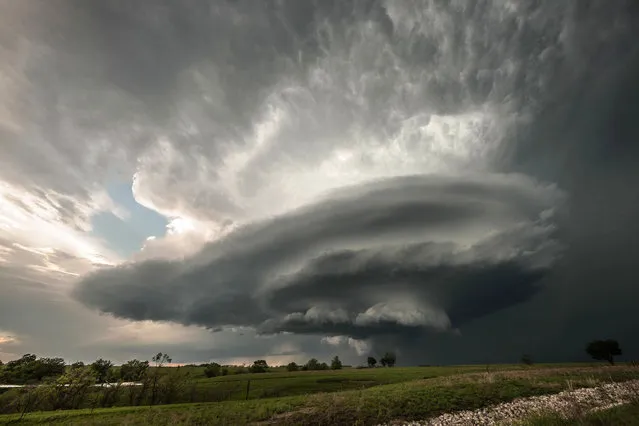
The rotating updraft base of a supercell thunderstorm, and a rear flank downdraft containing rain and hail, backlit by the setting sun, on May 10, 2014, in Climax, Kansas, United States. To most of us, dark clouds on the horizon usually means rain – but here in Kansas, they can also signal the start of a supercell. The huge formations, also known as rotating thunderstorms, are among the most powerful weather phenomenon found over land. (Photo by Stephen Locke/Barcroft Media)

The rotating updraft base of a supercell thunderstorm, and a rear flank downdraft containing rain and hail, backlit by the setting sun, on May 10, 2014, in Climax, Kansas, United States. To most of us, dark clouds on the horizon usually means rain – but here in Kansas, they can also signal the start of a supercell. The huge formations, also known as rotating thunderstorms, are among the most powerful weather phenomenon found over land. They can occur anywhere where the conditions are right, but are normally found in more arid climates. These awe-inspiring supercells were captured south of Climax city by storm chaser Stephen Locke. (Photo by Stephen Locke/Barcroft Media)
Details
18 Jul 2014 12:01:00
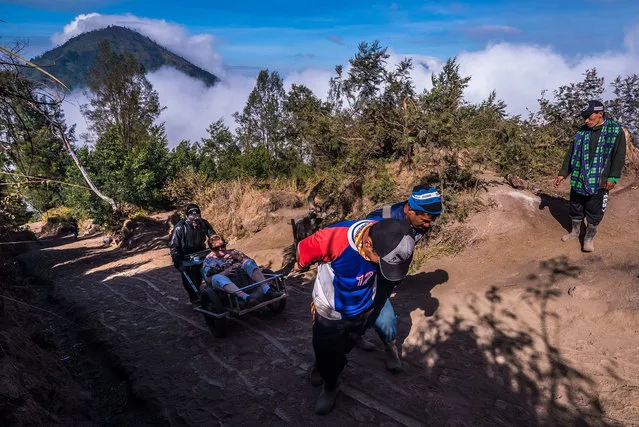
Miners pulling up lazy tourists to the rim of Kawah Ijen (Ijen Volcano), East Java, Indonesia on September 21, 2017. They will earn as much as they would bring down a load of sulfur. Nomadic Explorer, Cultural Lifestyle Photographer Claudio Sieber captured striking images of miners working at Ijen volcanic range in East Java, Indonesia. The sulphur miners risk their lives daily as they climb the active volcano carrying heavy loads, which they sell to sugar refineries. Shortly after midnight curious tourists are flocking in hundreds through the gate of Ijen's foothills to be right on time, driven by the images others took before them. Kawah Ijen is the one of the world's largest acidic volcanic crater lake; famous for its turquoise color as well as the unreal atmosphere it offers during darkness. A dusty path zigzags 3 kilometers up to the crater rim. This doesn't mean anything challenging; in particular, special sights have to be deserved anyway. The irritating smell of sulfur announces the near of the crater's existence. Arriving on the crater's rim the reward for the torture becomes visible. Blue fire darts its tongues through the fumes of sulfur dioxide. Somehow, the spectacle isn't as romantic as expected, since it is also the rough working space of approx. 150 sulfur miners who start their shift at 1 am. Lately, harvesting the abundance of devil's gold received international attention. This did obviously not really improve a miner's lifestyle; neither did it contribute to a better wage. (Photo by Claudio Sieber/Barcroft Images)

Miners pulling up lazy tourists to the rim of Kawah Ijen (Ijen Volcano), East Java, Indonesia on September 21, 2017. They will earn as much as they would bring down a load of sulfur. Nomadic Explorer, Cultural Lifestyle Photographer Claudio Sieber captured striking images of miners working at Ijen volcanic range in East Java, Indonesia. The sulphur miners risk their lives daily as they climb the active volcano carrying heavy loads, which they sell to sugar refineries. (Photo by Claudio Sieber/Barcroft Images)
Details
02 Oct 2017 08:31:00
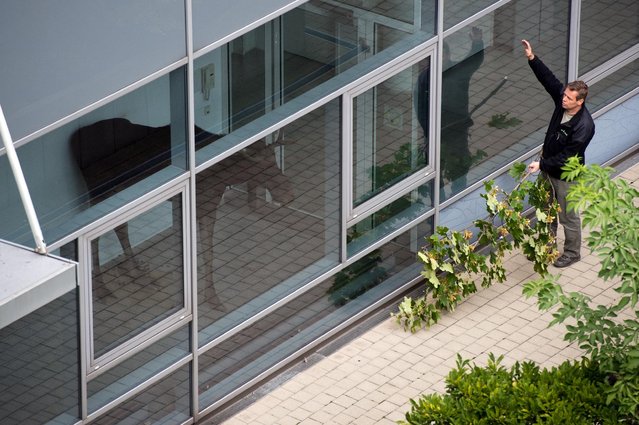
A zoo employee waves at a young moose in an administration building of Siemens in Dresden, Germany, Monday August 25, 2014. (Photo by Arno Burgi/AP Photo/DPA)

A young moose stands behind a window in an administration building of Siemens in Dresden, Germany Monday August 25, 2014. Police are trying to capture a moose on the loose in the eastern German city of Dresden. A spokesman for Dresden police says the young bull walked into the offices of German industrial giant Siemens on Monday and got stuck behind a glass wall. Marko Laske says officers and wildlife are trying to shoo the moose into a container so he can be taken to the local zoo. Moose are rare in Germany and the animal is likely to have come from neighboring Poland. (Photo by Arno Burgi/AP Photo/DPA)
Details
28 Aug 2014 10:55:00
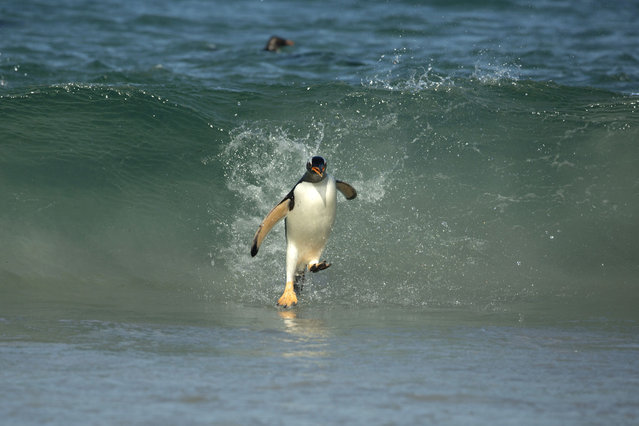
These surfing penguins are making waves as they glide gracefully across the ocean.They are showcasing their talent as they arrive on the East Coast beach of New Island in the Falklands.The penguins are of the gentoo species, characterised by their bright orange bills and the distinctive white stripes on their heads. Here: a lone penguin balancing cooly on a single foot as it catches a wave. (Photo by Shanu Subra/Solent News/SIPA Press)

These surfing penguins are making waves as they glide gracefully across the ocean.They are showcasing their talent as they arrive on the East Coast beach of New Island in the Falklands.The penguins are of the gentoo species, characterised by their bright orange bills and the distinctive white stripes on their heads. The dazzling images were captured by amateur photographer Shanu Subra, during a 26 day ecology expedition. Here: a lone penguin balancing cooly on a single foot as it catches a wave. (Photo by Shanu Subra/Solent News/SIPA Press)
Details
25 Nov 2014 10:55:00
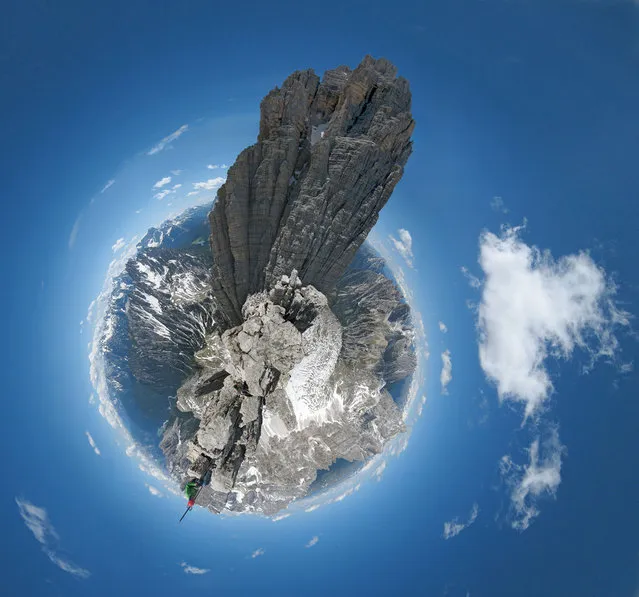
“Taken at the tiny summit of Cima Piccola in the the Tre Cima group in the Dolomites, Italy. The large peak is Cima Grande Some remote peaks have a summit register, and my climbing partner Steve can be seen signing this in the bottom of the picture”. (“Little Planets” Project. Photo and comment by Dan Arkle)

These are the amazing panoramic photographs that look like little planets. They were taken by photographer Dan Arkle, 34, from Sheffield, UK. He said: “On a sharp summit, you feel literally on top of the world, with dramatic views in all directions, including straight down. I tried using conventional photography to capture this feeling, but even with a wide angle lens I couldnt get all the view in the image”. Here: “Taken at the tiny summit of Cima Piccola in the the Tre Cima group in the Dolomites, Italy. The large peak is Cima Grande Some remote peaks have a summit register, and my climbing partner Steve can be seen signing this in the bottom of the picture”. (“Little Planets” Project. Photo and comment by Dan Arkle)
Details
06 Jun 2015 09:52:00
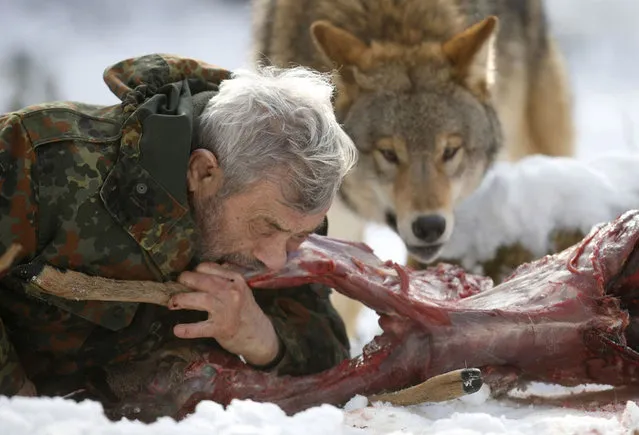
The Wolf Man

Wolfspark Werner Freund is a wolf sanctuary spread over 25 acres in western Germany. It is home to 29 wolves -- six distinct packs hailing from Europe, Siberia, Canada, the Arctic, and Mongolia. Researcher Werner Freund, 79, a former German paratrooper, established the sanctuary in 1972 and has raised more than 70 animals there over the last 40 years. He acquired the wolves as cubs from zoos or animal parks and has reared them mostly by hand. Werner has also taken to living closely with his wolves, behaving as an alpha male to earn their acceptance and respect. Reuters photographer Lisi Niesner recently spent some time with Freund and his wolves, capturing the interactions between these old friends.
Details
31 Jan 2013 15:50:00
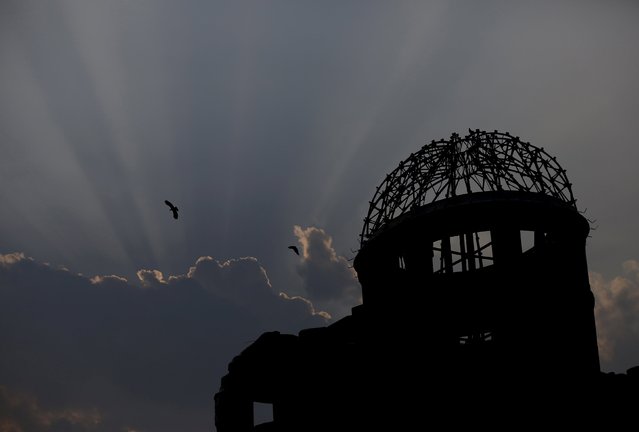
Birds fly over the Atomic Bomb Dome in Hiroshima, western Japan July 29, 2015. On August 6, 1945, the U.S. dropped the atomic bomb on Hiroshima, killing about 140,000 by the end of the year in a city of 350,000 residents, in the world's first nuclear attack. (Photo by Issei Kato/Reuters)

Birds fly over the Atomic Bomb Dome in Hiroshima, western Japan July 29, 2015. On August 6, 1945, the U.S. dropped the atomic bomb on Hiroshima, killing about 140,000 by the end of the year in a city of 350,000 residents, in the world's first nuclear attack. Three days later, a second atomic bomb was dropped on Nagasaki. Influenced by the shadows scorched into outdoor surfaces by the heat of the blasts 70 years ago, Reuters photographer Issei Kato pays homage to survivors, residents and historic buildings in both cities in a personal project that captures the shadows of today. (Photo by Issei Kato/Reuters)
Details
04 Aug 2015 12:01:00