Loading...
Done
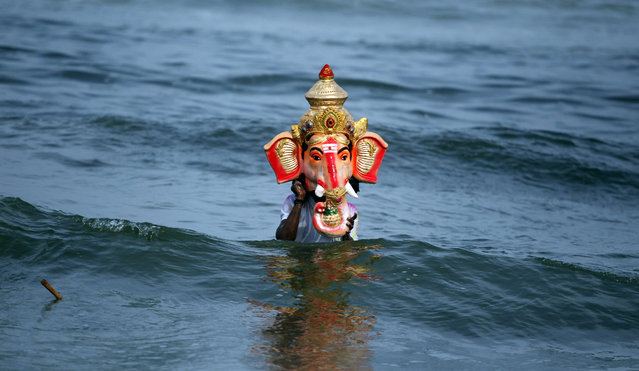
A man holds an idol of  Hindu God Ganesha before immersing it in the Bay of Bengal during Ganesh Chaturthi festival in Chennai, India, Sunday, September 20, 2015. The festival marks the birth of Ganesha who is widely worshiped by Hindus as the god of wisdom, prosperity and good fortune. (Photo by Arun Sankar K./AP Photo)

A man holds an idol of Hindu God Ganesha before immersing it in the Bay of Bengal during Ganesh Chaturthi festival in Chennai, India, Sunday, September 20, 2015. The festival marks the birth of Ganesha who is widely worshiped by Hindus as the god of wisdom, prosperity and good fortune. (Photo by Arun Sankar K./AP Photo)
Details
23 Sep 2015 08:04:00
Girls enjoy nice weather at a park in front of the Pothonggang Department Store in central Pyongyang October 11, 2015. (Photo by Damir Sagolj/Reuters)

Girls enjoy nice weather at a park in front of the Pothonggang Department Store in central Pyongyang October 11, 2015. (Photo by Damir Sagolj/Reuters)
Details
02 Nov 2015 08:02:00
Pedestrians are falling after a gust of wind in Munich southern Germany, Tuesday, March 31, 2015. (Photo by Sven Hoppe/AP Photo/DPA)

Pedestrians are falling after a gust of wind in Munich southern Germany, Tuesday, March 31, 2015. One of the strongest storm fronts in years hit Germany on Tuesday, as Storm “Niklas” uncovered roofs, toppled scaffolding and caused severe disruption to rail services. (Photo by Sven Hoppe/AP Photo/DPA)
Details
01 Apr 2015 11:30:00
A woman wearing cut-off jeans and a halter-neck sun top in St Tropez, 1972. (Photo by Roy Jones/Getty Images)

A woman wearing cut-off jeans and a halter-neck sun top in St Tropez, 1972. (Photo by Roy Jones)
Details
20 May 2013 12:32:00


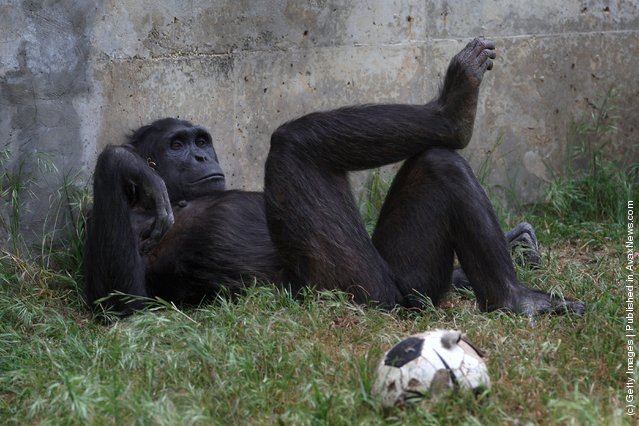
A chimpanzee relaxes in the shade at the Safari Park as the popular attraction prepares for the upcoming Jewish festival of Pesach (Passover) on April 14, 2008 in Ramat Gan near Tel Aviv, Israel. (Photo by David Silverman/Getty Images)
Details
25 May 2011 08:22:00


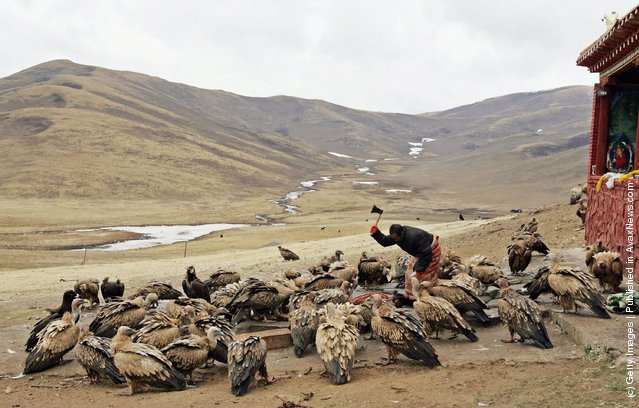
“Sky burial or ritual dissection was once a common funerary practice in Tibet wherein a human corpse is cut in specific locations and placed on a mountaintop, exposing it to the elements or the mahabhuta and animals – especially to birds of prey. The location of the sky burial preparation and place of execution are understood in the Vajrayana traditions as charnel grounds. In Tibet the practice is known as jhator, which literally means, «giving alms to the birds»”. – Wikipedia

Photo: A burial master chops bones of a body to feed vultures during a celestial burial ceremony on April 19, 2006 in Dari County of Guoluo Prefecture, Qinghai Province, northwest China. Celestial burial is a traditional funeral of Tibetan people, which began in the 7th century. (Photo by China Photos/Getty Images)

Details
18 Jun 2011 12:12:00
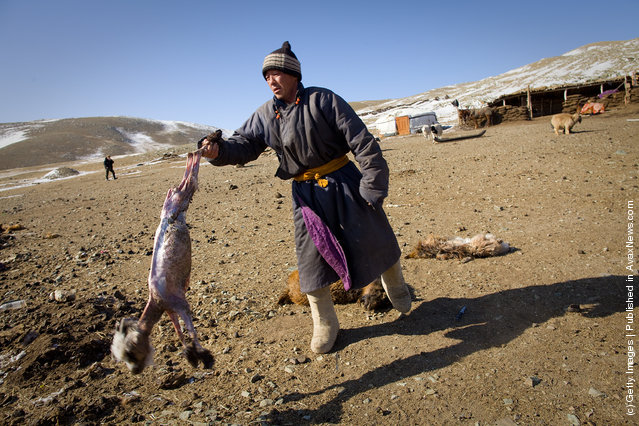
Extreme Mongolian Winter

Mongolian herder, Khurelsukh, throws the carcass of a goat onto a heap as he struggles to deal with losing a quarter of his herd, on March 8, 2010 in Bayantsogt, Tuv province, Mongolia. (Photo by Paula Bronstein /Getty Images)
Details
18 Dec 2011 11:44:00
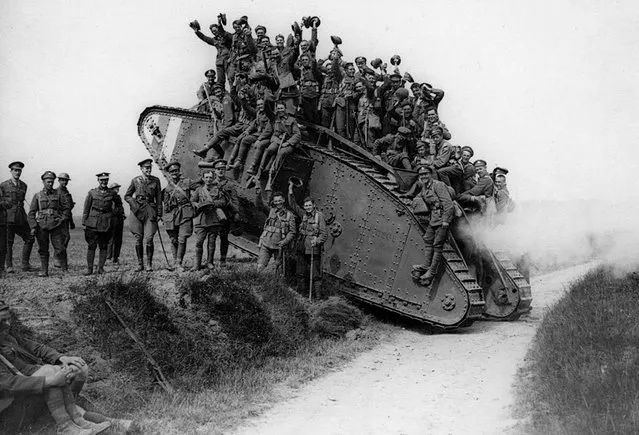
These black-and-white photos are taken from the new book “Armoured Warfare in the First World War 1916 – 1918” by Anthony Tucker-Jones and published by Pen & Sword Military. “Interestingly the British, French and Germans took completely different approaches with varying results”. The British military produced “Little Willie” in Autumn 1915 weighing 18 tonnes, which had a crew of two plus four gunners. “Inspired by a tracked artillery tractor “Little Willie” was referred to as a water tank – hence the name tank – to ensure secrecy”, said Anthony. “This led to the strange looking Mark I with its peculiar rhomboid shape, designed to cross trenches with guns in sponsons on either side. The Germans saw the tank as unchivalrous and were slow to grasp its utility. They favoured the Stormtrooper (specialist soldiers used to infiltrate enemy trenches) and artillery, not the tank”, said Anthony. “However, they didn’t hesitate to make use of captured British tanks. Although the tank helped secure victory and German soldiers dubbed it “Germany’s Downfall” the country was ultimately brought to its knees by the Allies blockade”. Here: British troops hitch a ride on a Mark IV after the massed tank fleet spearheading attack at Cambrai on November 20, 1917. (Photo by Anthony Tucker-Jones/Mediadrumworld.com)

These black-and-white photos are taken from the new book “Armoured Warfare in the First World War 1916 – 1918” by Anthony Tucker-Jones and published by Pen & Sword Military. Here: British troops hitch a ride on a Mark IV after the massed tank fleet spearheading attack at Cambrai on November 20, 1917. (Photo by Anthony Tucker-Jones/Mediadrumworld.com)
Details
23 Feb 2017 00:02:00