Loading...
Done
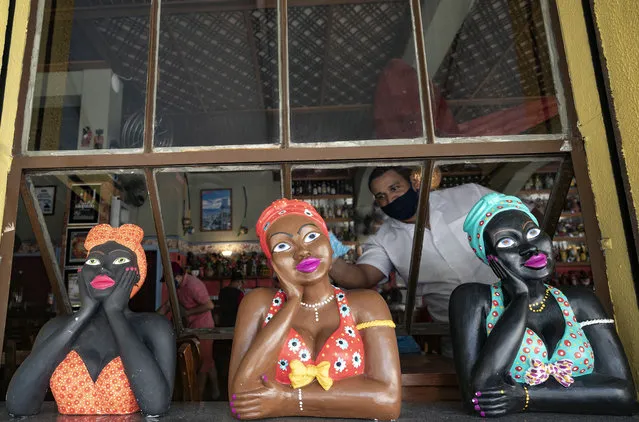
A restaurant worker wearing a mask cleans the windows as the restaurant reopens amid the COVID-19 pandemic in Sao Paulo, Brazil, Monday, July 6, 2020. Bars, restaurants and beauty salons were allowed to re-open Monday after over three months of quarantine, and are required to observe preventative measures and reduced operating hours only during the day. (Photo by Andre Penner/AP Photo)

A restaurant worker wearing a mask cleans the windows as the restaurant reopens amid the COVID-19 pandemic in Sao Paulo, Brazil, Monday, July 6, 2020. Bars, restaurants and beauty salons were allowed to re-open Monday after over three months of quarantine, and are required to observe preventative measures and reduced operating hours only during the day. (Photo by Andre Penner/AP Photo)
Details
26 Jan 2021 10:21:00
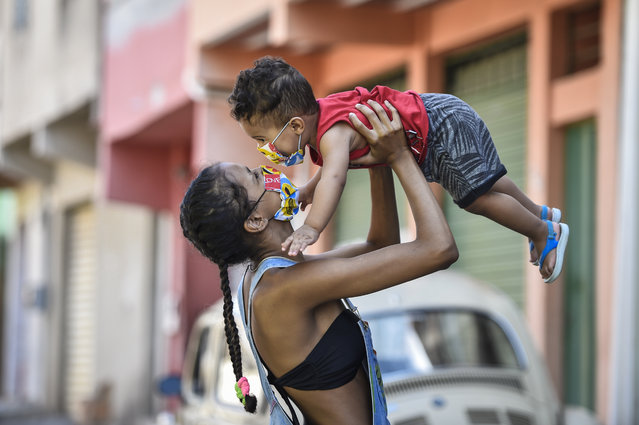
Carolaine Reis and her son Miguel Alves, residents of the Aglomerado da Serra favela, wear a protective mask against the spread of the new Coronavirus (COVID-19) made by the seamstresses of the Remexe Favelinha studio, in the Aglomerado da Serra favela, on April 13, 2020 in Belo Horizonte, Brazil. Facial masks follow the protocol and guidelines defined by the Ministry of Health. Around 6,000 masks have already been produced. The masks are being distributed to a part of the population and sold throughout the country, in the amount of 5 reais per unit. (Photo by Pedro Vilela/Getty Images)

Carolaine Reis and her son Miguel Alves, residents of the Aglomerado da Serra favela, wear a protective mask against the spread of the new Coronavirus (COVID-19) made by the seamstresses of the Remexe Favelinha studio, in the Aglomerado da Serra favela, on April 13, 2020 in Belo Horizonte, Brazil. Facial masks follow the protocol and guidelines defined by the Ministry of Health. Around 6,000 masks have already been produced. The masks are being distributed to a part of the population and sold throughout the country, in the amount of 5 reais per unit. (Photo by Pedro Vilela/Getty Images)
Details
16 Apr 2020 00:03:00
Kawakanih Yawalapiti, 9, Upper Xingu region of Mato Grosso, Brazil, 2018: Kawakanih lives with her tribe, the Yawalapiti, in Xingu national park, a preserve in the Amazon basin of Brazil. The Yawalapiti collect seeds to preserve species unique to their ecosystem, which lies between the rain forest and savannah. Kawakanih’s diet is simple, consisting mainly of fish, cassava, porridge, fruit and nuts. “It takes five minutes to catch dinner”, says Kawakanih. “When you’re hungry, you just go to the river with your net”. (Photo by Gregg Segal/The Guardian)

Photographer Gregg Segal travelled the world to document children and the food they eat in a week. Partly inspired by the increasing problems of childhood obesity, he tracked traditional regional diets as yet unaffected by globalisation, and ironically, found that the healthiest diets were often eaten by the least well off. (Photo by Gregg Segal/The Guardian)
Details
03 Jul 2019 00:03:00
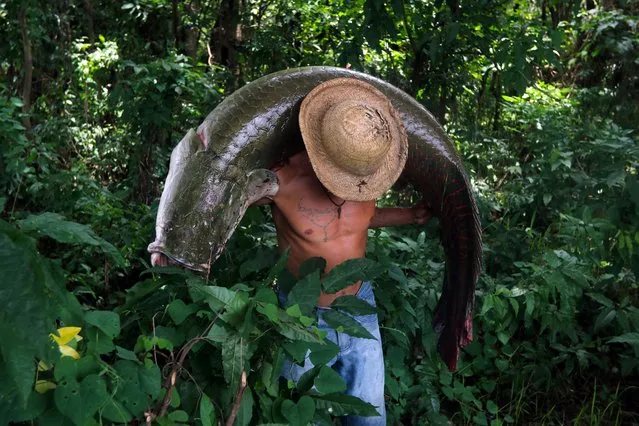
A fisherman carries a large Pirarucu (Arapaima gigas) at the Piagacu-Purus Sustainable Development Reserve in Amazonas state, Brazil, on October 24, 2019. The pirarucu -a giant fish of the Amazon, that had been on the verge of extinction- can measure up to three meters and weigh more than 200 kilos. The soft and tasty white meat fish is nowadays served in renowned restaurants in Rio de Janeiro. (Photo by Ricardo Oliveira/AFP Photo)

A fisherman carries a large Pirarucu (Arapaima gigas) at the Piagacu-Purus Sustainable Development Reserve in Amazonas state, Brazil, on October 24, 2019. The pirarucu -a giant fish of the Amazon, that had been on the verge of extinction- can measure up to three meters and weigh more than 200 kilos. The soft and tasty white meat fish is nowadays served in renowned restaurants in Rio de Janeiro. (Photo by Ricardo Oliveira/AFP Photo)
Details
31 Oct 2019 00:07:00
France's defender #07 Sakina Karchaoui (L) and France's forward #11 Kadidiatou Diani (R) celebrate their win at the end of the Australia and New Zealand 2023 Women's World Cup Group F football match between France and Brazil at Brisbane Stadium in Brisbane on July 29, 2023. (Photo by Dan Peled/Reuters)

France's defender #07 Sakina Karchaoui (L) and France's forward #11 Kadidiatou Diani (R) celebrate their win at the end of the Australia and New Zealand 2023 Women's World Cup Group F football match between France and Brazil at Brisbane Stadium in Brisbane on July 29, 2023. (Photo by Dan Peled/Reuters)
Details
09 Aug 2023 00:18:00
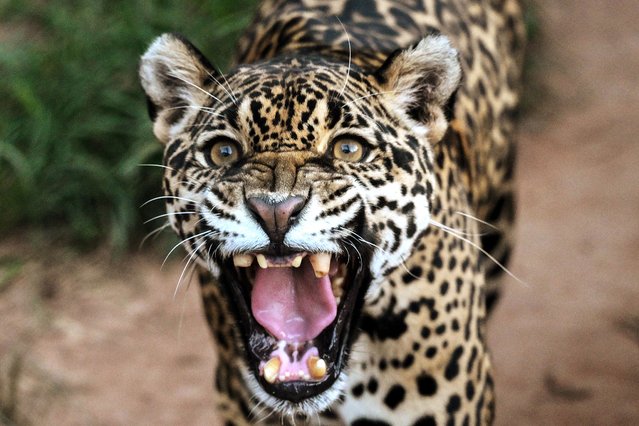
A jaguar (Panthera onca) growls at the Mata Ciliar association, an organization for the conservation of biodiversity, in Jundiai, Sao Paulo state, Brazil on May 29, 2025. Twenty-five pumas and ten jaguars are currently recovering at the Brazilian Center for the Conservation of Neotropical Felines at Mata Ciliar, a site as large as 40 football fields where monkeys, wild dogs, maned wolves, ocelots, and other regional animals are also rehabilitated. (Photo by Nelson Almeida/AFP Photo)

A jaguar (Panthera onca) growls at the Mata Ciliar association, an organization for the conservation of biodiversity, in Jundiai, Sao Paulo state, Brazil on May 29, 2025. Twenty-five pumas and ten jaguars are currently recovering at the Brazilian Center for the Conservation of Neotropical Felines at Mata Ciliar, a site as large as 40 football fields where monkeys, wild dogs, maned wolves, ocelots, and other regional animals are also rehabilitated. (Photo by Nelson Almeida/AFP Photo)
Details
22 Jun 2025 02:21:00
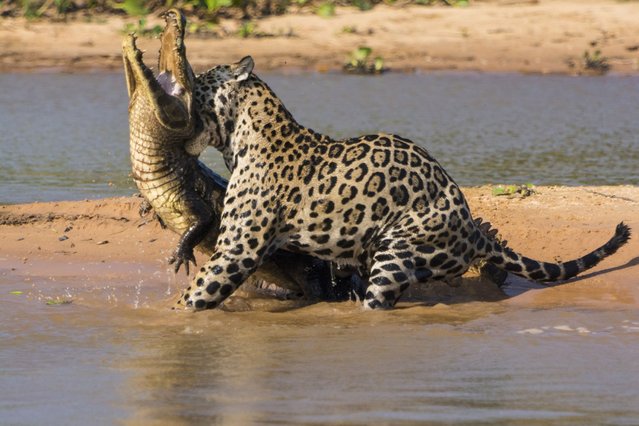
Jaguar attacks a Yacare Caiman. (Photo by Barcroft Media)

These stunning images show the 20-stone cat striking with lightning speed while the eight-foot reptile basks on a river island. The scene unfolded by the Cuiabá River in the Pantanal Wetlands of western Brazil. Photo: Jaguar attacks a Yacare Caiman. (Photo by Barcroft Media)
Details
28 Oct 2013 10:17:00
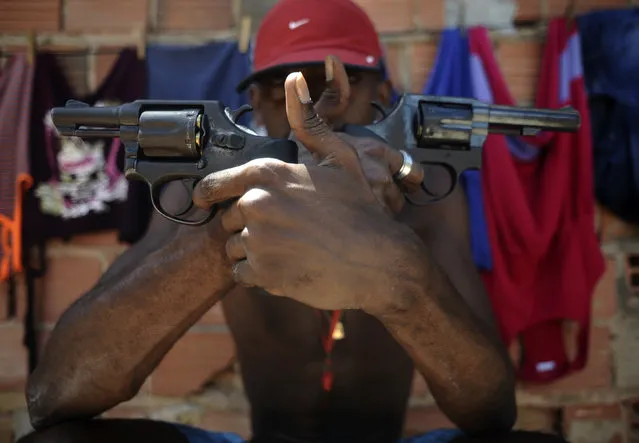
A Brazilian drug gang member nicknamed Pilintra, 26, poses with a gun atop a hill overlooking a slum in Salvador, Bahia State, April 11, 2013. One of Brazil's main tourist destinations and a 2014 World Cup host city, Salvador suffers from an unprecedented wave of violence with an increase of over 250% in the murder rate, according to the Brazilian Center for Latin American Studies (CEBELA). (Photo by Lunae Parracho/Reuters)

A Brazilian drug gang member nicknamed Pilintra, 26, poses with a gun atop a hill overlooking a slum in Salvador, Bahia State, April 11, 2013. One of Brazil's main tourist destinations and a 2014 World Cup host city, Salvador suffers from an unprecedented wave of violence with an increase of over 250% in the murder rate, according to the Brazilian Center for Latin American Studies (CEBELA). (Photo by Lunae Parracho/Reuters)
Details
04 May 2013 11:12:00