Loading...
Done
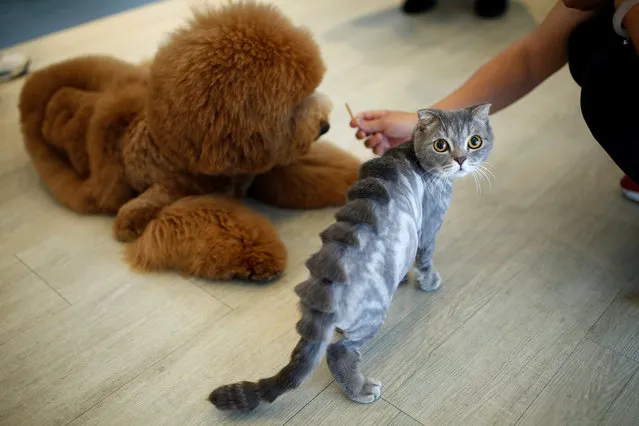
A cat with a “stegosaurus spine” design cut into its fur is seen next to a dog at a pet shop, in Tainan, Taiwan June 19, 2016. Lee Mei-chen, Taiwanese hairdresser turned pet groomer, shaves paw prints, lion faces and characters from Japanese brand Hello Kitty on to animal backs. The teddy bear design is one of the most complex in the furry repertoire. Ou Shih-jou, owner of the salon where Lee works in southern Taiwan, said the quirky pet patterns came from owners wanting something different to the normal summer shave, with designs determined by the natural assets of the pets. (Photo by Tyrone Siu/Reuters)

A cat with a “stegosaurus spine” design cut into its fur is seen next to a dog at a pet shop, in Tainan, Taiwan June 19, 2016. Lee Mei-chen, Taiwanese hairdresser turned pet groomer, shaves paw prints, lion faces and characters from Japanese brand Hello Kitty on to animal backs. The teddy bear design is one of the most complex in the furry repertoire. Photo by Tyrone Siu/Reuters)
Details
23 Jun 2016 12:30:00
Israeli soldiers play the parts of wounded civilians during a drill simulating a toxic spill from an attack on a train in Beersheba, southern Israel, 13 January 2016, as Home Front medical teams, fire fighters and police carry out rescue operations. The large scale drill is the concluding exercise of the Fourth International Conference on Healthcare System Preparedness and Response to Emergencies and Disasters and includes some 200 of the world's experts on health system readiness from around the world. (Photo by Jim Hollander/EPA)

Israeli soldiers play the parts of wounded civilians during a drill simulating a toxic spill from an attack on a train in Beersheba, southern Israel, 13 January 2016, as Home Front medical teams, fire fighters and police carry out rescue operations. The large scale drill is the concluding exercise of the Fourth International Conference on Healthcare System Preparedness and Response to Emergencies and Disasters and includes some 200 of the world's experts on health system readiness from around the world. The conference is dealing with all types of medical emergencies from terrorist attacks to natural disasters. (Photo by Jim Hollander/EPA)
Details
15 Jan 2016 08:02:00
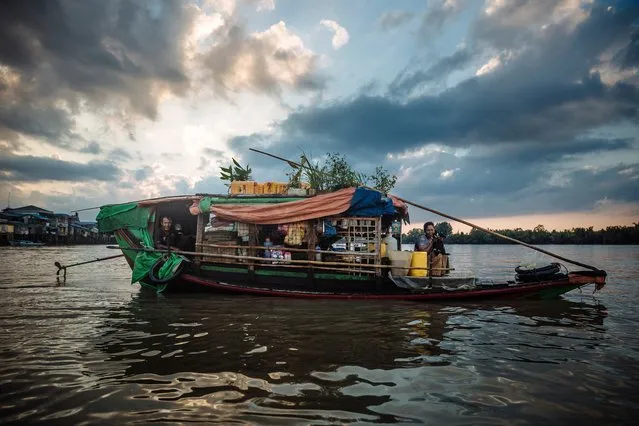
Tin and Naing win live on a small boat which they sail throughout the Delta region in Myanmar. The former gardeners once had a home on land but it was destroyed when a powerful cyclone ravaged the area in 2008. Since then, the couple have not been able to afford to rebuild their home, so they live on the boat from which they sell fish paste to make a living. (Photo by Muse Mohammed/IOM)

The ferocity of crises worldwide is forcing a record number of people to flee their homes, seeking some form of safety within their own country or across international borders. There are 65.3 million displaced people worldwide, including 21.3 million refugees. Most have lost their homes to armed conflict or natural disasters but other factors, such as extreme poverty and climate change, also drive displacement. The International Organisation for Migration commissioned photojournalist Muse Mohammed to document the plight of the displaced. (Photo by Muse Mohammed/IOM)
Details
02 Jan 2017 12:04:00
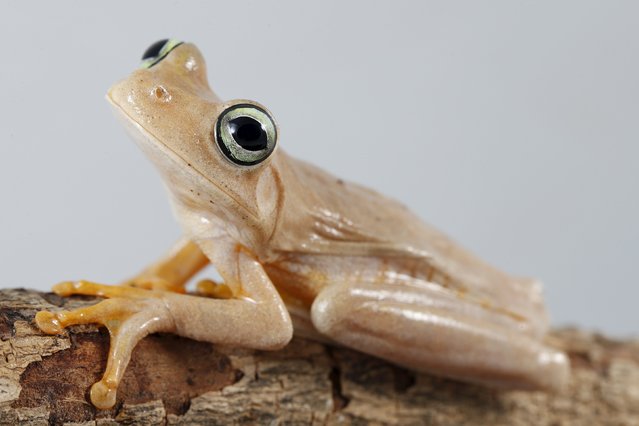
A Hypsiboas crepitans frog is pictured at a terrarium in Caracas November 30, 2015. Venezuelan frogs and toads are in critical danger due to climate change as rising temperatures complicate reproduction and spread a deadly fungus, say scientists, who liken the species to canaries in a coalmine warning of imminent danger. (Photo by Carlos Garcia Rawlins/Reuters)

A Hypsiboas crepitans frog is pictured at a terrarium in Caracas November 30, 2015. Venezuelan frogs and toads are in critical danger due to climate change as rising temperatures complicate reproduction and spread a deadly fungus, say scientists, who liken the species to canaries in a coalmine warning of imminent danger. The survival of a group of nearly 20 frog and toad species, which top Venezuela's list of endangered species, may rest on a small group of academics in a Caracas laboratory attempting to recreate the amphibians' natural reproductive conditions. (Photo by Carlos Garcia Rawlins/Reuters)
Details
17 Dec 2015 08:04:00
Norwegian Trolls By Ivar Rodningen Part 2

Some people think of trolls as nothing but savage beast, yet others realize that beneath their rock-hard skin hides a gentle kind heart. Ivar Rodningem is one of the people who knows the true nature of trolls. Though these creatures look unruly, it is just the way they were born. Trolls come in all shapes and sizes. Some are small, some are large, and some are simply enormous. They help each other out, though elders tend to be loners, preferring the company of their own thoughts to anybody else. You shouldn’t run for your life if you ever meet a troll, though we wouldn’t recommend pestering them, as they are mighty strong, even the little ones.


See also:Part 1
Details
07 Mar 2015 12:05:00
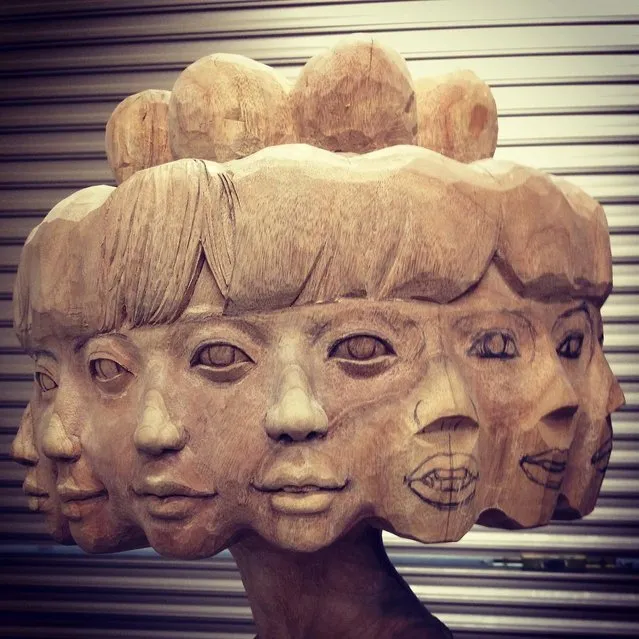
Sculpture By Yoshitoshi Kanemaki

There are many ways to interpret the creations of Yoshitoshi Kanemaki, whose works usually involve sculptures of people where two or more characters have merged into a single being. Possibly, Yoshitoshi Kanemaki is trying to express through his sculptures that everyone’s soul is multifaceted. Good emotions are mixed with the bad, love is mixed with hate, contempt with admiration. How often do you hear that a person loves someone deeply, while doing completely horrendous things, unable to see that he or she is destroying their object of love? Nevertheless, we should be thankful to the nature for all the different emotions that we are able to feel. Unlike animals, who only show simple forms of emotions, such as anger, happiness, and a few others, human soul is much deeper, allowing us to feel a full plethora of emotions. (Photo by Yoshitoshi Kanemaki)

Details
20 Nov 2014 12:26:00
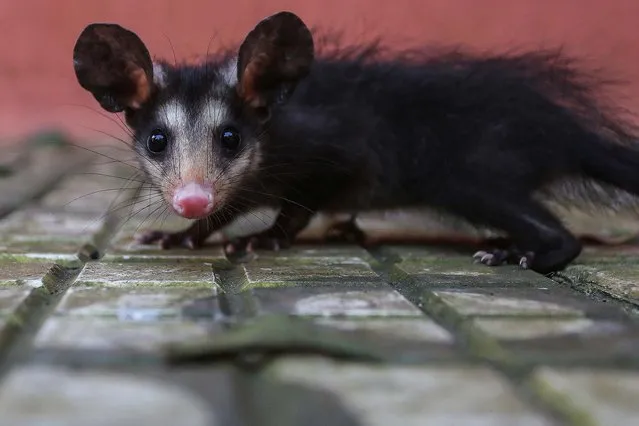
Photo taken on September 19, 2015 shows a baby Brazilian opossum at the “Parque Estoril” zoo in Sao Bernardo do Campo of Sao Paulo, Brazil. According to local press, the “Parque Estoril” zoo houses currently 23 orphan cubs of wild animals rescued in the south region of Sao Paulo, victims of illegal wildlife trade or problems caused by urban growth. (Photo by Rahel Patrasso/Xinhua via ZUMA Wire)

Photo taken on September 19, 2015 shows a baby Brazilian opossum at the “Parque Estoril” zoo in Sao Bernardo do Campo of Sao Paulo, Brazil. According to local press, the “Parque Estoril” zoo houses currently 23 orphan cubs of wild animals rescued in the south region of Sao Paulo, victims of illegal wildlife trade or problems caused by urban growth. According to the zoo, all the animals arrived in the last three months, and many of them, not being able to be reintroduced to their natural habitat, will be used as examples in environmental education classes. (Photo by Rahel Patrasso/Xinhua via ZUMA Wire)
Details
26 Sep 2015 08:00:00
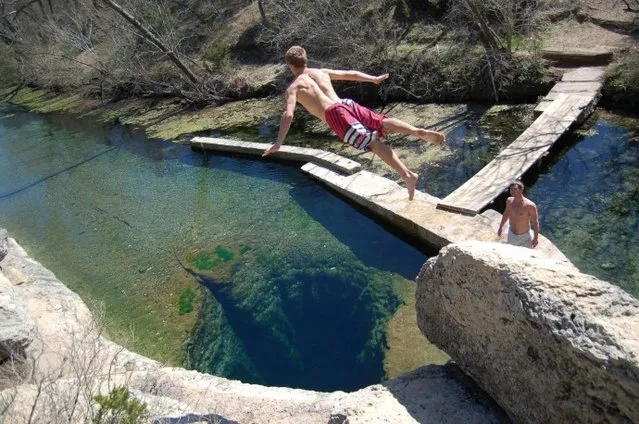
Dive The Deadly Jacob’s Well In Texas

Jacob's Well is a perennial karstic spring in the Texas Hill Country flowing from the bed of Cypress Creek, located northwest of Wimberley, Texas. The twelve foot (four meter) diameter mouth of the spring serves as a popular swimming spot for the local land owners whose properties adjoin Cypress Creek. From the opening in the creek bed, Jacob's Well cave descends vertically for about thirty feet (ten meters), then continues downward at an angle through a series of silted chambers separated by narrow restrictions, finally reaching a depth of one hundred and twenty feet (forty meters). Until the modern era, the Trinity Aquifer-fed natural artesian spring gushed water from the mouth of the cave, with a measured flow in 1924 of one hundred and seventy gallons per second (six hundred and forty liters per second) discharging six feet (two meters) into the air. The spring is the greatest source of water recharging the Edwards Aquifer.
Details
03 Jan 2014 08:20:00