Loading...
Done
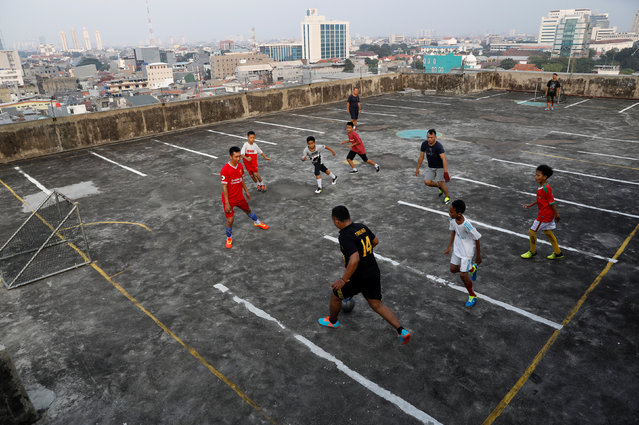
Local residents play soccer on the top floor of a parking garage in Jakarta, Indonesia, May 4, 2018. (Photo by Darren Whiteside/Reuters)

As Russia puts the finishing touches to the carefully manicured fields that will host the World Cup from next week, people around the globe are playing soccer on a surprising variety of makeshift pitches. Off the coast of an island in southern Thailand, they play on a floating platform; in the mountains of northern Italy, they kick about in the snow – images captured by Reuters photographers around the world. Here: Local residents play soccer on the top floor of a parking garage in Jakarta, Indonesia, May 4, 2018. (Photo by Darren Whiteside/Reuters)
Details
09 Jun 2018 00:01:00
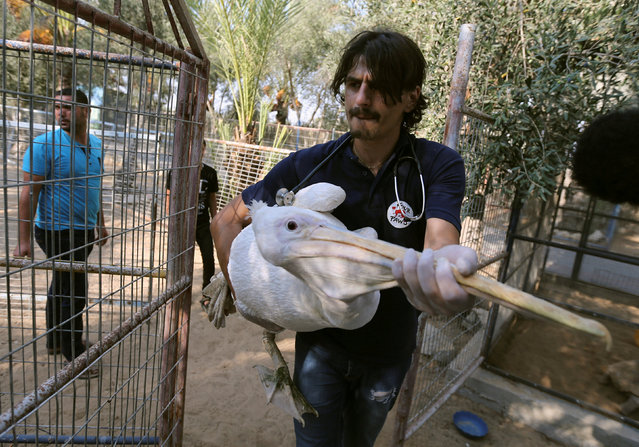
A member of Four Paws International team carries a pelican to be taken out of Gaza, at a zoo in Khan Younis in the southern Gaza Strip August 23, 2016. Fifteen animals including a bengal tiger were removed from “the world’s worst zoo” in the Gaza town of Khan Younis as it was finally closed down. Animal welfare group, Four Paws International, will help bring most of the refugees to a zoo in Jordan, but the tiger will be taken to a refuge in South Africa. Five monkeys, a porcupine, an emu and the tiger, among others, crossed from the occupied territory into Israel after the zoo suffered from years of difficulty. With lack of awareness of animal welfare in Gaza, the densely-populated territory has previously made headlines after another zoo painted donkeys with stripes to resemble zebras in 2009. (Photo by Ibraheem Abu Mustafa/Reuters)

A member of Four Paws International team carries a pelican to be taken out of Gaza, at a zoo in Khan Younis in the southern Gaza Strip August 23, 2016. Fifteen animals including a bengal tiger were removed from “the world’s worst zoo” in the Gaza town of Khan Younis as it was finally closed down. Animal welfare group, Four Paws International, will help bring most of the refugees to a zoo in Jordan, but the tiger will be taken to a refuge in South Africa. (Photo by Ibraheem Abu Mustafa/Reuters)
Details
26 Aug 2016 10:22:00
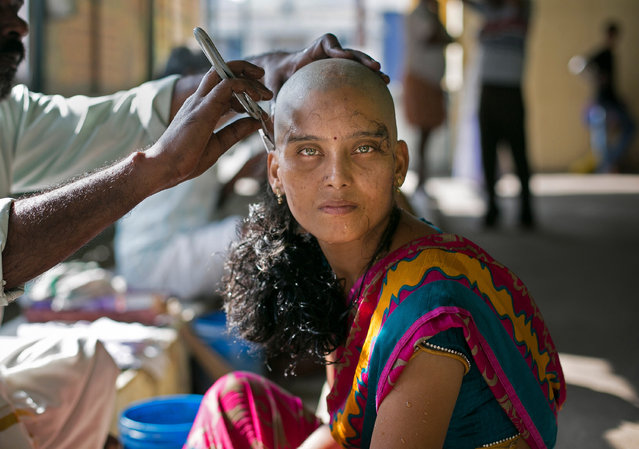
28 year old Rupa has her hair shaven to donate to the Gods at the Thiruthani Murugan Temple November 10, 2016 in Thiruttani, India. Rupa donated her hair with the wish that her daughter's illness is cured. The process of shaving ones hair and donating it to the Gods is known as tonsuring. It is common for Hindu believers to tonsure their hair at a temple as a young child, and also to celebrate a wish coming true, such as the birth of a baby or the curing of an illness. The “temple hair”, as it's known, is then auctioned off to a processing plant and then sold as pricey wigs and weaves in the US, Europe and Africa. (Photo by Allison Joyce/Getty Images)

28 year old Rupa has her hair shaven to donate to the Gods at the Thiruthani Murugan Temple November 10, 2016 in Thiruttani, India. Rupa donated her hair with the wish that her daughter's illness is cured. The process of shaving ones hair and donating it to the Gods is known as tonsuring. It is common for Hindu believers to tonsure their hair at a temple as a young child, and also to celebrate a wish coming true, such as the birth of a baby or the curing of an illness. The “temple hair”, as it's known, is then auctioned off to a processing plant and then sold as pricey wigs and weaves in the US, Europe and Africa. (Photo by Allison Joyce/Getty Images)
Details
21 Nov 2016 10:30:00
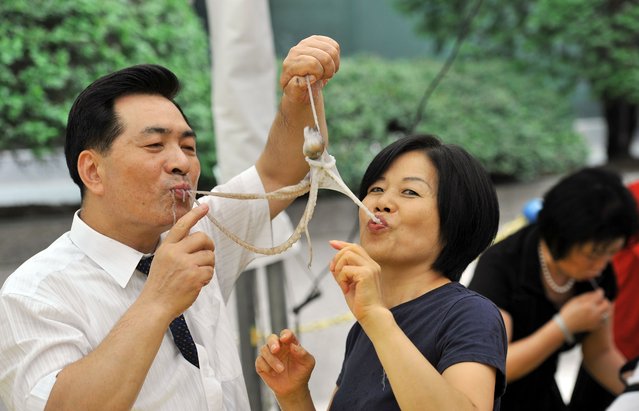
A South Korean man and a woman eat a live octopus during an event to promote a local food festival in Seoul on September 12, 2013. (Photo by Jung Yeon-Je/AFP Photo)

Live octopus is a delicacy in South Korea but is a known choking hazard, since the still-moving suction cups can cause tentacle pieces to stick in a person's throat. A baby octopus is often consumed whole, while larger varieties are cut up and the still-wriggling tentacles eaten with a splash of sesame oil. Photo: A South Korean man and a woman eat a live octopus during an event to promote a local food festival in Seoul on September 12, 2013. (Photo by Jung Yeon-Je/AFP Photo)
Details
13 Sep 2013 09:40:00
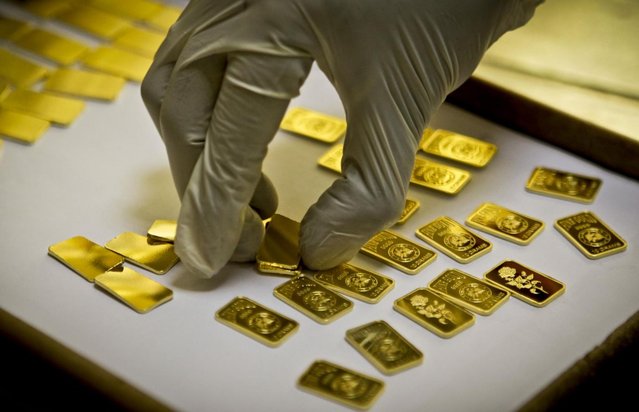
A gold press operator collects 10 gram gold blanks to press them with the logo of the Emirates Gold company in Dubai, United Arab Emirates. Gold prices remained relatively steady in 2012, close to $1,700 an ounce. (Photo by Kamran Jebreili/AP Photo)

“Dubai is sometimes called the “City of Gold” because of its stunning growth from a sleepy Gulf port to a world-famous business crossroads in the space of a single generation. Its nickname has a literal meaning for traders in the precious metal. The city is building itself up as a center for the gold trade, between sources in Africa and consumers in the rising economies of China and India”. – Kamran Jebreili via Associated Press

Photo: A gold press operator collects 10 gram gold blanks to press them with the logo of the Emirates Gold company in Dubai, United Arab Emirates. Gold prices remained relatively steady in 2012, close to $1,700 an ounce. (Photo by Kamran Jebreili/AP Photo)
Details
06 Jan 2013 12:38:00


“Chameleons (family Chamaeleonidae) are a distinctive and highly specialized clade of lizards. They are distinguished by their parrot-like zygodactylous feet, their separately mobile and stereoscopic eyes, their very long, highly modified, and rapidly extrudable tongues, their swaying gait, the possession by many of a prehensile tail, crests or horns on their distinctively shaped heads, and the ability of some to change color. Uniquely adapted for climbing and visual hunting, the approximately 160 species of chameleon range from Africa, Madagascar, Spain and Portugal, across south Asia, to Sri Lanka, have been introduced to Hawaii, California and Florida, and are found in warm habitats that vary from rain forest to desert conditions”. – Wikipedia

Photo: A woman with the latest fashion accessory, a chameleon. (Photo by Fox Photos/Getty Images). Circa 1926
Details
20 Mar 2011 15:45:00
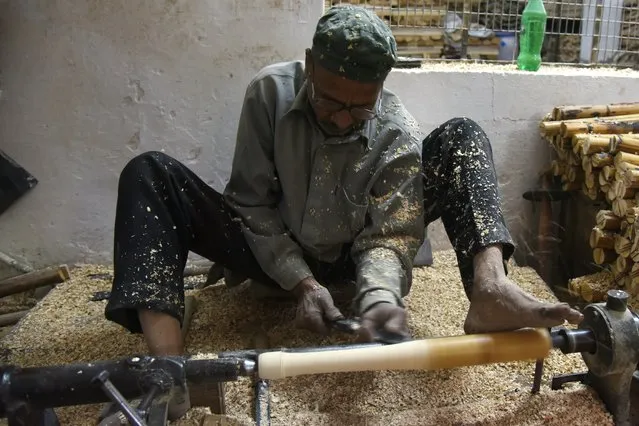
In this photograph taken on December 14, 2016, an Indian craftsman works on unfinished cricket bats in a factory in Meerut, some 70 kms north- east of New Delhi. As Indian factory worker Jitender Singh carves out another big- hitting slab of thick willow he insists MCC proposals to limit the size of cricket bats won' t tame Twenty20 marauders. “I don' t think the thickness matters. It' s more about the balance of the bat and the talent of the batsman”, says Singh, who has made bats for many stars, including South Africa's AB de Villiers. The World Cricket committee of the MCC, the guardians of the game, recommended in December 2016 that limitations be placed on the width and depth of bats because it had become too easy to smash fours and sixes. (Photo by Dominique Faget/AFP Photo)

In this photograph taken on December 14, 2016, an Indian craftsman works on unfinished cricket bats in a factory in Meerut, some 70 kms north- east of New Delhi. (Photo by Dominique Faget/AFP Photo)
Details
11 Jan 2017 14:32:00


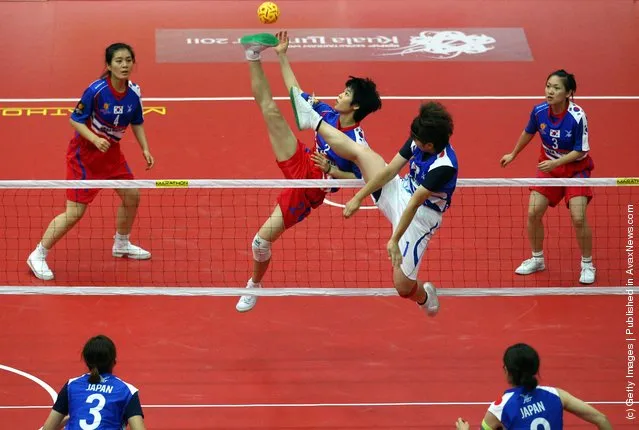
“Sepak takraw or kick volleyball, is a sport native to the Malay-Thai Peninsula. Sepak takraw differs from the similar sport of volleyball in its use of a rattan ball and only allowing players to use their feet, knee, chest and head to touch the ball. It is a popular sport in Indonesia, Malaysia, Thailand, Singapore, Myanmar, Vietnam, Cambodia, Laos, and Philippines”. – Wikipedia

Photo: Hyun Ju Kim of Korea kicks over the net against Yukie Sato of Japan during the round robin match between Korea and Japan during day one of the ISTAF Sepaktakraw World Cup at Titiwangsa Stadium on July 21, 2011 in Kuala Lumpur, Malaysia. (Photo by Ryan Pierse/Getty Images for UFA Sports)
Details
23 Jul 2011 11:45:00