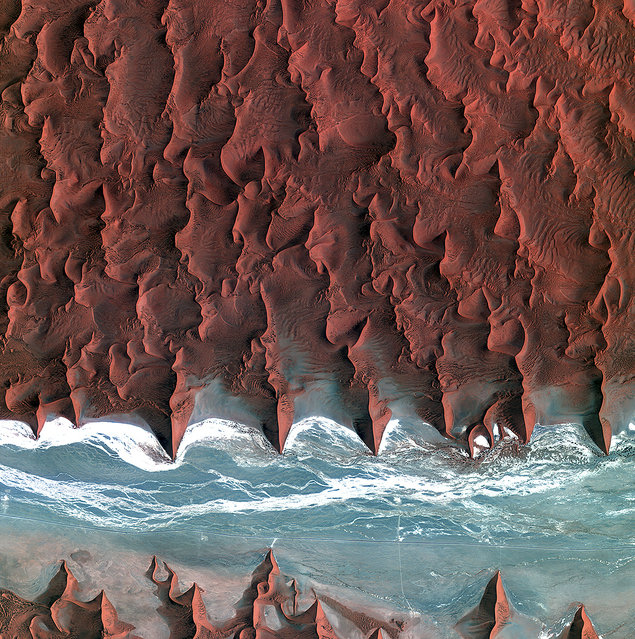
These are the dunes of the Namib Desert, taken by Korea's Kompstat-2 satellite. The blue and white area is the dried riverbed of the Tsauchab river. (Photo by The European Space Agency)
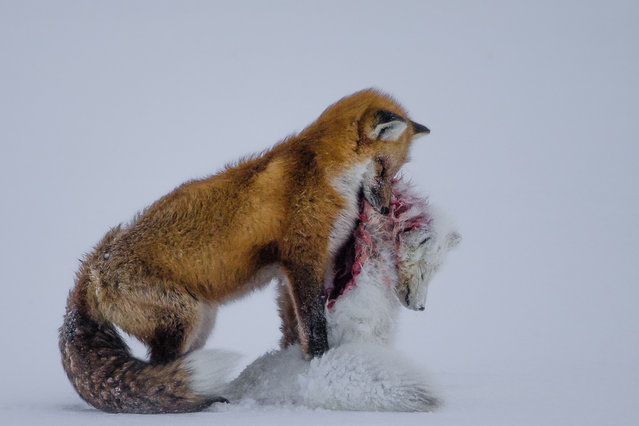
A tale of two foxes. Surprising behaviour, witnessed in Wapusk national park, on Hudson Bay, Canada, in early winter. Red foxes don’t actively hunt Arctic foxes, but where the ranges of two predators overlap, there can be conflict. Though the light was poor, the snow-covered tundra provided the backdrop for the moment that the red fox paused with the smaller fox in its mouth in a grim pose. (Photo by Don Gutoski/2015 Wildlife Photographer of the Year)
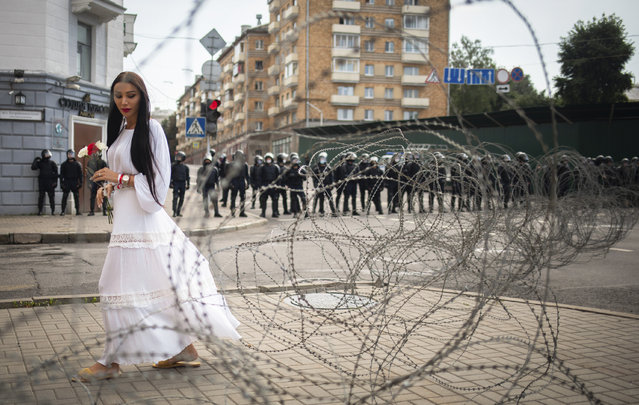
A woman walks past the barbed wire separating Belarusian servicemen and Belarusian opposition supporters during a rally in Minsk, Belarus, Sunday, August 30, 2020. Tens of thousands of demonstrators have gathered in the capital of Belarus, beginning the fourth week of daily protests demanding that the country's authoritarian president resign. The protests began after an Aug. 9 presidential election that protesters say was rigged and officials say gave President Alexander Lukashenko a sixth term in office. (Photo by Tut.By via AP Photo)
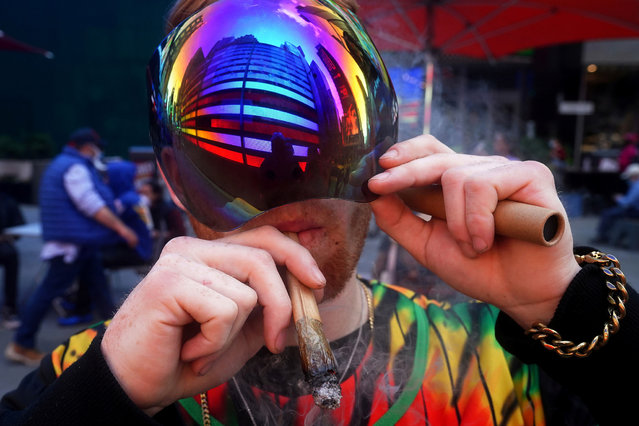
A man smokes a marijuana cigarette to celebrate 420, in Times Square amid the coronavirus disease (COVID-19) pandemic in New York City, New York, U.S., April 20, 2021. (Photo by Carlo Allegri/Reuters)
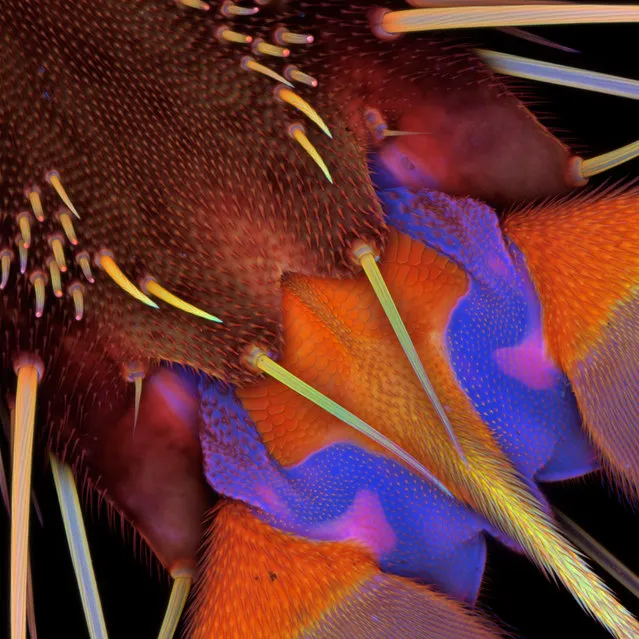
“Microscope images forge an extraordinary bond between science and art, said Hidenao Tsuchiya, Olympus America's Vice President and General Manager for the Scientific Equipment Group. We founded this competition to focus on the fascinating stories coming out of today's life science research laboratories. The thousands of images that people have shared with the competition over the years reflect some of the most exciting work going on in research today – work that can help shed light on the living universe and ultimately save lives. We look at BioScapes and these beautiful images as sources of education and inspiration to us and the world”. – OlympusBioScapes
Photo: Pretarsus of the third leg of a female drone fly (Eristalis tenax), ventral view, by Dr. Jan Michels, Institute of Zoology, Christian-Albrechts-University of Kiel, Germany. (Photo by Olympus BioScapes)
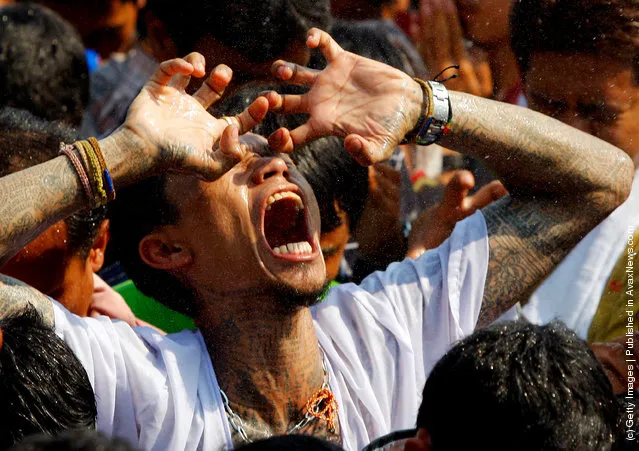
A Thai devotee in a state of trance screams while holy water is sprayed as thousands race towards the edifice of the founder monk during the annual Tattoo fesitval at Wat Bang Phra on March 7, 2009 in Nakhom Pathom, Thailand. Some men take on the characteristics of sacred animals that have been carved onto their skin. Thousands of believers from all over Thailand come to take part in one of the country's most bizarre festivals about 50 miles outside Bangkok to pay respect to the temple's monks who are master tattooist. In Thai culture the tattoo or Thai word sak yant is worn as a symbol of spiritual and physical protection, many believe that the tattoo have mystical powers. Many tattoo fanatics choose to have monkeys and tigers as well as the Khmer/Cambodia ancient script on their bodies. (Photo Paula Bronstein/Getty Images)
A Kenya Wildlife Services (KWS) veterinarian and security personnel back away from a tranquilised black-Rhino calf August 30, 2017 after she appeared to prematurely overcome the sedative at the Nairobi National Park, during an identification-tagging excercise to ease quick identification of resident rhino during anti-poaching patrols. (Photo by Tony Karumba/AFP Photo)