Loading...
Done
Kritchaya “Lolita” Boonhor (R) curls her eyelashes in ladyboy Candy's (L) room while she chats her about her boyfriend, in Bangkok, Thailand, 27 November 2017. (Photo by Lola Levan/EPA/EFE)

Kritchaya “Lolita” Boonhor (R) curls her eyelashes in ladyboy Candy's (L) room while she chats her about her boyfriend, in Bangkok, Thailand, 27 November 2017. Most things in life are a question of negotiation. Lolita is a woman, that was not to be negotiated. What needed to be negotiated was how she was perceived by those around her. And that negotiation was one that took time and effort. (Photo by Lola Levan/EPA/EFE)
Details
19 Jan 2018 07:39:00
A man walks past a neon soaked street scene mural titled “Belfast – Blurry Eyed” by Dan Kitchener, also known as DANK on March 1, 2018 in Belfast, Northern Ireland. (Photo by Charles McQuillan/Getty Images)

A man walks past a neon soaked street scene mural titled “Belfast – Blurry Eyed” by Dan Kitchener, also known as DANK on March 1, 2018 in Belfast, Northern Ireland. (Photo by Charles McQuillan/Getty Images)
Details
24 Mar 2018 00:03:00
People skate through the forest at Domaine de la Foret Perdu or the Lost Forest, a 15km weaving and zambonied forest trail made for skating in Notre-Dame-du-Mont-Carmel, near Three Rivers, Quebec January 29, 2017. (Photo by Christinne Muschi/Reuters)

People skate through the forest at Domaine de la Foret Perdu or the Lost Forest, a 15km weaving and zambonied forest trail made for skating in Notre-Dame-du-Mont-Carmel, near Three Rivers, Quebec January 29, 2017. (Photo by Christinne Muschi/Reuters)
Details
01 Feb 2017 06:16:00
In this January 24, 2017 photo, boxer Idamerys Moreno wraps a bandage on her hand before a training session at a sports center in Havana, Cuba. Boxing has long been an athletic engine for Cuba, which has won 72 Olympic medals in that category but women are not allowed to box. (Photo by Ramon Espinosa/AP Photo)

In this January 24, 2017 photo, boxer Idamerys Moreno wraps a bandage on her hand before a training session at a sports center in Havana, Cuba. Boxing has long been an athletic engine for Cuba, which has won 72 Olympic medals in that category but women are not allowed to box. (Photo by Ramon Espinosa/AP Photo)
Details
02 Feb 2017 04:21:00
A devotee pulls a chariot during the Hindu festival of Thaipusam in Singapore February 9, 2017. (Photo by Edgar Su/Reuters)

A devotee pulls a chariot during the Hindu festival of Thaipusam in Singapore February 9, 2017. (Photo by Edgar Su/Reuters)
Details
11 Feb 2017 00:06:00
On Keo Wa, 25, carries her 9-month-old baby while working at a banana plantation operated by a Chinese company in the province of Bokeo in Laos April 24, 2017. (Photo by Jorge Silva/Reuters)

On Keo Wa, 25, carries her 9-month-old baby while working at a banana plantation operated by a Chinese company in the province of Bokeo in Laos April 24, 2017. (Photo by Jorge Silva/Reuters)
Details
12 May 2017 06:54:00
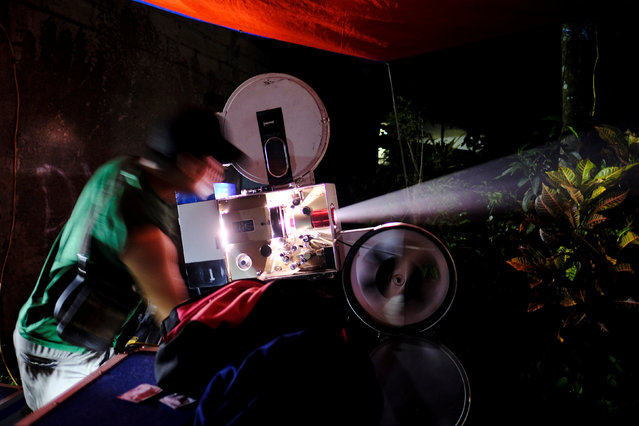
An operator adjusts a film projector during a wedding party in Bogor, Indonesia, February 18, 2017. (Photo by Reuters/Beawiharta)

An operator adjusts a film projector during a wedding party in Bogor, Indonesia, February 18, 2017. Indonesian entrepreneur Kamaluddin loves the gritty look of old 35-millimeter film so much that he spends most of his nights screening vintage movies at weddings and parties around Jakarta, the capital. (Photo by Reuters/Beawiharta)
Details
30 May 2017 08:20:00
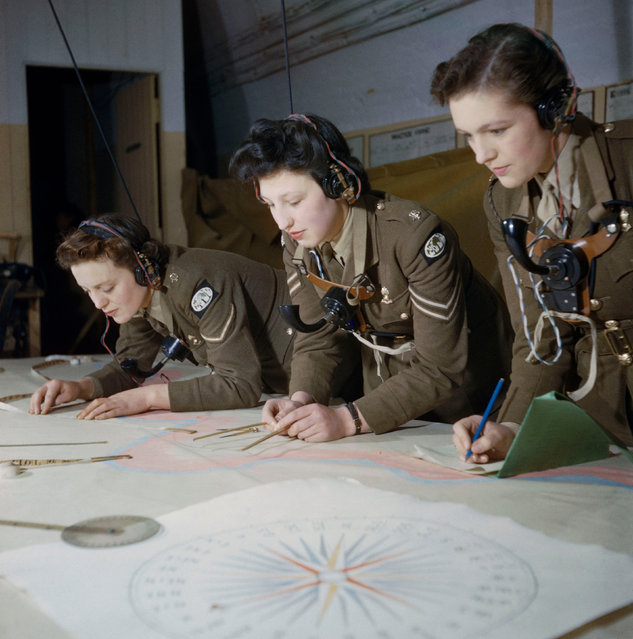
Auxiliary Territorial Service (ATS) plotters at work at Coastal Artillery Headquarters in Dover, December 1942. (Photo by Ted Dearberg/IWM/PA Wire)

Auxiliary Territorial Service (ATS) plotters at work at Coastal Artillery Headquarters in Dover, December 1942. The Auxiliary Territorial Service was the women's branch of the British Army during the Second World War. It was formed on 9 September 1938, initially as a women's voluntary service, and existed until 1 February 1949, when it was merged into the Women's Royal Army Corps. The ATS had its roots in the Women's Auxiliary Army Corps (WAAC), which was formed in 1917 as a voluntary service. During the First World War its members served in a number of jobs including clerks, cooks, telephonists and waitresses. The WAAC was disbanded after four years in 1921. (Photo by Ted Dearberg/IWM/PA Wire)
Details
13 Jul 2017 07:52:00