Loading...
Done
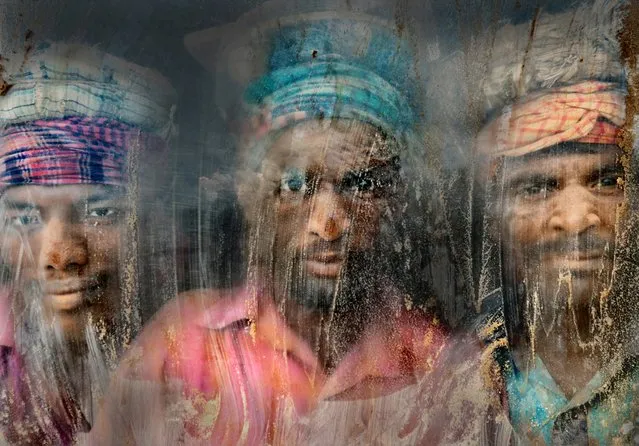
Gravel Workmen of Chittagong, Bangladesh, by Faisal Azim. Gravel workmen look through a glass window at a gravel-crushing yard in Chittagong. Full of dust and sand, it is an extremely unhealthy environment for working, but still hundreds of people work here for their livelihoods. (Photo by Faisal Azim/2016 Atkins CIWEM Environmental Photographer of the Year)

From Tibetan monks playing basket ball with ice thawing high up in the Himalayas, to the pollution that hides behind the Taj Mahal, here’s pick from 60 exceptional environmental photographs, by photographers and filmmakers from 70 countries, that will go on show at the Royal Geographical Society in London from 29 June to 21 August. The winners will be announced on 28 June. Here: Gravel Workmen of Chittagong, Bangladesh, by Faisal Azim. Gravel workmen look through a glass window at a gravel-crushing yard in Chittagong. Full of dust and sand, it is an extremely unhealthy environment for working, but still hundreds of people work here for their livelihoods. (Photo by Faisal Azim/2016 Atkins CIWEM Environmental Photographer of the Year)
Details
01 Jun 2016 12:25:00
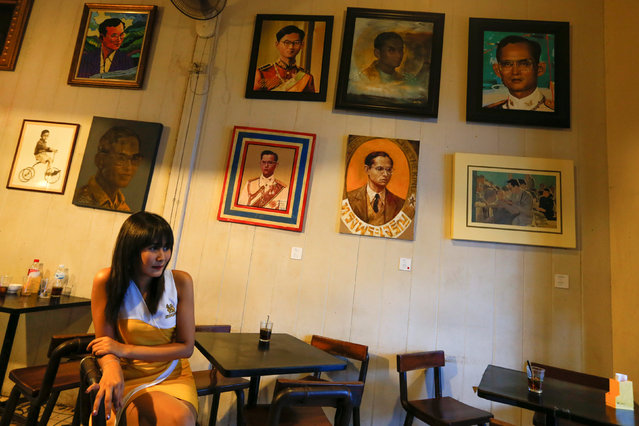
A hostess sits at a restaurant with paintings depicting Thailand's King Bhumibol Adulyadej hanging on a wall in Bangkok, Thailand, June 6, 2016. (Photo by Athit Perawongmetha/Reuters)

A hostess sits at a restaurant with paintings depicting Thailand's King Bhumibol Adulyadej hanging on a wall in Bangkok, Thailand, June 6, 2016. (Photo by Athit Perawongmetha/Reuters)
Details
10 Jun 2016 13:03:00
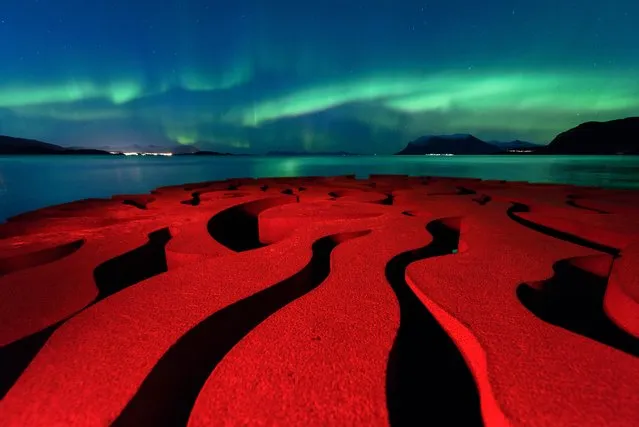
“Seven Magic Points”. The rusty red swirls of the circular, iron sculpture Seven Magic Points in Brattebergan, Norway mirror the rippling aurora above. (Photo by Rune Engebø/Royal Observatory Greenwich’s Astronomy Photographer of the Year 2016/National Maritime Museum)

Gorgeous galaxies and stunning stars make up this selection of pictures from the shortlisted entries for this year’s Insight Astronomy Photographer of the Year award. The winners will be announced on 15 September, and an exhibition of the winning images will be will be displayed in a free exhibition at the Royal Observatory Greenwich’s Astronomy Centre from 17 September. Here: “Seven Magic Points”. The rusty red swirls of the circular, iron sculpture Seven Magic Points in Brattebergan, Norway mirror the rippling aurora above. (Photo by Rune Engebø/Royal Observatory Greenwich’s Astronomy Photographer of the Year 2016/National Maritime Museum)
Details
28 Jul 2016 13:51:00
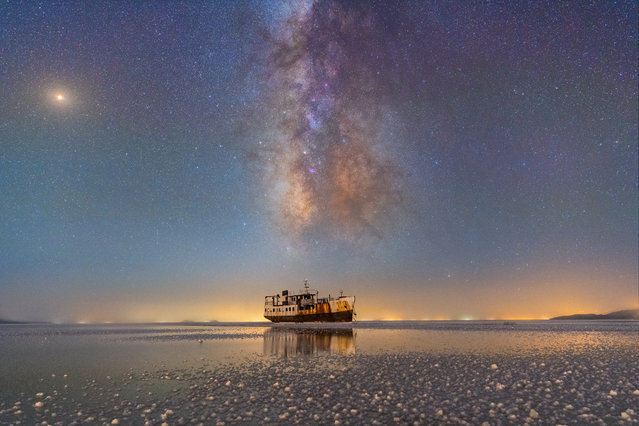
Sharafkhaneh port and lake Urmia. Masoud Ghadiri (Iran). The summer Milky Way is very prominent in this photo. On the galaxy zone, Saturn is located besides the Lagoon nebula. On the right of the horizon, you can see the extreme light pollution of Urmia, which is caused by ever-increasing city development. (Photo by Masoud Ghadiri/National Maritime Museum)

Sharafkhaneh port and lake Urmia. Masoud Ghadiri (Iran). The summer Milky Way is very prominent in this photo. On the galaxy zone, Saturn is located besides the Lagoon nebula. On the right of the horizon, you can see the extreme light pollution of Urmia, which is caused by ever-increasing city development. (Photo by Masoud Ghadiri/National Maritime Museum)
Details
20 Jun 2019 00:01:00
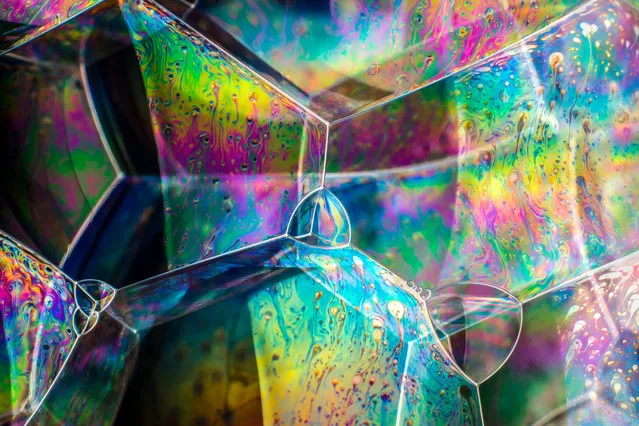
Soap Bubble Structures by Kym Cox. Bubbles optimise space and minimise their surface area for a given volume of air. This phenomenon makes them a useful tool in many areas of research, in particular, materials science and ‘packing’ – how things fit together. Bubble walls drain under gravity, thin at the top, thick at the bottom, which interferes with travelling lightwaves to create bands of colour. Black spots show the wall is too thin for interference colours, indicating the bubble is about to burst. (Photo by Kym Cox/2019 Science Photographer of the Year/RPS)

Soap Bubble Structures by Kym Cox. Bubbles optimise space and minimise their surface area for a given volume of air. This phenomenon makes them a useful tool in many areas of research, in particular, materials science and “packing” – how things fit together. Bubble walls drain under gravity, thin at the top, thick at the bottom, which interferes with travelling lightwaves to create bands of colour. Black spots show the wall is too thin for interference colours, indicating the bubble is about to burst. (Photo by Kym Cox/2019 Science Photographer of the Year/RPS)
Details
15 Aug 2019 00:03:00
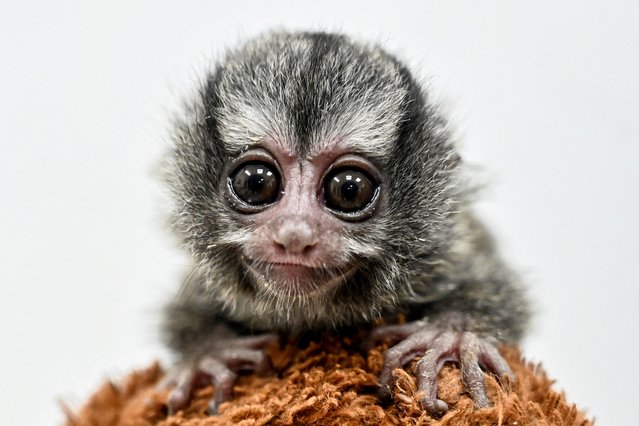
A grey-bellied Night Monkey (Aotus Lemurinus) plays with a teddy bear at the veterinary clinic of the Cali Zoo in Cali, Colombia on January 27, 2020. They monkey is being raised by personnel of the Cali Zoo after a worker found it near the complex. Apparently it fall from a tree with his father who had health problems. (Photo by Luis Robayo/AFP Photo)

A grey-bellied Night Monkey (Aotus Lemurinus) plays with a teddy bear at the veterinary clinic of the Cali Zoo in Cali, Colombia on January 27, 2020. They monkey is being raised by personnel of the Cali Zoo after a worker found it near the complex. Apparently it fall from a tree with his father who had health problems. (Photo by Luis Robayo/AFP Photo)
Details
30 Dec 2020 00:05:00
U.S. President Donald Trump holds news conference on the coronavirus outbreak at the White House in Washington, U.S., February 26, 2020. (Photo by Carlos Barria/Reuters)

U.S. President Donald Trump holds news conference on the coronavirus outbreak at the White House in Washington, U.S., February 26, 2020. (Photo by Carlos Barria/Reuters)
Details
02 Jan 2021 00:05:00
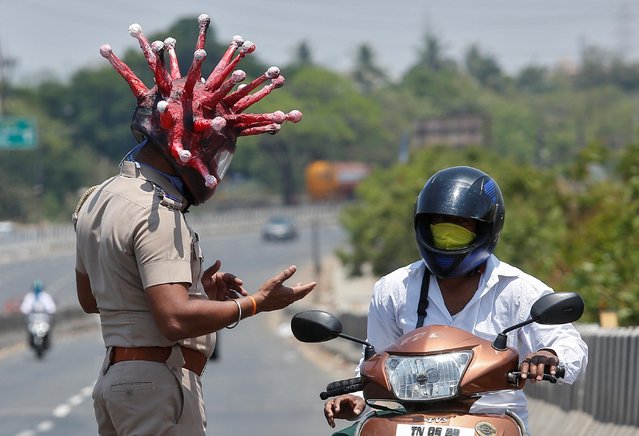
Rajesh Babu, a police officer, wearing a helmet depicting coronavirus, requests a commuter to stay at home during a 21-day nationwide lockdown to limit the spreading of coronavirus disease (COVID-19), in Chennai, India, March 28, 2020. (Photo by P. Ravikumar/Reuters)

Rajesh Babu, a police officer, wearing a helmet depicting coronavirus, requests a commuter to stay at home during a 21-day nationwide lockdown to limit the spreading of coronavirus disease (COVID-19), in Chennai, India, March 28, 2020. (Photo by P. Ravikumar/Reuters)
Details
05 Jan 2021 00:05:00