Loading...
Done
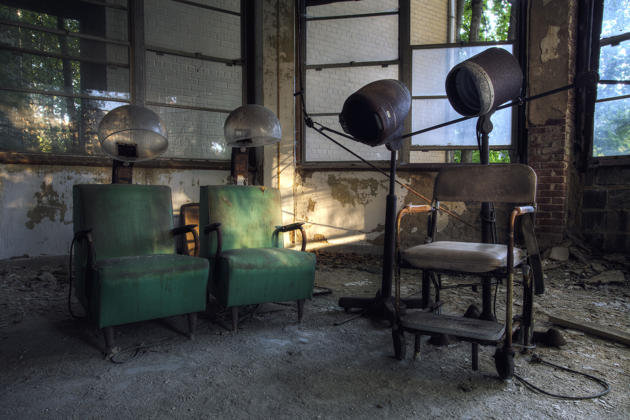
Salon equipment inside a sanatorium in New York. Daniel said: “We visited five states and several major cities, from New York City to Pittsburgh. It got pretty wild at times, so much so that in the more destitute areas, our guide carried a Glock”. (Photo by Daniel Barter/Caters News)

“These creepy pictures of abandoned asylums, prisons and schools give a sense of what life was like in institutions of 20th century America. Photographer Daniel Barter, 30, captured on film bowling alleys, theatres and hairdressing salons all completely intact. The Londoner was on travelling through Americas north eastern states when he had the chance to explore the derelict public buildings left untouched since their last inhabitants shut the doors”. – Caters News. Photo: Salon equipment inside a sanatorium in New York. (Photo by Daniel Barter/Caters News)
Details
09 May 2014 09:25:00
Wells Clock – World's Oldest Mechanical Clock

“Wells Cathedral is a Church of England cathedral in Wells, Somerset, England. Built between 1175 and 1490, Wells Cathedral has been described as “the most poetic of the English Cathedrals”. The Wells clock, an astronomical clock, is located in the north transept. The surviving mechanism, dated to between 1386 and 1392, was replaced in the 19th century, and was eventually moved to the Science Museum in London, where it continues to operate. It is the second-oldest surviving clock in England”. – Wikipedia

Photo: The clock face of world's oldest continually-working mechanical clock is seen as it is hand wound for the very last time on August 21, 2010 in Wells, England. (Photo by Matt Cardy/Getty Images)
Details
10 Aug 2011 11:23:00


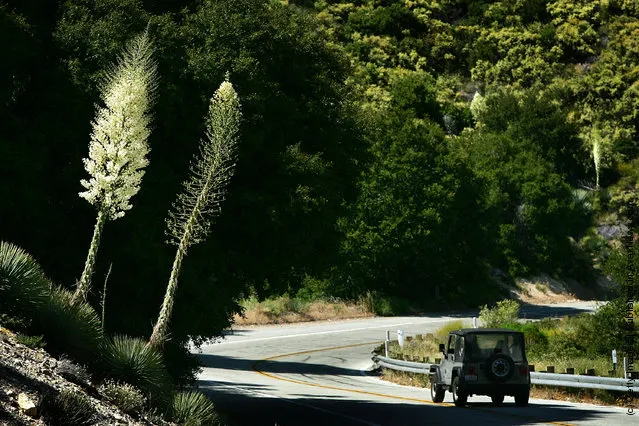
“Yucca is a genus of perennial shrubs and trees in the agave family, Agavaceae. Its 40-50 species are notable for their rosettes of evergreen, tough, sword-shaped leaves and large terminal panicles of white or whitish flowers. They are native to the hot and dry (arid) parts of North America, Central America, South America, and the Caribbean. Early reports of the species were confused with the cassava (Manihot esculenta). Consequently, Linnaeus mistakenly derived the generic name from the Carib word for the latter, yuca. It is also colloquially known in the midwest United States as “Ghosts in the graveyard”, as it is commonly found growing in rural graveyards and when in bloom the flowers appear as an apparition floating.” – Wikipedia

Photo: A yucca standing among flowers bursts forth a very large stalk of flowers as a heavy wildflower bloom on June 21, 2005 in the Angeles National Forest northwest of La Canada, California. (Photo by David McNew/Getty Images)
Details
29 Mar 2011 07:31:00
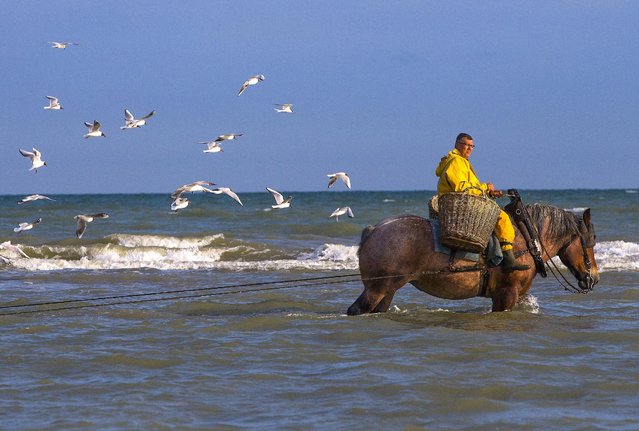
A Belgian shrimp fisherman rides a carthorse to haul a net out in the sea to catch shrimps during low tide at the coastal town of Oostduinkerke, Belgium July 3, 2015. (Photo by Yves Herman/Reuters)

A Belgian shrimp fisherman rides a carthorse to haul a net out in the sea to catch shrimps during low tide at the coastal town of Oostduinkerke, Belgium July 3, 2015. At the end of each fishing session, the fishermen and their mounts leave the water to empty the net's contents into two wicker baskets fixed on each side of the horse. This traditional method of catching shrimps along the North Sea coast, which dates back to some 500 years, attracts tourists every summer. In 2013, Unesco recognized shrimp fishing on horseback as an intangible cultural heritage. (Photo by Yves Herman/Reuters)
Details
04 Jul 2015 11:29:00
Cardi B, left, with American model Slick Woods, right, at the Moschino Miami Party, Art Basel, Miami Beach, Florida, USA on December 7, 2017. (Photo by Griffin Lipson/BFA/Rex Features/Shutterstock)

American rapper Cardi B, left, with American model Slick Woods, right, at the Moschino Miami Party, Art Basel, Miami Beach, Florida, USA on December 7, 2017. (Photo by Griffin Lipson/BFA/Rex Features/Shutterstock)
Details
22 Apr 2018 00:05:00


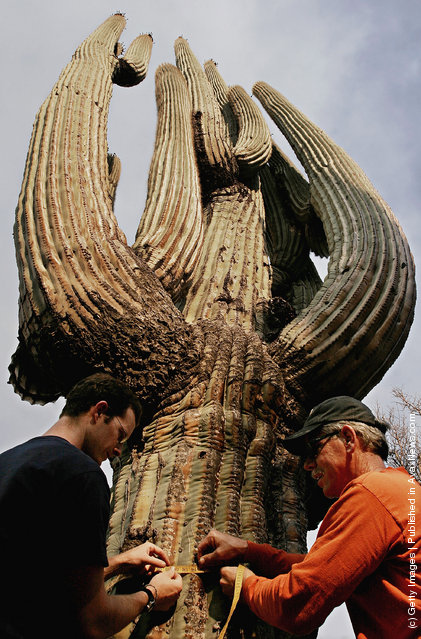
“The saguaro (scientific name Carnegiea gigantea) is a large, tree-sized cactus species in the monotypic genus Carnegiea. It is native to the Sonoran Desert in the U.S. state of Arizona, the Mexican state of Sonora, a small part of Baja California in the San Felipe Desert and an extremely small area of California, U.S. The saguaro blossom is the State Wildflower of Arizona”. – Wikipedia

Photo: Daniel Appel (L), a firefighter with Engine 84 from the Lassen National Forest in California and Mike Hallen, (R), Arizona representative of the National Register of Big Trees, measure the circumference of this Saguaro cactus called the "Grand One," in the Tonto National Forest on July 1, 2005 35 miles north of Phoenix, near Carefree, Arizona. The cactus, estimated to be more than 200 years old, measures a circumference of 7 feet, 10 inches (2.4 meters) and stands 46 feet high (14 meters). The cactus was burned in the Cave Creek Complex fire and may not survive. It was once the largest Saguaro in the world, two others have been found recently that have tied it's measurements. The fire has burned more than 214,000 acres of the Sonoran desert. (Photo by Jeff Topping/Getty Images)
Details
26 Jul 2011 12:27:00
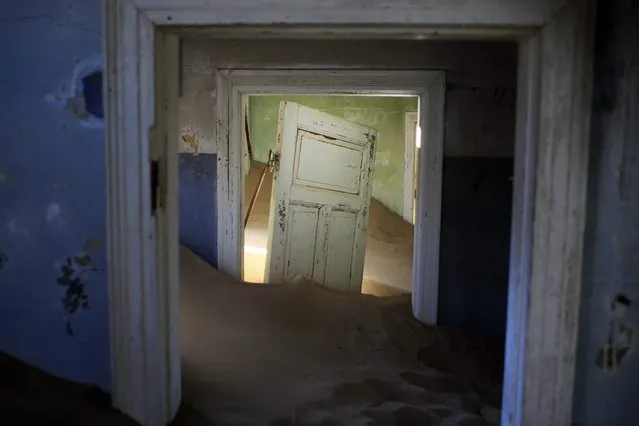
In this July 23, 2013 photo, sand fills an abandoned house in Kolmanskop, Namibia. Kolmanskop, was a diamond mining town south of Namibia, build in 1908 and deserted in 1956. SInce then, the desert slowly reclaims its territory, with sand invading the buildings where 350 German colonists and more than 800 local workers lived during its hay-days of the 1920s. (Photo by Jerome Delay/AP Photo)

In this July 23, 2013 photo, sand fills an abandoned house in Kolmanskop, Namibia. Kolmanskop, was a diamond mining town south of Namibia, build in 1908 and deserted in 1956. SInce then, the desert slowly reclaims its territory, with sand invading the buildings where 350 German colonists and more than 800 local workers lived during its hay-days of the 1920s. (Photo by Jerome Delay/AP Photo)
Details
14 Nov 2014 14:34:00
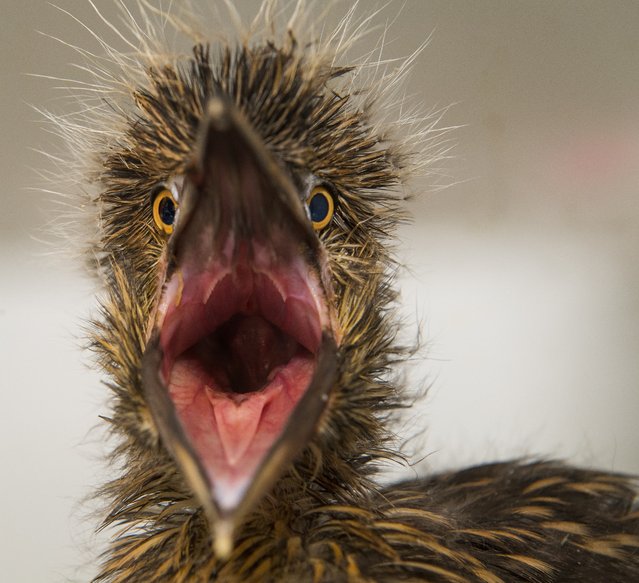
A baby Black-crowned Night Heron squawks in its incubator while being cared for at City Wildlife rescue and rehabilitation center in Washington, DC on May 31, 2017. The heron is one of several that have been brought to CW by the staff at The National Zoo over the past few years. The heron is a native bird and has made an established rookery inside the zoo grounds over a hundred years ago.  Every year at this time, some of the chicks get pushed or fall out of the nest and require human care.  Because the birds are native and not part of the Smithsonian collection, they partnered with CW to rehabilitate the herons for re-release back to the flock inside Zoo. They're reintroduced back to their flock so that they can migrate together in the Fall. The Black-crowned heron usually migrates from the DC area down to southeast North Carolina, some going as far as Jacksonville, FL in winter. The Black-crowned heron is the species of greatest conservation need in the District of Columbia because their numbers are in such rapid decline due to habitat loss. (Photo Linda Davidson/The Washington Post)

A baby Black-crowned Night Heron squawks in its incubator while being cared for at City Wildlife rescue and rehabilitation center in Washington, DC on May 31, 2017. The heron is one of several that have been brought to CW by the staff at The National Zoo over the past few years. (Photo Linda Davidson/The Washington Post)
Details
04 Jun 2017 08:04:00