Katie Austin (L) and Denise Austin attend the 2019 ESPY Awards at Microsoft Theater on July 10, 2019 in Los Angeles, California. (Photo by Chelsea Lauren/Rex Features/Shutterstock)
A man from the Dominican Republic wears a devil mask while dancing in the street during Carnival celebrations in Panama City, Monday, February 16, 2015. (Photo by Arnulfo Franco/AP Photo)
“The Sunsetter”. An EF-4 tornado rips through the open space of farmland near Rozel, Kansas. This tornado moves slowly but powerful towards the setting sun an gets its beautiful color right before sunset. Storm Chasers are spotting on the left side. Photo location: Rozel, Kansas. (Photo and caption by Dennis Oswald/National Geographic Photo Contest)
ATTENTION! All pictures are presented in high resolution. To see Hi-Res images – just TWICE click on any picture. In other words, click small picture – opens the BIG picture. Click BIG picture – opens VERY BIG picture.
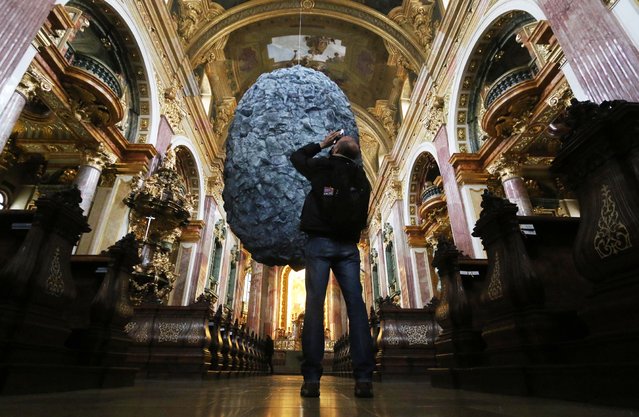
A visitor takes a photo of a boulder plastic made of synthetic material called “To be in Limbo” hangs from the ceiling of the 20 meter high Jesuit Church in Vienna, Austria, Tuesday, November 25, 2014. The eight meter high, hollow and 700 kilogram heavy sculpture from the artists group Steinbrener/Dempf and Huber is supposed to symbolize faith and its threatening moments. The installation will remain until April 19, 2015 and then move to a church in Hamburg, Germany. (Photo by Ronald Zak/AP Photo)
Robot couple Xiaolan (L) and Xiaotao carry trays of food at a restaurant in Jinhua, Zhejiang province, China, May 18, 2015. The restaurant, which opened on Monday, has two robots delivering food for customers. The robots were designed as a couple, Xiaolan and Xiaotao, according to local media. (Photo by Reuters/Stringer)
A woman takes a selfie in front a damaged Turkish military APC that was attacked by protesters near the Turkish military headquarters in Ankara, Turkey, Saturday, July 16, 2016. (Photo by Hussein Malla/AP Photo)
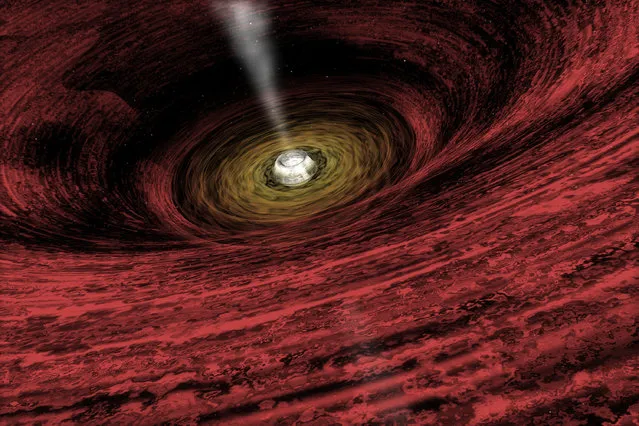
An artist's impression of a growing supermassive black hole located in the early Universe is seen in this NASA handout illustration released on June 15, 2011. Using the deepest X-ray image ever taken, astronomers found the first direct evidence that massive black holes were common in the early universe. This discovery from NASA's Chandra X-Ray Observatory shows that very young black holes grew more aggressively than previously thought, in tandem with the growth of their host galaxies. (Photo by Reuters/NASA/Chandra X-Ray Observatory/A.Hobart)