Loading...
Done
Lao Peoples Democratic Republic

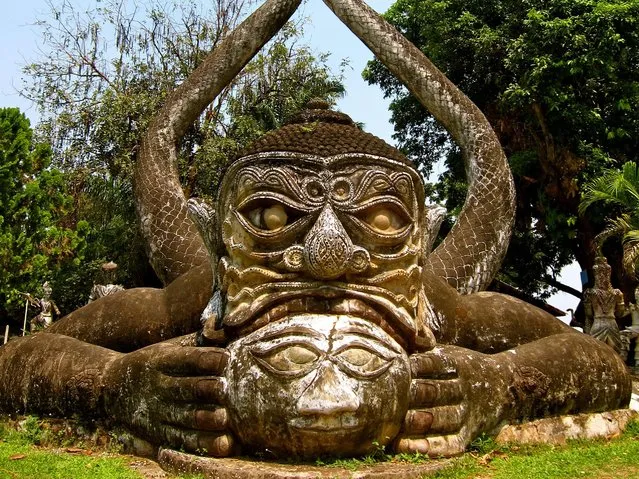
Laos, officially the Lao People's Democratic Republic, is a landlocked country in Southeast Asia, bordered by Burma and China to the northwest, Vietnam to the east, Cambodia to the south, and Thailand to the west. Its population was estimated to be around 6.5 million in 2012. A third (33%) of the country's population lives below the international poverty line which means living on less than U.S. $1.25 per day.
Details
01 Sep 2013 14:51:00
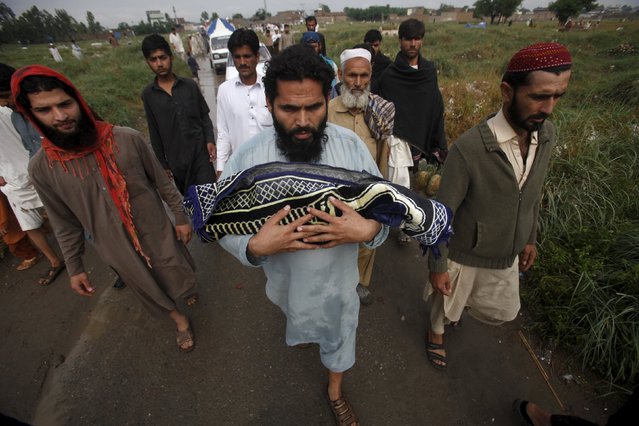
A man carries the body of his son for burial after he was killed when a rooftop of his house collapsed due to heavy rain in the outskirts of Peshawar, Pakistan April 27, 2015. (Photo by Fayaz Aziz/Reuters)

A man carries the body of his son for burial after he was killed when a rooftop of his house collapsed due to heavy rain in the outskirts of Peshawar, Pakistan April 27, 2015. A severe storm in northwest Pakistan, dubbed a “mini-cyclone”, has killed 44 people and injured more than 200, officials said, raising their previous death toll. (Photo by Fayaz Aziz/Reuters)
Details
28 Apr 2015 13:23:00
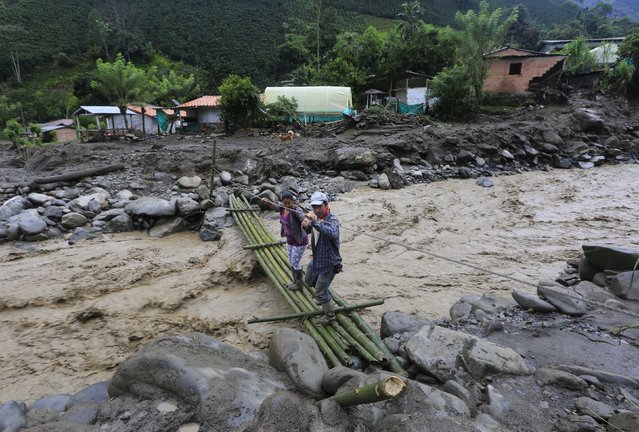
Residents cross over an improvised bridge after a landslide sent mud and water crashing onto homes close to the municipality of Salgar in Antioquia department, Colombia May 19, 2015. (Photo by Jose Miguel Gomez/Reuters)

Residents cross over an improvised bridge after a landslide sent mud and water crashing onto homes close to the municipality of Salgar in Antioquia department, Colombia May 19, 2015. A landslide sent mud and water crashing onto homes in a town in Colombia's northwest mountains on Monday, killing at least 50 people and injuring dozens, officials said. (Photo by Jose Miguel Gomez/Reuters)
Details
20 May 2015 09:15:00
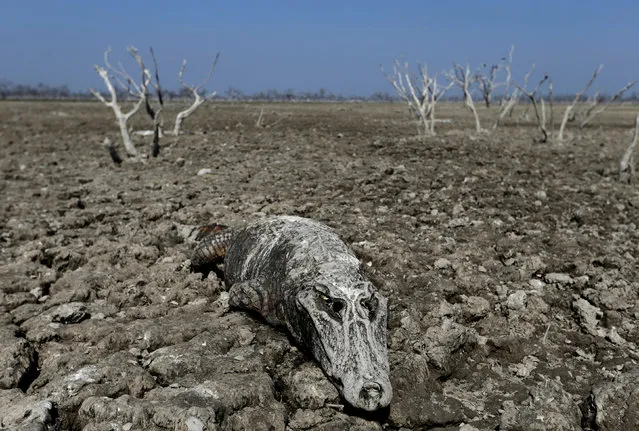
The carcass of a yacare caiman lies in the dried-up river bed of the Pilcomayo river in Boqueron, Paraguay, August 14, 2016. In Paraguay, alongside the Pilcomayo River, black vultures flew over a shrinking pond where a group of crocodilian reptiles known as yacare caimans sought refuge. Water from the river, which divides Paraguay and Argentina in the area of the Gran Chaco, was scarce. This is not an uncommon sight in the region of General Diaz, about 700 kilometres (435 miles) northwest of the country's capital Asuncion, where the Pilcomayo's waters form lakes and streams that give life to capybaras, birds and caimans. “The river's situation is critical. No water is forecast to enter the basin until December, as happens every year”, said Alcides Gonzalez, a resident of the area. (Photo by Jorge Adorno/Reuters)

The carcass of a yacare caiman lies in the dried-up river bed of the Pilcomayo river in Boqueron, Paraguay, August 14, 2016. In Paraguay, alongside the Pilcomayo River, black vultures flew over a shrinking pond where a group of crocodilian reptiles known as yacare caimans sought refuge. Water from the river, which divides Paraguay and Argentina in the area of the Gran Chaco, was scarce. This is not an uncommon sight in the region of General Diaz, about 700 kilometres (435 miles) northwest of the country's capital Asuncion, where the Pilcomayo's waters form lakes and streams that give life to capybaras, birds and caimans. (Photo by Jorge Adorno/Reuters)
Details
03 Nov 2016 12:40:00
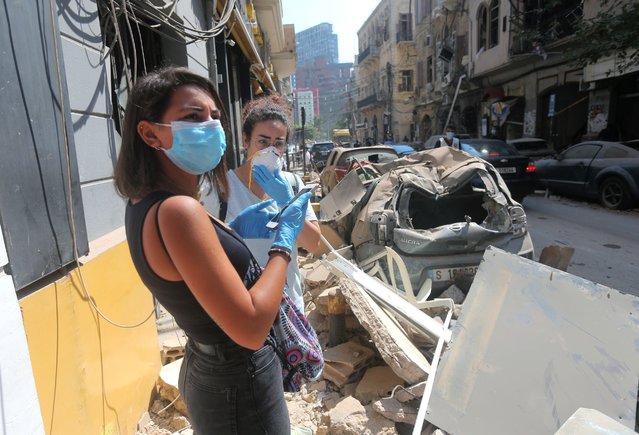
Young Lebanese women wearing protective masks and gloves against the coronavirus pandemic, stand on August 5, 2020 amid the rubble in Beirut's Gimmayzeh commercial district which was heavily damaged by the previous day's powerful explosion that tore through Lebanon's capital, resulting from the ignition of a huge depot of ammonium nitrate at the city's main port. Rescuers searched for survivors in Beirut after a cataclysmic explosion at the port sowed devastation across entire neighbourhoods, killing more than 100 people, wounding thousands and plunging Lebanon deeper into crisis. The blast, which appeared to have been caused by a fire igniting 2,750 tonnes of ammonium nitrate left unsecured in a warehouse, was felt as far away as Cyprus, some 150 miles (240 kilometres) to the northwest. (Photo by AFP Photo/Stringer)

Young Lebanese women wearing protective masks and gloves against the coronavirus pandemic, stand on August 5, 2020 amid the rubble in Beirut's Gimmayzeh commercial district which was heavily damaged by the previous day's powerful explosion that tore through Lebanon's capital, resulting from the ignition of a huge depot of ammonium nitrate at the city's main port. Rescuers searched for survivors in Beirut after a cataclysmic explosion at the port sowed devastation across entire neighbourhoods, killing more than 100 people, wounding thousands and plunging Lebanon deeper into crisis. The blast, which appeared to have been caused by a fire igniting 2,750 tonnes of ammonium nitrate left unsecured in a warehouse, was felt as far away as Cyprus, some 150 miles (240 kilometres) to the northwest. (Photo by AFP Photo/Stringer)
Details
10 Aug 2020 00:05:00


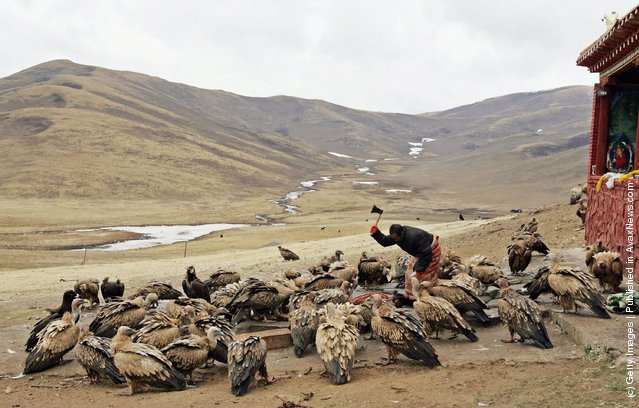
“Sky burial or ritual dissection was once a common funerary practice in Tibet wherein a human corpse is cut in specific locations and placed on a mountaintop, exposing it to the elements or the mahabhuta and animals – especially to birds of prey. The location of the sky burial preparation and place of execution are understood in the Vajrayana traditions as charnel grounds. In Tibet the practice is known as jhator, which literally means, «giving alms to the birds»”. – Wikipedia

Photo: A burial master chops bones of a body to feed vultures during a celestial burial ceremony on April 19, 2006 in Dari County of Guoluo Prefecture, Qinghai Province, northwest China. Celestial burial is a traditional funeral of Tibetan people, which began in the 7th century. (Photo by China Photos/Getty Images)
Details
18 Jun 2011 12:12:00
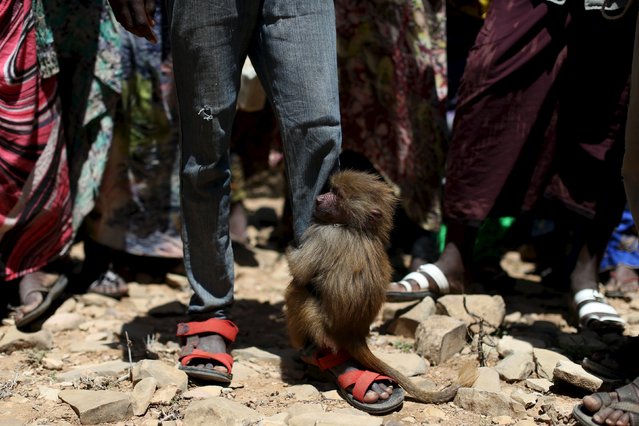
A baboon clings to the leg of an internally displaced boy at a camp on the outskirts of the town of Qol Ujeed, on the border with Ethiopia, Somaliland April 17, 2016. (Photo by Siegfried Modola/Reuters)

A baboon clings to the leg of an internally displaced boy at a camp on the outskirts of the town of Qol Ujeed, on the border with Ethiopia, Somaliland April 17, 2016. Across the Horn of Africa, millions have been hit by the severe El Nino-related drought. In Somaliland and its neighbouring, also semi-autonomous, Puntland region, 1.7 million people are in need of aid, according to the United Nations. In Somaliland itself, the most affected areas include the northwest Awdal region bordering Ethiopia. (Photo by Siegfried Modola/Reuters)
Details
29 Apr 2016 11:19:00
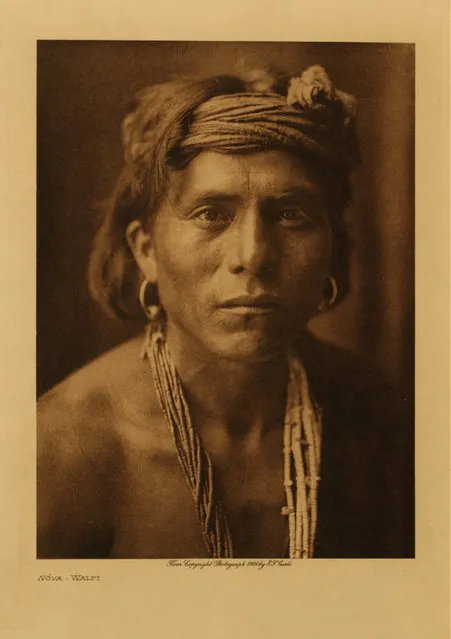
Nova, a Walpi, in 1906. (Photo by Edward S. Curtis)

At the beginning of the 20th century, Edward S. Curtis set out to document what he saw as a disappearing race: the Native American. From 1907 to 1930, Curtis took more than 2,000 photos of 80 tribes stretching from the Great Plains to the Pacific Northwest and Alaska. He then published and sold these photos, along with narrative text, in 20 volumes of work known as “The North American Indian”. It is one of the most significant collections of its kind, “probably the most important photographic document of its age and its topic,” said Jeffrey Garrett, associate university librarian for Special Libraries at Northwestern University. (Photo by Edward S. Curtis)
Details
07 Sep 2014 12:57:00