Loading...
Done
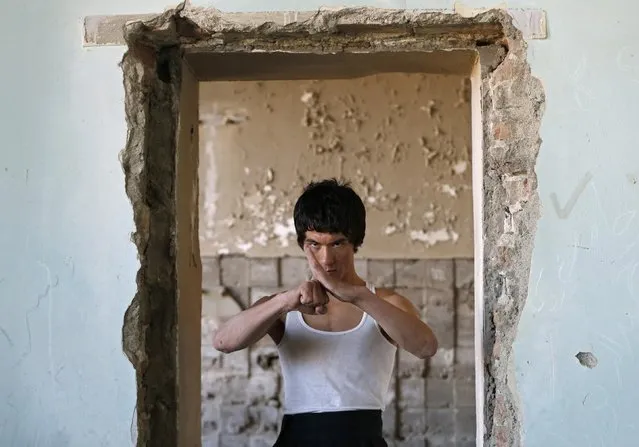
Abbas Alizada, who calls himself the Afghan Bruce Lee, poses during a media event in Kabul December 9, 2014. From the ruins of an iconic bombed-out palace above Kabul, the young Afghan man bearing a striking resemblance to kung fu legend Bruce Lee is high-kicking his way to Internet fame, aiming to show another side to his war-weary nation. (Photo by Mohammad Ismail/Reuters)

Abbas Alizada, who calls himself the Afghan Bruce Lee, poses during a media event in Kabul December 9, 2014. From the ruins of an iconic bombed-out palace above Kabul, the young Afghan man bearing a striking resemblance to kung fu legend Bruce Lee is high-kicking his way to Internet fame, aiming to show another side to his war-weary nation. (Photo by Mohammad Ismail/Reuters)
Details
10 Dec 2014 12:17:00
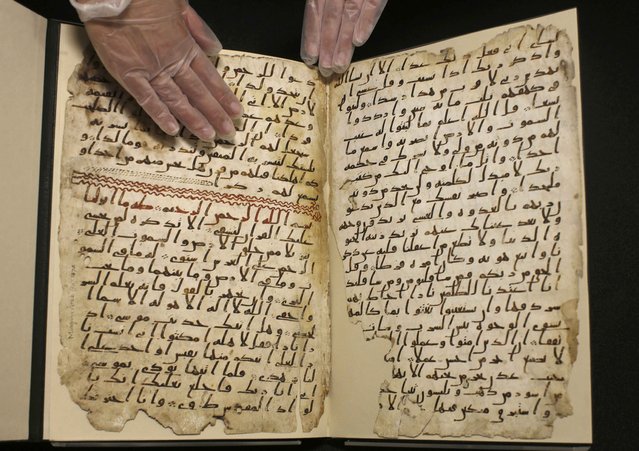
A fragment of a Koran manuscript is seen in the library at the University of Birmingham in Britain July 22, 2015. A British university said on Wednesday that fragments of a Koran manuscript found in its library were from one of the oldest surviving copies of the Islamic text in the world, possibly written by someone who might have known Prophet Mohammad. (Photo by Peter Nicholls/Reuters)

A fragment of a Koran manuscript is seen in the library at the University of Birmingham in Britain July 22, 2015. A British university said on Wednesday that fragments of a Koran manuscript found in its library were from one of the oldest surviving copies of the Islamic text in the world, possibly written by someone who might have known Prophet Mohammad. Radiocarbon dating indicated that the parchment folios held by the University of Birmingham in central England were at least 1,370 years old, which would make them one of the earliest written forms of the Islamic holy book in existence. (Photo by Peter Nicholls/Reuters)
Details
23 Jul 2015 11:00:00
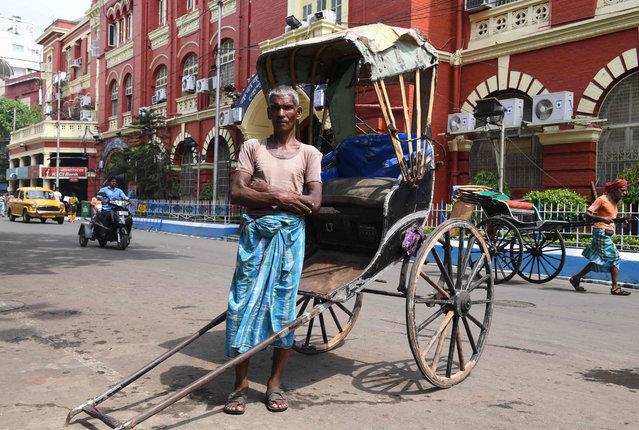
Mohammad Ashgar, 65, an Indian rickshaw puller, poses for a photograph next to his rickshaw in Kolkata on April 21, 2018. A mainstay of 19 th century transportation options, the hand- pulled rickshaw survives in India only in Kolkata after being outlawed elsewhere. The local puller's union puts the number of pullers in the city at 3,000. The union has resisted all previous attempts to ban their livelihood, previously organising mass protests of their members against moves to stamp out the practice. (Photo by Dibyangshu Sarkar/AFP Photo)

Ahead of May Day, AFP' s video and photo teams spoke to men and women around the globe whose jobs are becoming increasingly rare, particularly as technology transforms societies. Here: Mohammad Ashgar, 65, an Indian rickshaw puller, poses for a photograph next to his rickshaw in Kolkata on April 21, 2018. (Photo by Dibyangshu Sarkar/AFP Photo)
Details
02 May 2018 00:01:00
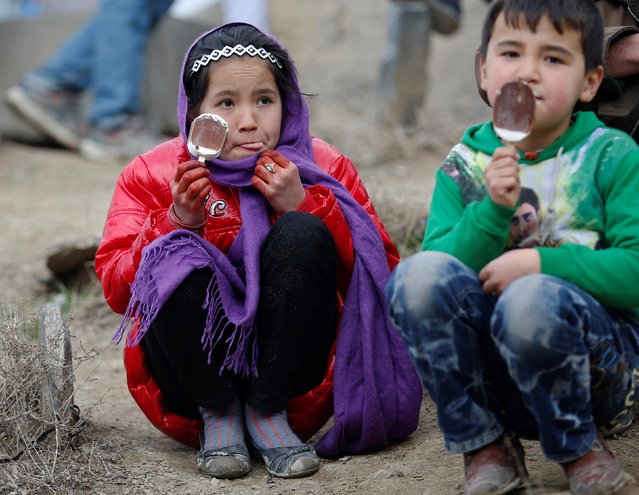
Afghan children have ice cream during the Afghan New Year (Newroz) celebration in Kabul March 21, 2014. (Photo by Ahmad Masood/Reuters)

Afghan children have ice cream during the Afghan New Year (Newroz) celebration in Kabul March 21, 2014. Afghanistan uses the Persian calendar which runs from the vernal equinox. The calendar takes as its start date the time when the Prophet Mohammad moved from Mecca to Medina in 621 AD. The current Persian year is 1393. (Photo by Ahmad Masood/Reuters)
Details
24 Mar 2014 08:19:00
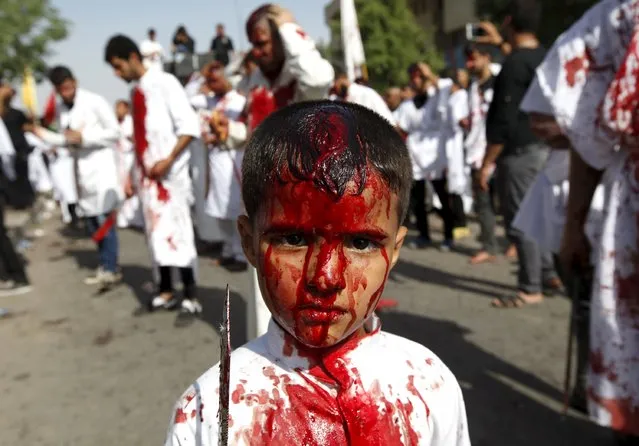
An Iraqi Shi'ite boy poses for a photograph as Iraq Shi'ite Muslims commemorate Ashura in Baghdad, October 24, 2015. (Photo by Ahmed Saad/Reuters)

An Iraqi Shi'ite boy poses for a photograph as Iraq Shi'ite Muslims commemorate Ashura in Baghdad, October 24, 2015. Ashura, which falls on the 10th day of the Islamic month of Muharram, commemorates the death of Imam Hussein, grandson of Prophet Mohammad, who was killed in the seventh century battle of Kerbala. (Photo by Ahmed Saad/Reuters)
Details
27 Oct 2015 08:00:00
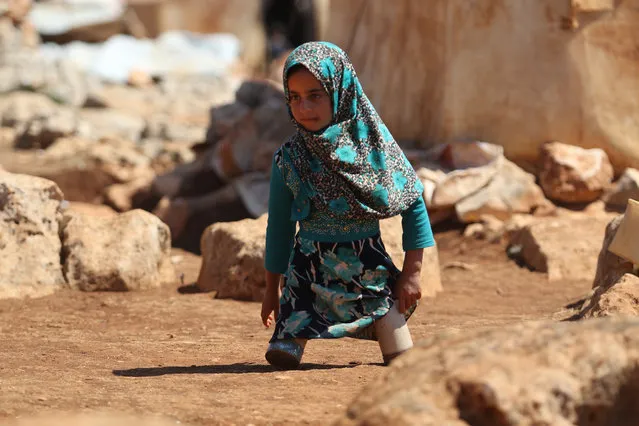
Eight year-old Maya Mohammad Ali Merhi walks using prosthetic legs made by her father from tin cans in a camp for displaced people, in the northern Syrian province of Idlib on June 20, 2018. Maya and her father were both born without lower limbs. Unable to afford real prosthetic limbs, her father made her a pair out of tin cans filled with cotton and scrap pieces of cloth. Maya's family had to leave their home in the Aleppo province to flee battles. (Photo by Aaref Watad/AFP Photo)

Eight year-old Maya Mohammad Ali Merhi walks using prosthetic legs made by her father from tin cans in a camp for displaced people, in the northern Syrian province of Idlib on June 20, 2018. Maya and her father were both born without lower limbs. Unable to afford real prosthetic limbs, her father made her a pair out of tin cans filled with cotton and scrap pieces of cloth. Maya's family had to leave their home in the Aleppo province to flee battles. (Photo by Aaref Watad/AFP Photo)
Details
09 Aug 2018 00:01:00
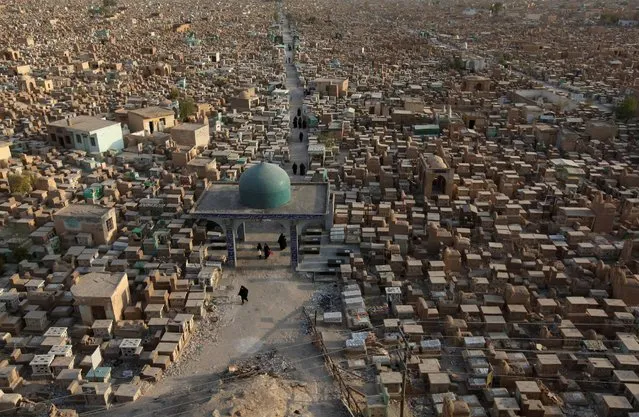
The Wadi al-Salam cemetery, Arabic for “Peace Valley”, is seen in Najaf, south of Baghdad, Iraq August 3, 2016. The world's largest cemetery, in Iraq's Shi'ite holy city of Najaf, is expanding at double its usual rate as Shi'ite militias bury their dead from the war against Islamic State. The Wadi al-Salam cemetery, Arabic for “Peace Valley” has a special place in the hearts of Shi'ite Muslims as it surrounds the Mausoleum of their first imam, Ali Bin Abi Talib, a cousin and son-in-law of Prophet Mohammad. (Photo by Alaa Al-Marjani/Reuters)

The Wadi al-Salam cemetery, Arabic for “Peace Valley”, is seen in Najaf, south of Baghdad, Iraq August 3, 2016. The world's largest cemetery, in Iraq's Shi'ite holy city of Najaf, is expanding at double its usual rate as Shi'ite militias bury their dead from the war against Islamic State. The Wadi al-Salam cemetery, Arabic for “Peace Valley” has a special place in the hearts of Shi'ite Muslims as it surrounds the Mausoleum of their first imam, Ali Bin Abi Talib, a cousin and son-in-law of Prophet Mohammad. (Photo by Alaa Al-Marjani/Reuters)
Details
24 Aug 2016 11:38:00
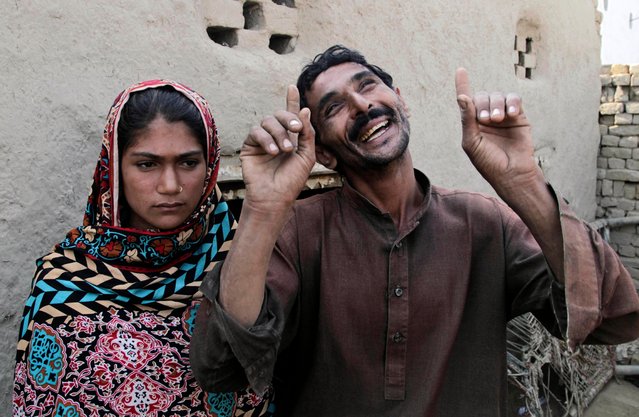
In this Tuesday, December 20, 2016 photo, Mohammad Ramzan, right, reacts while talking to The Associated Press with his young bride Saima in Jampur, Pakistan. Saima was given as a bride to the older man by her father so he could marry the groom’s sister, a practice of exchanging girls that is entrenched in conservative regions of Pakistan. It even has its own name in Urdu: Watta Satta, “give and take”. A mix of interests – family obligations, desire for sons, a wish to hand off a girl to a husband – can lead to a young teen in an a marriage she never sought. (Photo by K.M. Chaudhry/AP Photo)

In this Tuesday, December 20, 2016 photo, Mohammad Ramzan, right, reacts while talking to The Associated Press with his young bride Saima in Jampur, Pakistan. Saima was given as a bride to the older man by her father so he could marry the groom’s sister, a practice of exchanging girls that is entrenched in conservative regions of Pakistan. It even has its own name in Urdu: Watta Satta, “give and take”. A mix of interests – family obligations, desire for sons, a wish to hand off a girl to a husband – can lead to a young teen in an a marriage she never sought. (Photo by K.M. Chaudhry/AP Photo)
Details
31 Dec 2016 10:08:00