Loading...
Done
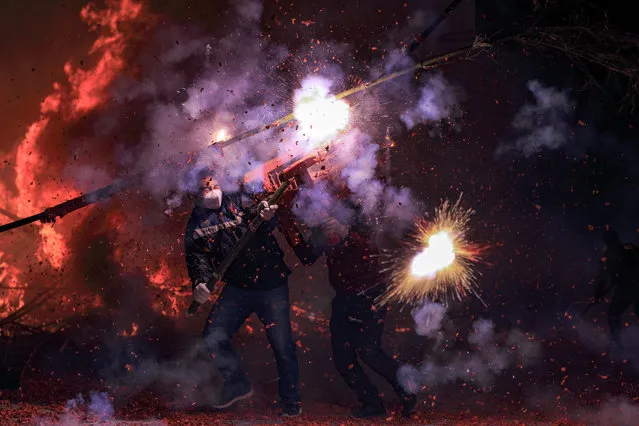
Villagers from Jiexi Jiantan village perform a ritual of “Zha Laoye”, or “Cracking local spirits”, in Chaoshan, Guangdong Province, China, 10 February 2019. Jiexi Jiantan Village celebrates the annual custom of “Zha Laoye” where Laoye are local spirits. Every third day of the lunar New Year, statues of local spirits known as the “Thousand-mile Eye” Laoye and “Ear Following the Wind” Laoye are brought out to the village committee to receive incensed tea offered by believers. By the sixth day of the year, the “Zha Laoye” activities begin with each man holding one of the statues on a chair above his head while run around a bonfire. Two other men light firecrackers strung up on a long bamboo poles and chase the spirit around the bonfire, signifying a bountiful new year. (Photo by EPA/EFE/ZNSEN)

Villagers from Jiexi Jiantan village perform a ritual of “Zha Laoye”, or “Cracking local spirits”, in Chaoshan, Guangdong Province, China, 10 February 2019. Jiexi Jiantan Village celebrates the annual custom of “Zha Laoye” where Laoye are local spirits. Every third day of the lunar New Year, statues of local spirits known as the “Thousand-mile Eye” Laoye and “Ear Following the Wind” Laoye are brought out to the village committee to receive incensed tea offered by believers. (Photo by EPA/EFE/ZNSEN)
Details
23 Feb 2019 00:07:00
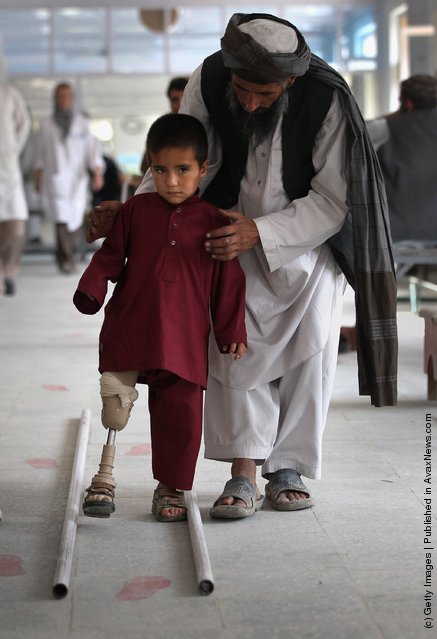
Afghan war amputees

An Afghan child practices walking with his new prosthesis at the International Committee of the Red Cross (ICRC), orthopedic center on September 10, 2011 in Kabul, Afghanistan. After more than 30 years of war and a decade since the 9/11 attacks in the United States, thousands of Afghans, both military and civilian, continue to pay a heavy price from the conflict. The ICRC center makes prosthetics for amputees and helps them, as well as Afghans with spinal injuries and children with congenital birth defects, to learn to walk. (Photo by John Moore/Getty Images)
Details
11 Sep 2011 09:56:00
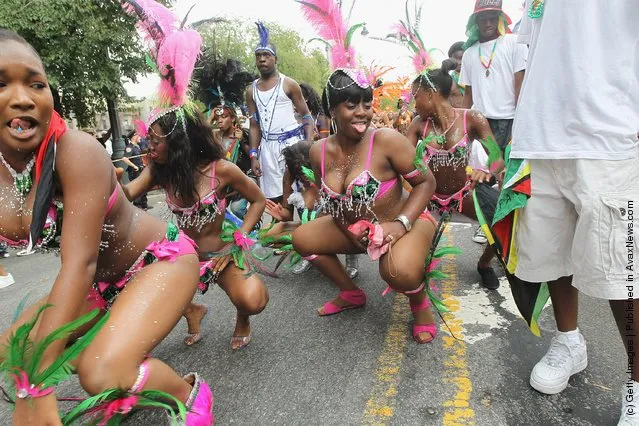
New Yorkers Celebrate At West Indian Day Parade

“The Labor Day Parade (or West Indian Carnival), is an annual celebration held on American Labor Day (the first Monday in September), in Crown Heights, Brooklyn, New York. Ms. Jessie Waddell and some of her West Indian friends started the Carnival in Harlem in the 1920s by staging costume parties in large enclosed places like the Savoy, Renaissance and Audubon Ballrooms due to the cold wintry weather of February. This is the usual time for the pre-Lenten celebrations held in most countries around the world. However, because of the very nature of Carnival, and the need to parade in costume to music, indoor confinement did not work well. The earliest known Carnival street parade was held on September 1, 1947. The Trinidad Carnival Pageant Committee was the founding force behind the parade, which was held in Harlem. The parade route was along Seventh Avenue, starting at 110th St.” – Wikipedia

Photo: A reveler looks on during the West Indian-American Day Parade September 5, 2011 in the Brooklyn borough of New York City. More than 2 million spectators were expected to attend the celebration of Caribbean culture. (Photo by Mario Tama/Getty Images)

Details
06 Sep 2011 11:18:00
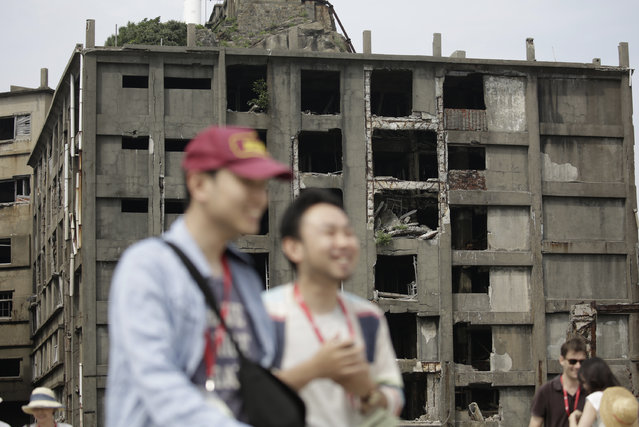
In this June 29, 2015 photo, forlorn buildings are seen at Hashima Island, commonly known as Gunkanjima, which means “Battleship Island”, off Nagasaki, Nagasaki Prefecture, southern Japan. (Photo by Eugene Hoshiko/AP Photo)

In this June 29, 2015 photo, forlorn buildings are seen at Hashima Island, commonly known as Gunkanjima, which means “Battleship Island”, off Nagasaki, Nagasaki Prefecture, southern Japan. The island is one of 23 old industrial facilities seeking UNESCO's recognition as world heritage “Sites of Japan's Meiji Industrial Revolution” meant to illustrate Japan's rapid transformation from a feudal farming society into an industrial power at the end of the 19th century. UNESCO's World Heritage Committee is expected to approve the proposal during a meeting being held in Bonn, Germany, through July 9. (Photo by Eugene Hoshiko/AP Photo)
Details
01 Jul 2015 13:41:00
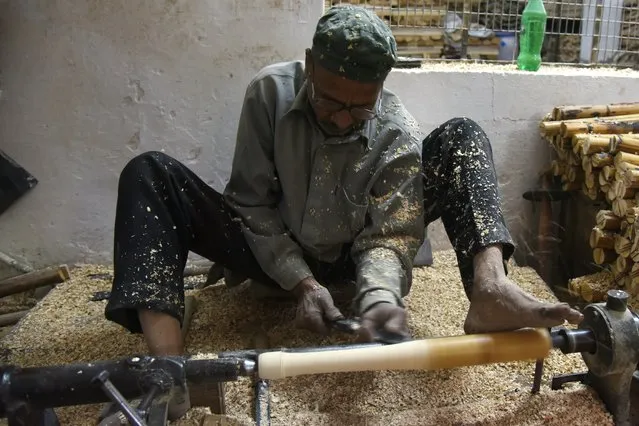
In this photograph taken on December 14, 2016, an Indian craftsman works on unfinished cricket bats in a factory in Meerut, some 70 kms north- east of New Delhi. As Indian factory worker Jitender Singh carves out another big- hitting slab of thick willow he insists MCC proposals to limit the size of cricket bats won' t tame Twenty20 marauders. “I don' t think the thickness matters. It' s more about the balance of the bat and the talent of the batsman”, says Singh, who has made bats for many stars, including South Africa's AB de Villiers. The World Cricket committee of the MCC, the guardians of the game, recommended in December 2016 that limitations be placed on the width and depth of bats because it had become too easy to smash fours and sixes. (Photo by Dominique Faget/AFP Photo)

In this photograph taken on December 14, 2016, an Indian craftsman works on unfinished cricket bats in a factory in Meerut, some 70 kms north- east of New Delhi. (Photo by Dominique Faget/AFP Photo)
Details
11 Jan 2017 14:32:00
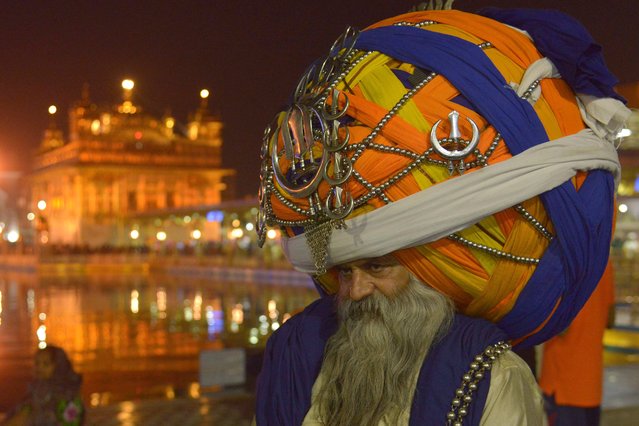
An Indian Sikh Nihang (a traditional Sikh religious warrior) Baba 'Avtar' Singh wears an oversized giant traditional turban as he pay respects at the Golden temple in Amritsar on November 10, 2015 on the eve of the Indian festival of Diwali, the festival of lights. (Photo by Narinder Nanu/AFP Photo)

An Indian Sikh Nihang (a traditional Sikh religious warrior) Baba 'Avtar' Singh wears an oversized giant traditional turban as he pay respects at the Golden temple in Amritsar on November 10, 2015 on the eve of the Indian festival of Diwali, the festival of lights. There will be no spectacular show of light and fireworks this Diwali at the Golden Temple as the Shiromani Gurdwara Parbandhak Committee (SGPC) has decided not to celebrate the festival in the wake of series of incidents of alleged desecration of the Guru Granth Sahib (Sikh holy book). (Photo by Narinder Nanu/AFP Photo)
Details
22 Nov 2015 08:05:00
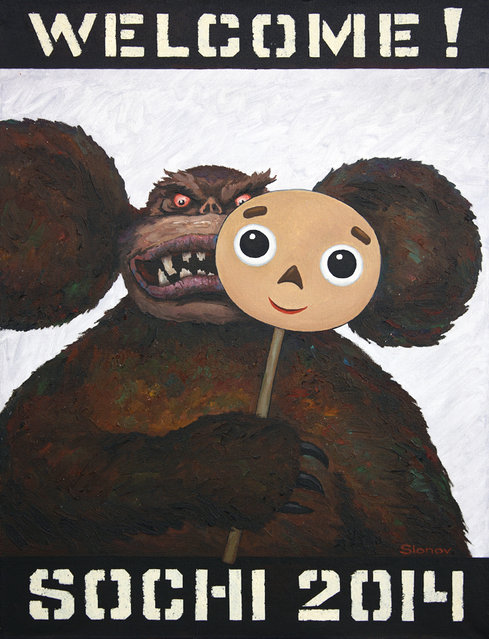
The Dark Side of Sochi Olympics by Vasily Slonov

“Exactly one year before the long awaited Sochi Olympics, Vladimir Putin went to Sochi personally to see how the construction is going. After receiving a report saying the ski jumps that were supposed to be ready in 2011, are not completed still, while their price has sky-rocketed from 1.2 billion to 8 billion roubles, he commented, “Good for you. Good job”, and then fired the vice president of the Olympic committee. Russian artist Vasily Slonov painted his view of the upcoming games, giving a new interpretation to the adored Russian mascot Cheburashka, and combining officially endorsed stereotypes of Russia with grimmer and less accepted ones”. – Ruskie.info. (Photo by Vasily Slonov)
Details
07 Jun 2013 10:24:00
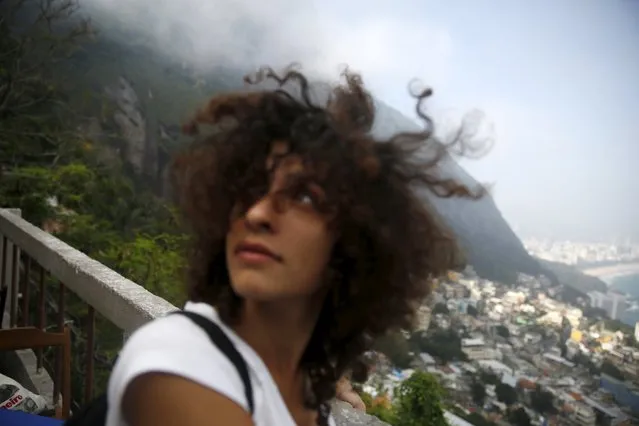
Syrian Tulin Hashemi waits for a job interview at a hotel in Vidigal slum in Rio de Janeiro, Brazil, September 22, 2015. Tulin, whose mother arrived two days ago, has been living in Brazil for two months. As she does not speak Portuguese, Tulin says it is difficult for her to find a job and therefore she is staying at the slum as it is one of the cheaper neighbourhoods to live in. (Photo by Pilar Olivares/Reuters)

Syrian Tulin Hashemi waits for a job interview at a hotel in Vidigal slum in Rio de Janeiro, Brazil, September 22, 2015. Tulin, whose mother arrived two days ago, has been living in Brazil for two months. As she does not speak Portuguese, Tulin says it is difficult for her to find a job and therefore she is staying at the slum as it is one of the cheaper neighbourhoods to live in. According to the National Committee for Refugees (CONARE), 2,077 people fleeing the Syrian civil war have settled in Brazil, whilst a quarter of the 8,400 refugees in the Latin American country come from Syria. (Photo by Pilar Olivares/Reuters)
Details
25 Sep 2015 08:05:00