Loading...
Done
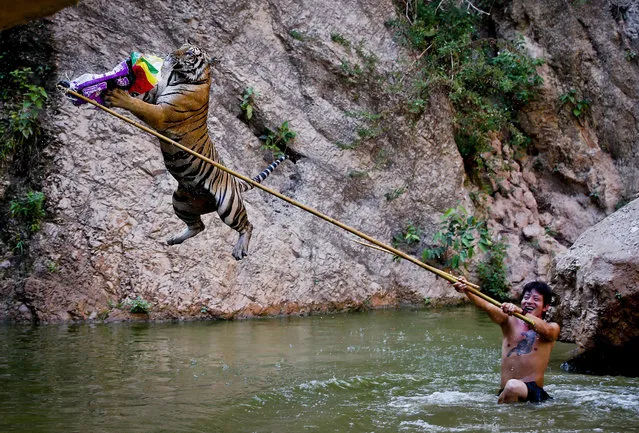
A picture made available 26 April 2016 shows a tiger playing in the water with a trainer nicknamed “Super Tiger Man” at the Tiger Temple in Kanchanaburi province, Thailand, 24 April 2016. The site known in Thai as “Wat Pa Luangta Maha Bua Yannasampanno” has been the focus of a dispute with the Department of National Parks, Wildlife and Plant Conservation (DNP) after the DNP asked in 2015 that the temple hands over its 147 tigers since it was not licensed to keep them. The temple has requested for a zoo license according to its managing director. (Photo by Diego Azubel/EPA)

A picture made available 26 April 2016 shows a tiger playing in the water with a trainer nicknamed “Super Tiger Man” at the Tiger Temple in Kanchanaburi province, Thailand, 24 April 2016. The site known in Thai as “Wat Pa Luangta Maha Bua Yannasampanno” has been the focus of a dispute with the Department of National Parks, Wildlife and Plant Conservation (DNP) after the DNP asked in 2015 that the temple hands over its 147 tigers since it was not licensed to keep them. The temple has requested for a zoo license according to its managing director. (Photo by Diego Azubel/EPA)
Details
01 Jun 2016 12:44:00
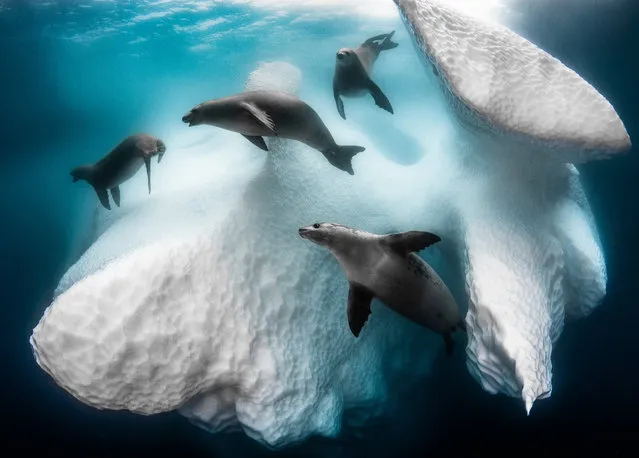
Underwater photographer of the year 2020 and wide angle category winner: Frozen Mobile Home by Greg Lecoeur (France) in the Antarctic peninsula, Antarctica. Crabeater seals swim around an iceberg. These massive and mysterious habitats are dynamic kingdoms that support marine life. As they swing and rotate slowly through polar currents, icebergs fertilise the oceans by carrying nutrients from land that spark blooms of phytoplankton, fundamental to the carbon cycle. (Photo by Greg Lecoeur/Underwater Photographer of the Year 2020)

Underwater photographer of the year 2020 and wide angle category winner: Frozen Mobile Home by Greg Lecoeur (France) in the Antarctic peninsula, Antarctica. Crabeater seals swim around an iceberg. These massive and mysterious habitats are dynamic kingdoms that support marine life. As they swing and rotate slowly through polar currents, icebergs fertilise the oceans by carrying nutrients from land that spark blooms of phytoplankton, fundamental to the carbon cycle. (Photo by Greg Lecoeur/Underwater Photographer of the Year 2020)
Details
28 Feb 2020 00:05:00
A couple dance by the Golden Horn leading to the Bosphorus Strait separating Europe and Asia, in Istanbul, Friday, May 14, 2021. (Photo by Emrah Gurel/AP Photo)

A couple dance by the Golden Horn leading to the Bosphorus Strait separating Europe and Asia, in Istanbul, Friday, May 14, 2021. (Photo by Emrah Gurel/AP Photo)
Details
21 May 2021 09:45:00
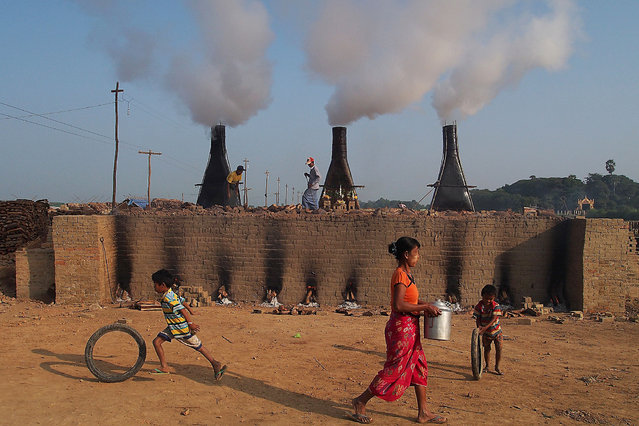
Children play in front of a brick factory on the outskirts of the northern Myanmar city of Mandalay on December 14, 2015. (Photo by Phyo Hein Kyaw/AFP Photo)

Children play in front of a brick factory on the outskirts of the northern Myanmar city of Mandalay on December 14, 2015. (Photo by Phyo Hein Kyaw/AFP Photo)
Details
06 May 2016 13:11:00
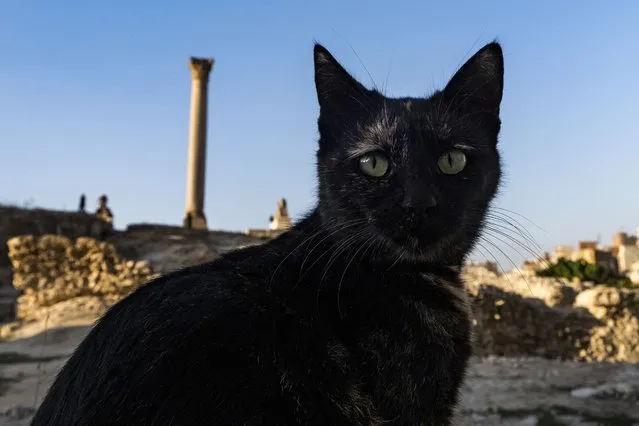
A cat looks on near the Victory Pillar at the ruins of the Serapeum of Alexandria, an ancient Greek temple dating to the Ptolemaic and Roman periods (246 BC – 391 AD) dedicated to the city's protector deity Serapis, in Egypt's northern coastal city of Alexandria on November 24, 2023. The giant Corinthian column, commonly misidentified as “Pompey's Pillar”, is a Roman triumphal column set up in honour of the Roman emperor Diocletian (298–302 AD), and originally supported a colossal porphyry statue of the emperor in armour. (Photo by Amir Makar/AFP Photo)

A cat looks on near the Victory Pillar at the ruins of the Serapeum of Alexandria, an ancient Greek temple dating to the Ptolemaic and Roman periods (246 BC – 391 AD) dedicated to the city's protector deity Serapis, in Egypt's northern coastal city of Alexandria on November 24, 2023. The giant Corinthian column, commonly misidentified as “Pompey's Pillar”, is a Roman triumphal column set up in honour of the Roman emperor Diocletian (298–302 AD), and originally supported a colossal porphyry statue of the emperor in armour. (Photo by Amir Makar/AFP Photo)
Details
13 Dec 2023 23:52:00
Residents ride on top of an overcrowded “Jeepney”, a locally manufactured public transport, along a highway in Mogpog town on Marinduque island in central Philippines April 8, 2015. (Photo by Erik De Castro/Reuters)

Residents ride on top of an overcrowded “Jeepney”, a locally manufactured public transport, along a highway in Mogpog town on Marinduque island in central Philippines April 8, 2015. (Photo by Erik De Castro/Reuters)
Details
03 Sep 2016 09:47:00
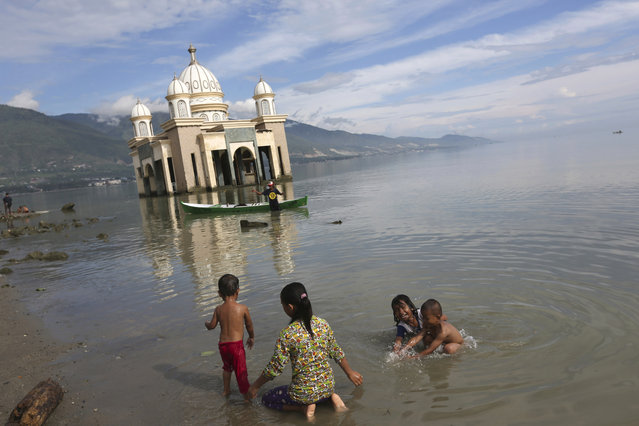
In this Wednesday, April 3, 2019, photo, children play in the water on a beach as a mosque collapsed during the Sept. 28, 2018, earthquake is seen in the background in Palu, Central Sulawesi, Indonesia. The earthquake spawned a large localized tsunami that wiped out coastal areas, while liquefaction caused by the shaking turned entire neighborhoods into rivers of sludge. The disaster killed thousands of people, making it the world’s deadliest seismic event in 2018. (Photo by Tatan Syuflana/AP Photo)

In this Wednesday, April 3, 2019, photo, children play in the water on a beach as a mosque collapsed during the Sept. 28, 2018, earthquake is seen in the background in Palu, Central Sulawesi, Indonesia. The earthquake spawned a large localized tsunami that wiped out coastal areas, while liquefaction caused by the shaking turned entire neighborhoods into rivers of sludge. The disaster killed thousands of people, making it the world’s deadliest seismic event in 2018. (Photo by Tatan Syuflana/AP Photo)
Details
04 May 2019 00:05:00
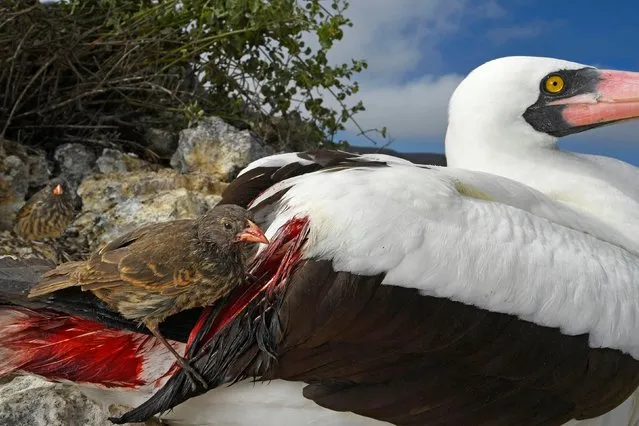
Bloodthirsty by Thomas P Peschak, Germany/South Africa — winner, Behaviour: birds. When rations run short on Wolf Island, in the remote northern Galápagos, the sharp-beaked ground finches become vampires. Their sitting targets are Nazca boobies and other large birds. The finches rely on a scant diet of seeds and insects, which regularly dries up, so they drink blood to survive. ‘I’ve seen more than half a dozen finches drinking from a single Nazca booby,’ says Tom. Rather than leave their nests the boobies tolerate the vampires, and the blood loss doesn’t seem to cause permanent harm. (Photo by Thomas P Peschak/2018 Wildlife Photographer of the Year)

Bloodthirsty by Thomas P. Peschak, Germany/South Africa — winner, Behaviour: birds. When rations run short on Wolf Island, in the remote northern Galápagos, the sharp-beaked ground finches become vampires. Their sitting targets are Nazca boobies and other large birds. The finches rely on a scant diet of seeds and insects, which regularly dries up, so they drink blood to survive. ‘I’ve seen more than half a dozen finches drinking from a single Nazca booby,’ says Tom. Rather than leave their nests the boobies tolerate the vampires, and the blood loss doesn’t seem to cause permanent harm. (Photo by Thomas P. Peschak/2018 Wildlife Photographer of the Year)
Details
19 Oct 2018 00:05:00