Loading...
Done
A devotee with his body painted poses as he waits to perform during a ritual as part of the annual Shiva Gajan religious festival at Sona Palasi village, in West Bengal, India, April 11, 2016. Devotees offer sacrifices and perform acts of devotion during the festival in the hopes of winning the favour of Hindu god Shiva and ensuring the fulfillment of their wishes, and also to mark the end of the Bengali calendar year. (Photo by Rupak De Chowdhuri/Reuters)

A devotee with his body painted poses as he waits to perform during a ritual as part of the annual Shiva Gajan religious festival at Sona Palasi village, in West Bengal, India, April 11, 2016. Devotees offer sacrifices and perform acts of devotion during the festival in the hopes of winning the favour of Hindu god Shiva and ensuring the fulfillment of their wishes, and also to mark the end of the Bengali calendar year. (Photo by Rupak De Chowdhuri/Reuters)
Details
13 Apr 2016 09:42:00
A woman spends her time outdoors to observe the ancient festival of Sizdeh Bedar, an annual public picnic day on the 13th day of the Iranian new year, at the Tochal mountainous area northern Tehran, Iran, Sunday, April, 2, 2017. Sizdeh Bedar, which comes from the Farsi words for “thirteen” and “day out”, is a legacy from Iran's pre-Islamic past that hard-liners in the Islamic Republic never managed to erase from calendars. (Photo by Ebrahim Noroozi/AP Photo)

A woman spends her time outdoors to observe the ancient festival of Sizdeh Bedar, an annual public picnic day on the 13th day of the Iranian new year, at the Tochal mountainous area northern Tehran, Iran, Sunday, April, 2, 2017. Sizdeh Bedar, which comes from the Farsi words for “thirteen” and “day out”, is a legacy from Iran's pre-Islamic past that hard-liners in the Islamic Republic never managed to erase from calendars. (Photo by Ebrahim Noroozi/AP Photo)
Details
21 Apr 2017 07:38:00
Racegoers in attendance on Ladies Day at Ascot Racecourse on June 21, 2018 in Ascot, England. Ladies Day is the biggest day in the racing calendar and brings with it all the glitz and glamour as those attending don their best outfits. Ascot Racecourse is steeped in Royal history, first founded by Queen Anne in 1711, with the first race in her honour held on August 11, 1711. This year’s Royal Ascot began Tuesday, June 19, with races every day until Saturday, June 23. (Photo by South West News Service)

Racegoers in attendance on Ladies Day at Ascot Racecourse on June 21, 2018 in Ascot, England. Ladies Day is the biggest day in the racing calendar and brings with it all the glitz and glamour as those attending don their best outfits. Ascot Racecourse is steeped in Royal history, first founded by Queen Anne in 1711, with the first race in her honour held on August 11, 1711. This year’s Royal Ascot began Tuesday, June 19, with races every day until Saturday, June 23. (Photo by South West News Service)
Details
23 Jun 2018 09:36:00
The moon rises over people gathered on Glastonbury Tor ahead of tomorrow's Blue Moon on July 30, 2015 in Somerset, England. The full moon appearing on July 31 will be what's called a Blue Moon, which refers to the second of two full moons appearing in the same calendar month. The last time this happened was in 2012 and there isn't due another until 2018. (Photo by Matt Cardy/Getty Images)

The moon rises over people gathered on Glastonbury Tor ahead of tomorrow's Blue Moon on July 30, 2015 in Somerset, England. The full moon appearing on July 31 will be what's called a Blue Moon, which refers to the second of two full moons appearing in the same calendar month. The last time this happened was in 2012 and there isn't due another until 2018. (Photo by Matt Cardy/Getty Images)
Details
02 Aug 2015 13:07:00
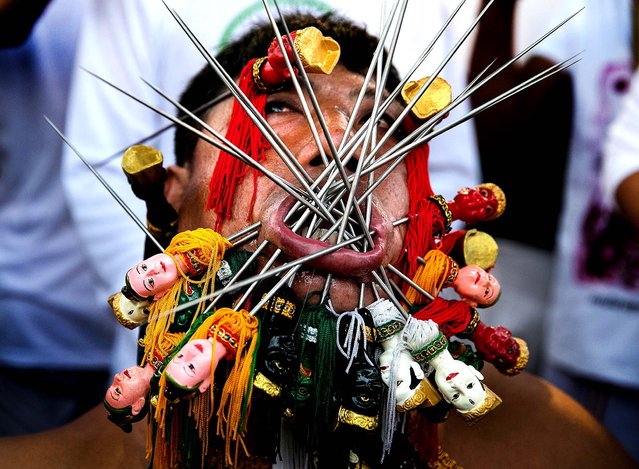
A devotee gest pierced at the Bang Neow shrine in Phuket. (Photo by Paula Bronstein/Getty Images)

“The Nine Emperor Gods Festival is a nine-day Taoist celebration beginning on the eve of 9th lunar month of the Chinese calendar, which is observed primarily in Southeast Asian countries like Myanmar, Singapore, Malaysia, Thailand and also the Riau Islands. In Thailand, this festival is called Tesagan Gin Je, the Vegetarian Festival. It is celebrated throughout the entire country, but the festivities are at their height in Phuket, where about 35% of the population is Chinese. It attracts crowds of spectators because of many of the unusual religious rituals that are performed”. – Wikipedia. Photo: A devotee gest pierced at the Bang Neow shrine in Phuket. (Photo by Paula Bronstein)
Details
11 Oct 2013 07:49:00
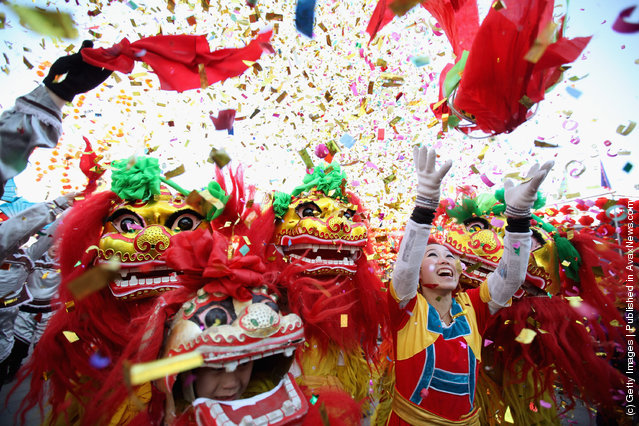
China Celebrates The Year Of The Dragon Spring Festival

Chinese folk artists perform the lion dance at a temple fair to celebrate the Lunar New Year of Dragon on January 22, 2012 in Beijing, China. Falling on January 23 this year, the Chinese Lunar New Year, also known as the Spring Festival, which is based on the Lunisolar Chinese calendar, is celebrated from the first day of the first month of the lunar year and ends with Lantern Festival on the Fifteenth day. (Photo by Feng Li/Getty Images)
Details
23 Jan 2012 10:13:00
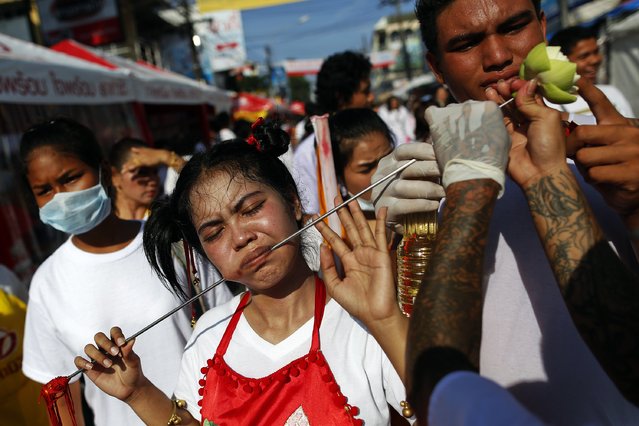
A devotee of the Ban Tha Rua Chinese shrine is helped with a spike pierced through her cheeks during a street procession celebrating the annual vegetarian festival in Phuket September 28, 2014. (Photo by Damir Sagolj/Reuters)

A devotee of the Ban Tha Rua Chinese shrine is helped with a spike pierced through her cheeks during a street procession celebrating the annual vegetarian festival in Phuket September 28, 2014. The festival, featuring face-piercing, spirit mediums and strict vegetarianism celebrates the local Chinese community's belief that abstinence from meat and various stimulants during the ninth lunar month of the Chinese calendar will help them obtain good health and peace of mind. (Photo by Damir Sagolj/Reuters)
Details
28 Sep 2014 11:34:00
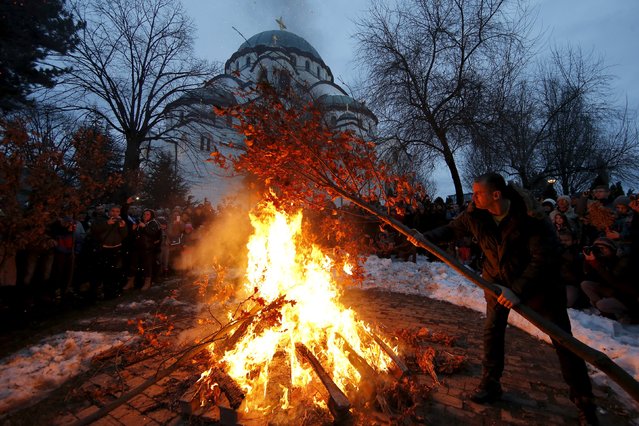
Believers burn dried oak branches, which symbolizes the Yule log, on Orthodox Christmas Eve in front of the St. Sava temple in Belgrade, Serbia, January 6, 2016. (Photo by Marko Djurica/Reuters)

Believers burn dried oak branches, which symbolizes the Yule log, on Orthodox Christmas Eve in front of the St. Sava temple in Belgrade, Serbia, January 6, 2016. Serbian Orthodox believers celebrate Christmas on January 7, according to the Julian calendar. (Photo by Marko Djurica/Reuters)
Details
08 Jan 2016 08:00:00