Loading...
Done
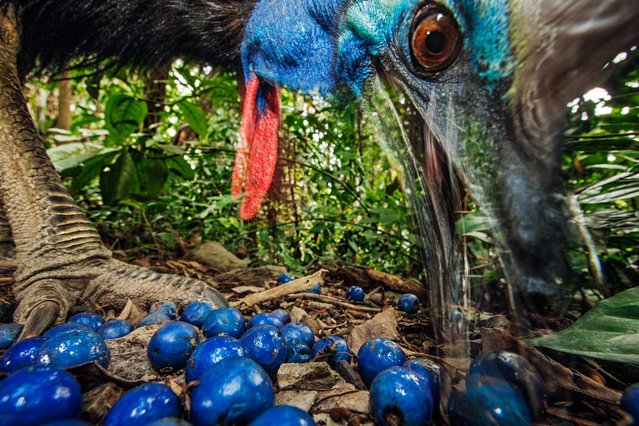
“Cassowaries are large, flightless birds related to emus and (more distantly) to ostriches, rheas, and kiwis”, writes Olivia Judson in the September issue of National Geographic magazine. (Photo by Christian Ziegler/National Geographic)

“Cassowaries are large, flightless birds related to emus and (more distantly) to ostriches, rheas, and kiwis”, writes Olivia Judson in the September issue of National Geographic magazine. How large? People-size: Adult males stand well over five foot five and top 110 pounds. Females are even taller, and can weigh more than 160 pounds. Dangerous when roused, they’re shy and peaceable when left alone. But even birds this big and tough are prey to habitat loss. The dense New Guinea and Australia rain forests where they live have dwindled. Today cassowaries might number 1,500 to 2,000. And because they help shape those same forests – by moving seeds from one place to another – “if they vanish”, Judson writes, “the structure of the forest would gradually change” too. (Photo by Christian Ziegler/National Geographic)
Details
06 Jan 2014 12:21:00
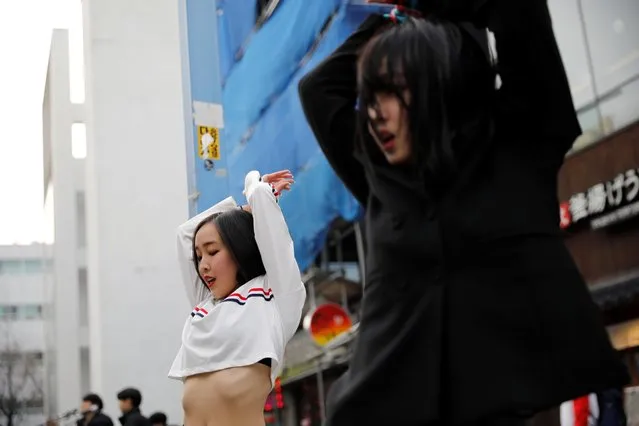
Japanese Yuuka Hasumi, 17, and Ibuki Ito, 17, also from Japan, who want to become K-pop stars, perform during their street performance in Hongdae area of Seoul, South Korea, March 21, 2019. Hasumi put high school in Japan on hold and flew to South Korea in February to try her chances at becoming a K-pop star, even if that means long hours of vocal and dance training, no privacy, no boyfriend, and even no phone. “It is tough”, Hasumi said. “Going through a strict training and taking my skill to a higher level to a perfect stage, I think that's when it is good to make a debut”. (Photo by Kim Hong-Ji/Reuters)

Japanese Yuuka Hasumi, 17, and Ibuki Ito, 17, also from Japan, who want to become K-pop stars, perform during their street performance in Hongdae area of Seoul, South Korea, March 21, 2019. (Photo by Kim Hong-Ji/Reuters)
Details
28 Feb 2021 10:09:00
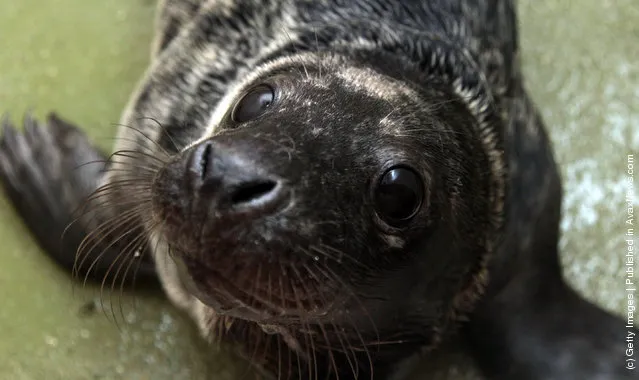
A recently rescued grey seal pup looks up from its indoor kennel at the RSPCA West Hatch Wildlife Centre

A recently rescued grey seal pup looks up from its indoor kennel at the RSPCA West Hatch Wildlife Centre on January 9, 2012 in Taunton, England. The centre is currently dealing with a number of mainly grey seals that have been rescued from the coast due to the recent storms. Staff at the centre hope to release all the seals back into the wild by the spring. (Photo by Matt Cardy/Getty Images)
Details
10 Jan 2012 13:34:00
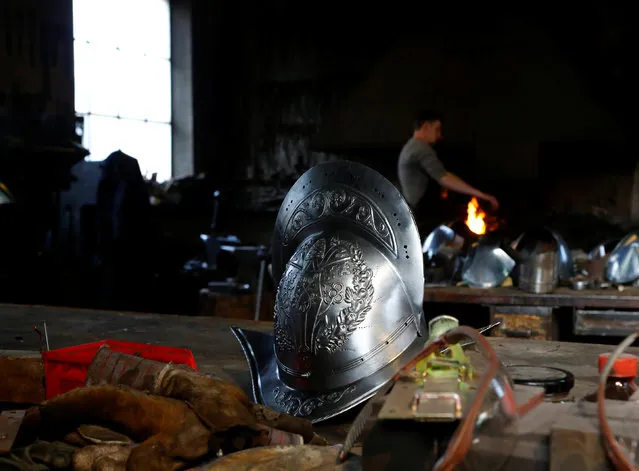
Blacksmith Johann Schmidberger works on a suit of armour for the Vatican's Swiss Guards at his workshop in Molln, Austria, March 29, 2017. (Photo by Leonhard Foeger/Reuters)

Blacksmith Johann Schmidberger works on a suit of armour for the Vatican's Swiss Guards at his workshop in Molln, Austria, March 29, 2017. Austrian blacksmiths who produce ceremonial suits of armour for the Vatican's Swiss Guards are close to the end of their current deal to do so, and say supplying the suits will not now be an issue for many years to come. One of the drawbacks of the Swiss Guards' medieval uniforms is that the craftsmanship needed to make them is disappearing. (Photo by Leonhard Foeger/Reuters)
Details
06 Apr 2017 09:08:00
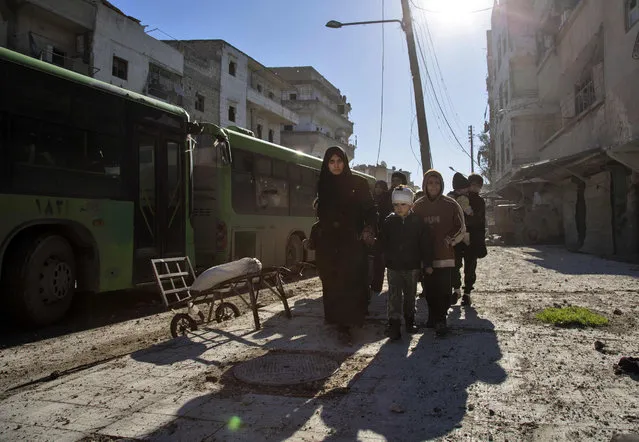
Syrians gather during an evacuation operation of rebel fighters and their families  from rebel-held neighbourhoods on December 15, 2016 in the embattled city of Aleppo. A convoy of ambulances and buses left rebel territory in Aleppo in the first evacuations under a deal for opposition fighters to leave the city after years of fighting. The rebel withdrawal will pave the way for President Bashar al-Assad's forces to reclaim complete control of Syria's second city, handing the regime its biggest victory in more than five years of civil war. (Photo by Karam Al-Masri/AFP Photo)

Syrians gather during an evacuation operation of rebel fighters and their families from rebel-held neighbourhoods on December 15, 2016 in the embattled city of Aleppo. A convoy of ambulances and buses left rebel territory in Aleppo in the first evacuations under a deal for opposition fighters to leave the city after years of fighting. The rebel withdrawal will pave the way for President Bashar al-Assad's forces to reclaim complete control of Syria's second city, handing the regime its biggest victory in more than five years of civil war. (Photo by Karam Al-Masri/AFP Photo)
Details
18 Dec 2016 08:18:00
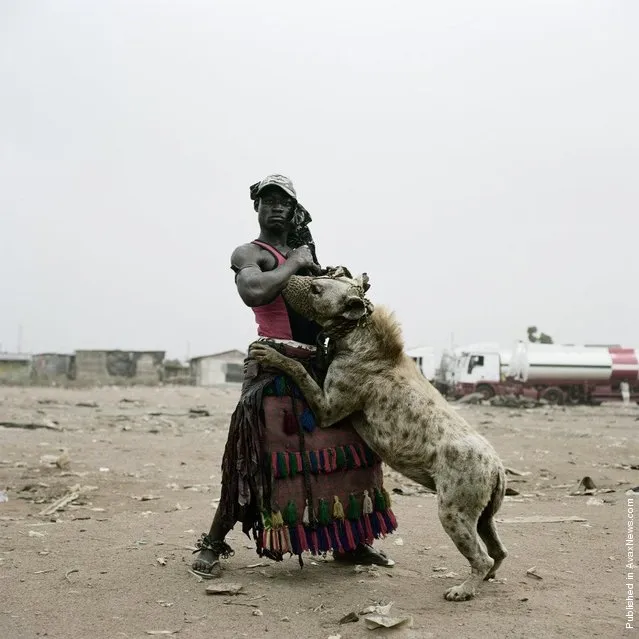
Abdullahi Mohammed with Mainasara, Ogere-Remo, Nigeria 2007

“Pieter Hugo was born 1976 and grew up in Cape Town, South Africa. He is a South African photographer who primarily works in portraiture and whose work engages with both documentary and art traditions with a focus on African communities. His most recognized work is the series called “The Hyena & Other Men” and which was published as a monograph. It has received a great deal of attention. Hugo won first prize in the Portraits section of the World Press Photo 2005 for a portrait of a man with a hyena”. – Wikipedia

Photo: Abdullahi Mohammed with Mainasara, Ogere-Remo, Nigeria 2007. (Photo by Pieter Hugo)
Details
24 Apr 2012 13:03:00
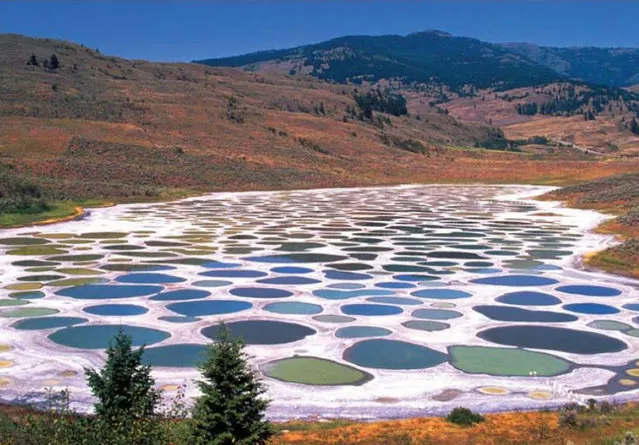
Kliluk, the Spotted Lake, Canada

Originally known to the First Nations of the Okanagan Valley as Khiluk, which was- and remains today revered as a sacred site producing therapeutic waters. During World War I the minerals of Spotted Lake were used in manufacturing ammunition. Later the area came under the control of the Ernest Smith Family, for a term of about 40 years. In 1979 Smith attempted to create interest in a spa at the lake. The First Nations responded with an effort to buy the lake; in October 2001 they finally struck a deal. First Nations arranged the purchase of 22 hectares of land for a total of $720,000, and contributed about 20% of the cost. The Indian Affairs Department paid the remainder.
Details
06 Mar 2015 12:59:00
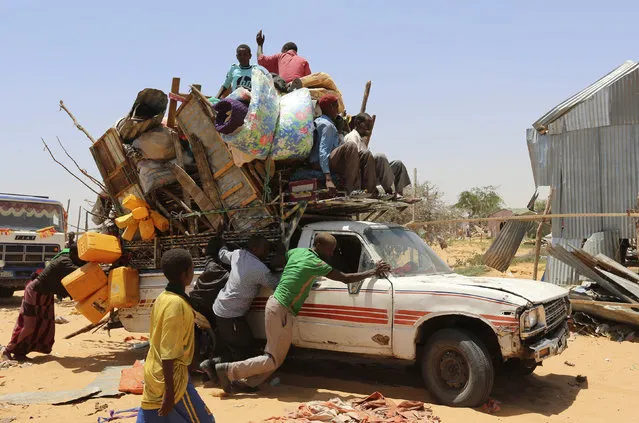
More than 6 billion people live in countries where serious levels of public sector corruption are fueling inequality and exploitation, according to Transparency International's 2015 index of perceived public sector corruption. The group's annual report measures perceptions of corruption due to the secrecy surrounding most corrupt dealings. Two thirds of the 168 countries assessed were identified as having a serious corruption problem. Somalia, which has been mired in conflict since civil war broke out in 1991, ranks bottom of the list. (Photo by Feisal Omar/Reuters)

More than 6 billion people live in countries where serious levels of public sector corruption are fueling inequality and exploitation, according to Transparency International's 2015 index of perceived public sector corruption. The group's annual report measures perceptions of corruption due to the secrecy surrounding most corrupt dealings. Two thirds of the 168 countries assessed were identified as having a serious corruption problem. Somalia, which has been mired in conflict since civil war broke out in 1991, ranks bottom of the list. (Photo by Feisal Omar/Reuters)
Details
13 May 2016 12:10:00