Loading...
Done
In this February 7, 2014 file photo, Matt Figi hugs and tickles his once severely-ill seven year old daughter Charlotte, as they walk together inside a greenhouse for a special strain of medical marijuana known as Charlotte's Web, which was named after the girl early in her treatment for crippling severe epilepsy, in the mountains west of Colorado Springs, Colo. (Photo by Brennan Linsley/AP Photo)

In this February 7, 2014 file photo, Matt Figi hugs and tickles his once severely-ill seven year old daughter Charlotte, as they walk together inside a greenhouse for a special strain of medical marijuana known as Charlotte's Web, which was named after the girl early in her treatment for crippling severe epilepsy, in the mountains west of Colorado Springs, Colo. Colorado is poised to award more than $8 million for medical marijuana research, a step toward addressing complaints that little is known about pot's medical potential. Among the research projects poised for approval on Wednesday, December 17, 2014, are one for pediatric epilepsy patients, and another for children with brain tumors. (Photo by Brennan Linsley/AP Photo)
Details
29 Dec 2014 13:12:00
An engineer (L) talks to a driver of a dump truck loaded with gold-bearing soil at the Vostochny opencast of the Olimpiada gold operation, owned by Polyus Gold International company, in Krasnoyarsk region, Eastern Siberia, Russia, June 30, 2015. (Photo by Ilya Naymushin/Reuters)

An engineer (L) talks to a driver of a dump truck loaded with gold-bearing soil at the Vostochny opencast of the Olimpiada gold operation, owned by Polyus Gold International company, in Krasnoyarsk region, Eastern Siberia, Russia, June 30, 2015. Polyus Gold International is the largest gold producer in Russia and one of the top 10 gold miners globally by ounces produced, according to the official web site of the company. Olimpiada is Polyus Gold's largest operation. (Photo by Ilya Naymushin/Reuters)
Details
04 Jul 2015 11:12:00
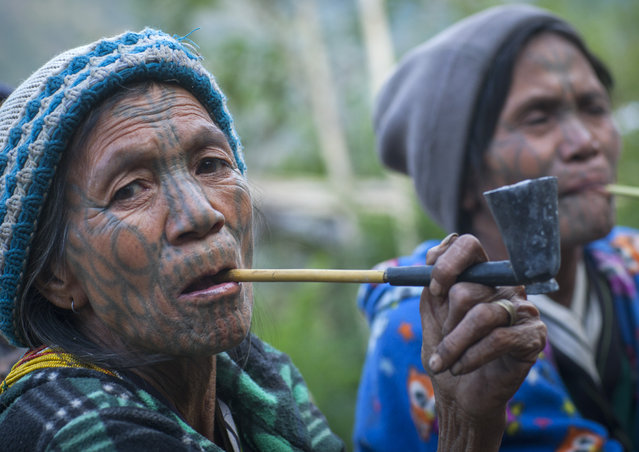
A group of tattooed women from the Muun tribe who inhabit the hills of the Arakan state. The design, known as the letter B-pattern, is common in the Mindat area. It is composed of dots, lines and occasionally circles, in February, 2015, in Myanmar, Burma. (Photo by Eric Lafforgue/Barcroft Media)

A group of tattooed women from the Muun tribe who inhabit the hills of the Arakan state. The design, known as the letter B-pattern, is common in the Mindat area. It is composed of dots, lines and occasionally circles, in February, 2015, in Myanmar, Burma. With spider webs, B-patterns and crossed lines painstakingly inked on their faces these stunning photographs show the tattooed women of Burma. French photographer Eric Lafforgue travelled to the Chin, Rakhine and Arakan states of northwestern Myanmar to capture the rare facial designs. (Photo by Eric Lafforgue/Barcroft Media)
Details
16 Mar 2015 10:54:00
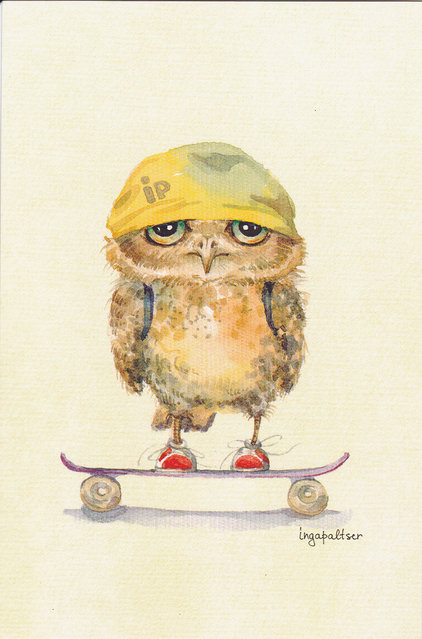
Owlets By Inga Paltser

Inga Paltser is a young painter from Severodvinsk known for her watercolor illustrations and paintings of owls. Inga prefers working with paper, but sometimes also creates on textile, wood, and canvas. She started painting in her childhood at the local school of arts. However, after high school Inga decided to become a biologist and now she works as a researcher. Even though art hasn’t become her profession, Inga finds time to create wonderful paintings presented on this website. Her first owls were painted spontaneously – Inga decided to utilize small pieces of watercolor and pastel paper and created two cute owls called “Friends”. Inga’s owls instantly received recognition across the web and social networks and now are greatly loved by thousands of people around the world.
Details
18 Nov 2013 10:08:00
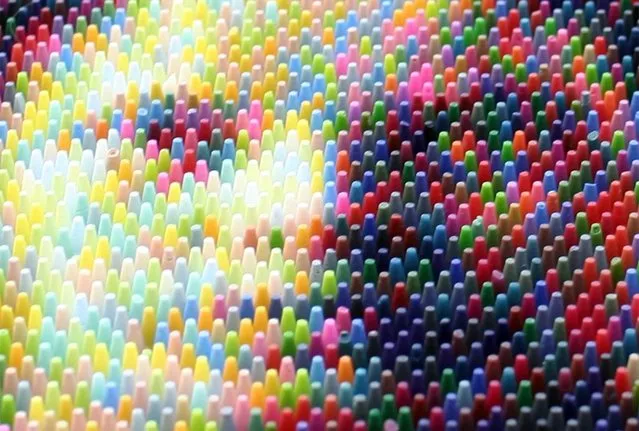
Art by Christian Faur

Christian Faur is an artist based in Granville, Ohio. Looking for a new technique, he experimented with painting with wax, but he didn’t feel the results were satisfactory.Then, at Christmas in 2005, his young daughter opened a box of 120 Crayola crayons he’d bought her, and everything clicked into place. Faur decided he would create pictures out of the crayons themselves, packing thousands of them together so they become like the colored pixels on a TV screen. He starts each work by scanning a photo into a computer and breaking the image down into colored blocks He then draws a grid that shows him exactly where to place each crayon The finished artworks are packed tightly into wooden frames. He actually makes the crayons himself, hand-casting each one in a mould.
Details
28 Jul 2012 10:03:00
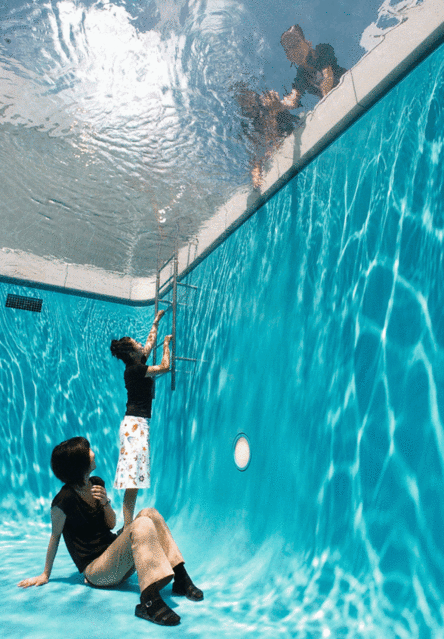
Swimming Pool Art Installation by Leandro Erlich

In one of the Museum’s courtyards is a swimming pool framed by a limestone deck. When seen from the deck, the pool appears to be filled with deep, shimmering water. In fact, however, a layer of water only some 10 centimeters deep is suspended over transparent glass. Below the glass is an empty space with aquamarine walls that viewers can enter. The work sets up an unfolding sequence of experiences—we view the pool through the glass wall enclosing the courtyard; from the deck, looking down into the pool; and from the interior of the pool, looking up. The Swimming Pool might hence be considered a place where, slowly, with time, different perspectives and perceptions of self and others all come to intersect.
Details
25 Aug 2012 07:31:00
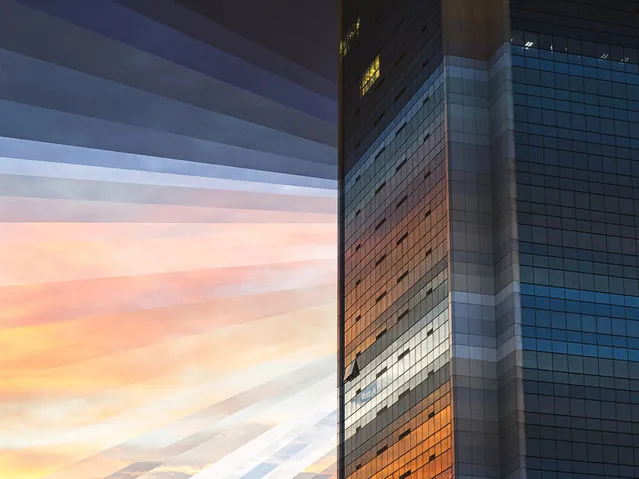
A glass building mirrors the sky in Singapore as the sun goes down over the city. (Photo by Fong Qi Wei/Thoughtful Photography)

Intrigued by photographing time, Singapore-based photographer Fong Qi Wei created single, composite pictures from a sequence of images spanning 2-4 hours. He concentrated on capturing sunrises and sunsets as they evolved over different landscapes, seascapes, and cityscapes. He then digitally stitched the images together to get a snapshot of time passing over the scene for his series “Time is a Dimension”. “Most paintings and photographs are an instance of time”, Wei explained in his artist’s statement. “That’s not the way the world works. We experience a sequence of time, and that’s why a video is somehow more compelling than a freeze frame”. (Photo by Fong Qi Wei/Thoughtful Photography)
Details
19 Aug 2014 10:28:00
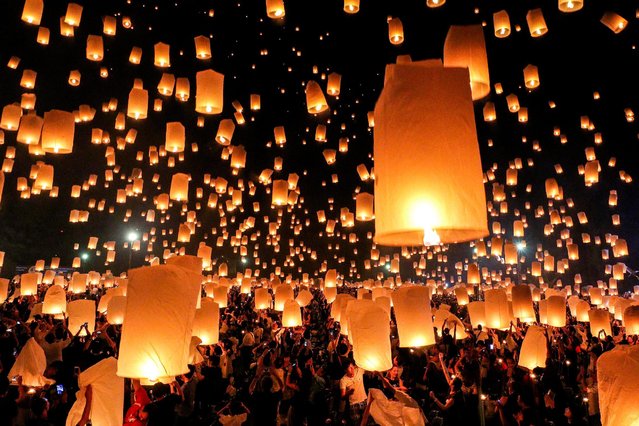
People release floating lanterns during the festival of Yee Peng in the northern capital of Chiang Mai, Thailand November 14, 2016. Yi Peng refers to the full moon day in the second month according to the Lanna lunar calendar (the twelfth month according to the Thai lunar calendar). Swarms of Lanna-style sky lanterns are launched into the air where they resemble large shoals of giant fluorescent jellyfish gracefully floating through the sky. The festival is meant as a time for tham bun, to make merit. Khom loi are made from a thin fabric, such as rice paper, stretched over a bamboo or wire frame, to which a candle or fuel cell is attached. When the fuel cell is lit, the resulting hot air is trapped inside the lantern and creates enough lift for the khom loi to float up into the sky. (Photo by Athit Perawongmetha/Reuters)

People release floating lanterns during the festival of Yee Peng in the northern capital of Chiang Mai, Thailand November 14, 2016. Yi Peng refers to the full moon day in the second month according to the Lanna lunar calendar (the twelfth month according to the Thai lunar calendar). Swarms of Lanna-style sky lanterns are launched into the air where they resemble large shoals of giant fluorescent jellyfish gracefully floating through the sky. The festival is meant as a time for tham bun, to make merit. Khom loi are made from a thin fabric, such as rice paper, stretched over a bamboo or wire frame, to which a candle or fuel cell is attached. When the fuel cell is lit, the resulting hot air is trapped inside the lantern and creates enough lift for the khom loi to float up into the sky. (Photo by Athit Perawongmetha/Reuters)
Details
15 Nov 2016 11:54:00