Loading...
Done
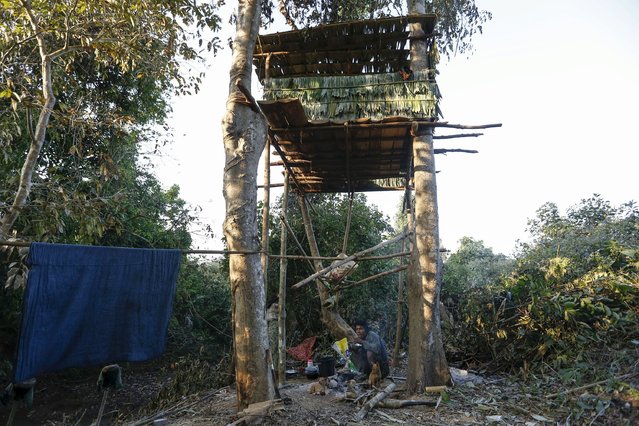
A man eats a meal under his tree house, which acts as a shelter from wild elephants, in Gwe Cho village, Shwe Taung Yan township Ayeyarwady division January 18, 2016. (Photo by Soe Zeya Tun/Reuters)

A man eats a meal under his tree house, which acts as a shelter from wild elephants, in Gwe Cho village, Shwe Taung Yan township Ayeyarwady division January 18, 2016. Wild elephants are driving villagers in a Myanmar township to seek refuge while the animals storm their rice paddies, in Ayeyarwady in the Delta region, West of Yangon. (Photo by Soe Zeya Tun/Reuters)
Details
20 Jan 2016 08:05:00
An ice covered entrance door to the international gene bank Svalbard Global Seed Vault (SGSV) near Longyearbyen on Spitsbergen, Norway, October 20, 2015. (Photo by Anna Filipova/Reuters)

An ice covered entrance door to the international gene bank Svalbard Global Seed Vault (SGSV) near Longyearbyen on Spitsbergen, Norway, October 20, 2015. Two consignments of crop seeds will be deposited next year in a “doomsday vault” built in an Arctic mountainside to safeguard global supplies. The vault, which opened on the Svalbard archipelago in 2008, is designed to protect crop seeds, such as beans, rice and wheat against the worst cataclysms of nuclear war or disease. (Photo by Anna Filipova/Reuters)
Details
17 Dec 2015 08:01:00
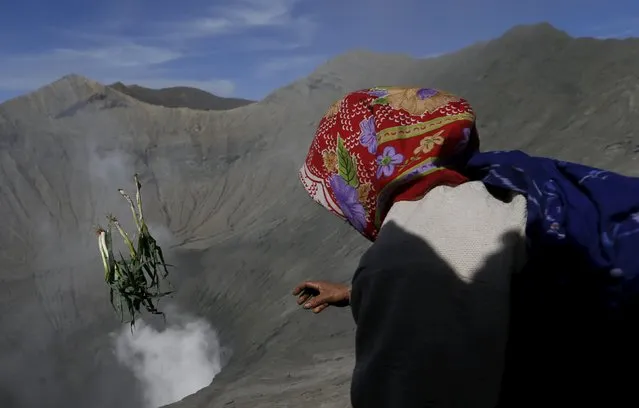
A Hindu worshipper throws vegetables into the crater as offerings during the Kasada Festival at Mount Bromo in Probolinggo, Indonesia's East Java province, August 1, 2015. (Photo by Reuters/Beawiharta)

A Hindu worshipper throws vegetables into the crater as offerings during the Kasada Festival at Mount Bromo in Probolinggo, Indonesia's East Java province, August 1, 2015. Every year people gather for the annual festival where offerings of rice, fruit, vegetables, livestock or money are made to Hindu gods at the active volcano to ask for blessings and assure a bountiful harvest. (Photo by Reuters/Beawiharta)
Details
02 Aug 2015 12:34:00
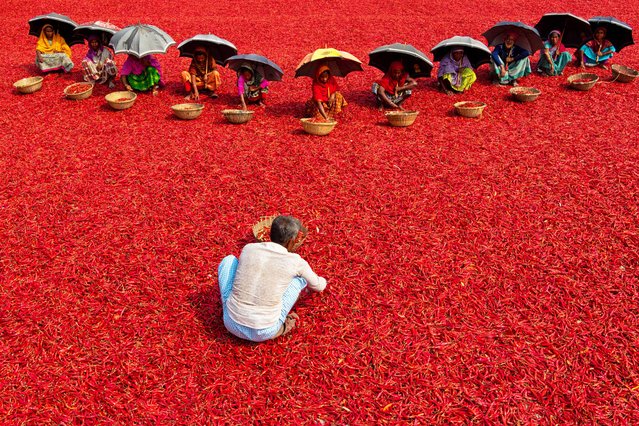
Rows of workers shelter under umbrellas from the scorching heat as they painstakingly sort through a red carpet of millions of chilli peppers in Bogra, Bangladesh on October 3, 2023. They sort the rotten and broken chilli peppers out to separate the poor quality ones which won't sell. In a line, the pickers who are paid less than £3 for a 10-hour shift slowly move forward with their baskets to separate the bad from the good after the chilies have been dried in the sun for a week. The dried & sorted chillies are then packaged and taken to the local market where they are brought mainly by companies to be made into chilli powder. The workers sort them in a warm environment, with temperatures reaching up to 45°C. More than 5,000 people work in almost 100 chilli farms in the Bogra district of Bangladesh to supply local spice companies with chillies for their recipes. Known as “Lal Morich” to the locals, chilli peppers are a major part of Bengali cuisine and are used as part of a combination of spices for various meat dishes, including chicken and beef. (Photo by Joy Saha/Rex Features/Shutterstock)

Rows of workers shelter under umbrellas from the scorching heat as they painstakingly sort through a red carpet of millions of chilli peppers in Bogra, Bangladesh on October 3, 2023. They sort the rotten and broken chilli peppers out to separate the poor quality ones which won't sell. In a line, the pickers who are paid less than £3 for a 10-hour shift slowly move forward with their baskets to separate the bad from the good after the chilies have been dried in the sun for a week. (Photo by Joy Saha/Rex Features/Shutterstock)
Details
21 Oct 2023 04:04:00
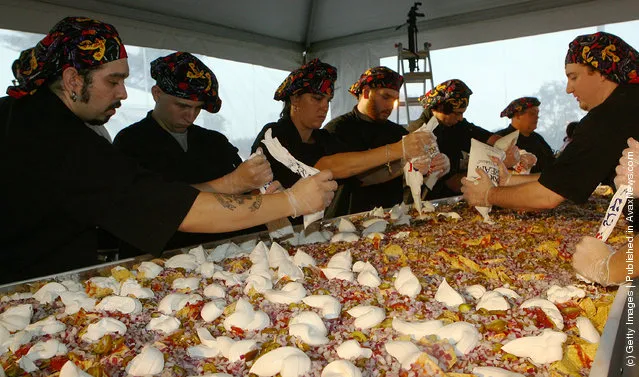
Guinness World Records World's Largest Nachos

“Nachos are a popular corn based food of Mexican origin associated with Tex-Mex cuisine that can be either made quickly to serve as a snack or prepared with more ingredients to make a full meal. In their simplest form, nachos are tortilla chips or totopos covered in melted cheese and salsa. First created circa 1943 by Ignacio "Nacho" Anaya, the original nachos consisted of fried corn tortillas covered with melted cheddar cheese and pickled jalapeño peppers”. – Wikipedia

Photo: Workers put the finishing touches on the nachos as Ninety Nine Restaurants in Billerica, Massachusetts set a new world record by creating the Guinness World Records World's Largest Nachos, weighing in at 3,999 lbs on October 1, 2011 in Billerica, Massachusetts. (Photo by Gail Oskin/Getty Images for Ninety Nine Restaurants)
Details
03 Oct 2011 09:31:00
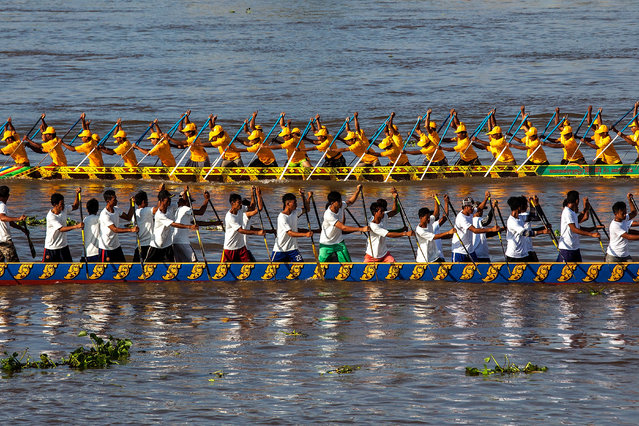
Boat crew members train on the waters of the Tonle Sap River on the morning of the first day of the Water Festival on November 13, 2016 in Phnom Penh, Cambodia. The yearly three-day Water Festival is one of the most important holidays in Cambodia and celebrates the end of the rainy season and the start of the rice harvesting. The Festival also coincides with the Tonle Sap river reversing course, which it does twice a year. Approximately 2 million people are expected to attend this year's festival, during which 259 boats and nearly 20,000 oarsmen will participate in the races. After a fatal stampede resulting in the death of some 353 people during the Water Festival in 2010, it has been cancelled four times over the past five years, with weather used as an official excuse. (Photo by Omar Havana/Getty Images)

Boat crew members train on the waters of the Tonle Sap River on the morning of the first day of the Water Festival on November 13, 2016 in Phnom Penh, Cambodia. The yearly three-day Water Festival is one of the most important holidays in Cambodia and celebrates the end of the rainy season and the start of the rice harvesting. The Festival also coincides with the Tonle Sap river reversing course, which it does twice a year. Approximately 2 million people are expected to attend this year's festival, during which 259 boats and nearly 20,000 oarsmen will participate in the races. After a fatal stampede resulting in the death of some 353 people during the Water Festival in 2010, it has been cancelled four times over the past five years, with weather used as an official excuse. (Photo by Omar Havana/Getty Images)
Details
15 Nov 2016 11:26:00
Camp director and “duck walk” inventor Rodin Gilbert Flores, 2nd R) teaches aspiring beauty queens how to “duck walk” at a beauty boot camp in Manila in this picture taken on March 8, 2015. From wading in muddy Philippine rice paddies, former housemaid Janicel Lubina now struts down runways for the country's top designers, and is poised to be crowned among the world's most beautiful. (Photo by Noel Celis/AFP Photo)

Camp director and “duck walk” inventor (Rodin Gilbert Flores, 2nd R) teaches aspiring beauty queens how to “duck walk” at a beauty boot camp in Manila in this picture taken on March 8, 2015. From wading in muddy Philippine rice paddies, former housemaid Janicel Lubina now struts down runways for the country's top designers, and is poised to be crowned among the world's most beautiful. Lubina is a star recruit in one of Manila's beauty pageant boot camps, where shy, lanky teenage girls from remote farming provinces are transformed into poised Barbie dolls who can preach about world peace in six-inch heels. (Photo by Noel Celis/AFP Photo)
Details
15 Mar 2015 06:51:00
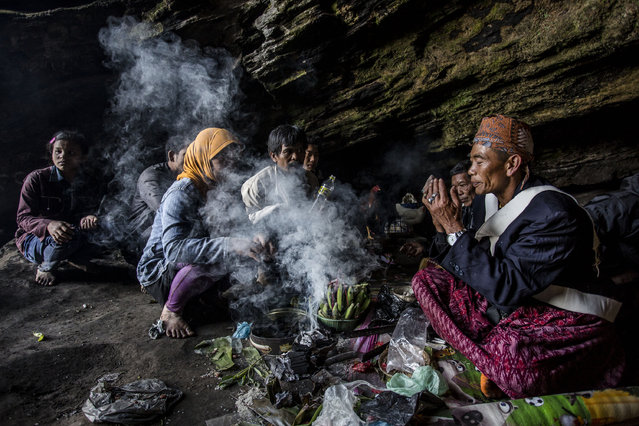
A Tenggerese shaman praying for worshippers at Widodaren cave during the Tenggerese Hindu Yadnya Kasada festival on July 31, 2015 in Probolinggo, East Java, Indonesia. The festival is the main festival of the Tenggerese people and lasts about a month. On the fourteenth day, the Tenggerese make the journey to Mount Bromo to make offerings of rice, fruits, vegetables, flowers and livestock to the mountain gods by throwing them into the volcano's caldera. (Photo by Ulet Ifansasti/Getty Images)

A Tenggerese shaman praying for worshippers at Widodaren cave during the Tenggerese Hindu Yadnya Kasada festival on July 31, 2015 in Probolinggo, East Java, Indonesia. The festival is the main festival of the Tenggerese people and lasts about a month. On the fourteenth day, the Tenggerese make the journey to Mount Bromo to make offerings of rice, fruits, vegetables, flowers and livestock to the mountain gods by throwing them into the volcano's caldera. The origin of the festival lies in the 15th century when a princess named Roro Anteng started the principality of Tengger with her husband Joko Seger, and the childless couple asked the mountain Gods for help in bearing children. The legend says the Gods granted them 24 children but on the provision that the 25th must be tossed into the volcano in sacrifice. The 25th child, Kesuma, was finally sacrificed in this way after initial refusal, and the tradition of throwing sacrifices into the caldera to appease the mountain Gods continues today. (Photo by Ulet Ifansasti/Getty Images)

Details
01 Aug 2015 12:07:00