Loading...
Done
A man carries a bag on his back in Guangzhou, Guangdong province, January 26, 2016. According to traffic police, over 2.9 billion trips will be made around China during the 40-day Spring Festival travel rush, which started on January 24. (Photo by Reuters/Stringer)

A man carries a bag on his back in Guangzhou, Guangdong province, January 26, 2016. According to traffic police, over 2.9 billion trips will be made around China during the 40-day Spring Festival travel rush, which started on January 24. (Photo by Reuters/Stringer)
Details
30 Jan 2016 13:00:00
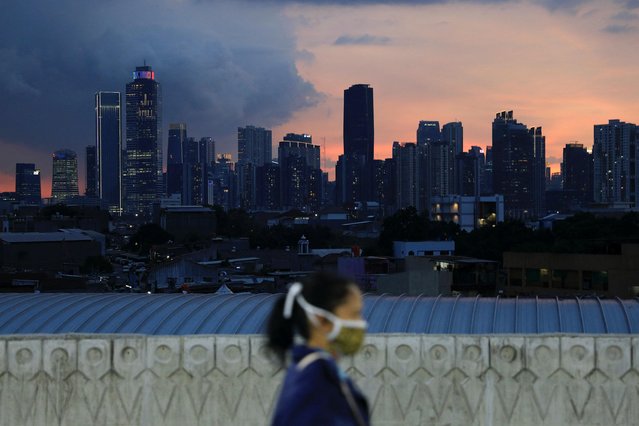
A woman wearing a protective mask walks through a platform of a train station during the afternoon rush hours as the Omicron variant continues to spread, amid the coronavirus disease (COVID-19) pandemic, in Jakarta, Indonesia, January 3, 2022. (Photo by Willy Kurniawan/Reuters)

A woman wearing a protective mask walks through a platform of a train station during the afternoon rush hours as the Omicron variant continues to spread, amid the coronavirus disease (COVID-19) pandemic, in Jakarta, Indonesia, January 3, 2022. (Photo by Willy Kurniawan/Reuters)
Details
22 Jan 2022 06:28:00
Gold granules are displayed at the Prioksky Non-Ferrous Metals Plant in Kasimov, Russia February 14, 2017. (Photo by Sergei Karpukhin/Reuters)

Gold granules are displayed at the Prioksky Non-Ferrous Metals Plant in Kasimov, Russia February 14, 2017. (Photo by Sergei Karpukhin/Reuters)
Details
18 Feb 2017 00:04:00
Avenue of the Baobabs

The Avenue or Alley of the Baobabs is a prominent group of baobab trees lining the dirt road between Morondava and Belon'i Tsiribihina in the Menabe region in western Madagascar. Its striking landscape draws travelers from around the world, making it one of the most visited locations in the region. It has been a center of local conservation efforts, and was granted temporary protected status in July 2007 by the Ministry of Environment, Water and Forests, the first step toward making it Madagascar's first natural monument.
Details
16 Nov 2012 10:05:00
A 'Double Eagle' gold twenty dollar coin

“A Double Eagle is a gold coin of the United States with a denomination of $20. (Its gold content of 0.9675 troy oz was worth $20 at the then official price of $20.67/oz). The coins are made from a 90% gold (0.900 fine = 21.6 kt) and 10% copper alloy”. – Wikipedia

Photo: A “Double Eagle” gold twenty dollar coin is displayed above a catalogue picture showing the reverse side of the coin at Goldsmith's Hall on March 2, 2012 in London, England. Nearly half a million of these coins were originally minted in the midst of the Great Depression in the US. Only 13 are known today after the rest were melted down before they ever left the US Mint, sacrificed as part of a strategy to stabalise the American economy. In 2002 a Double Eagle sold at auction for $7.6 million. (Photo by Peter Macdiarmid/Getty Images)
Details
03 Mar 2012 10:37:00
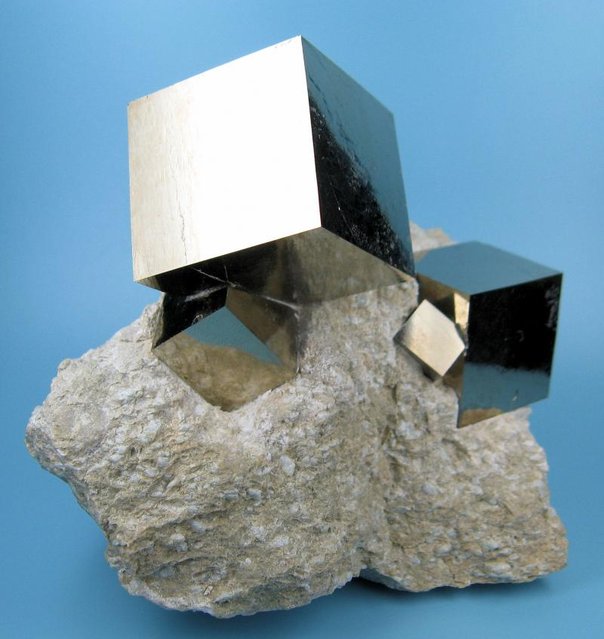
Pyrite Cubic Crystals

The mineral pyrite, or iron pyrite, also known as fool's gold, is an iron sulfide with the formula FeS2. This mineral's metallic luster and pale brass-yellow hue give it a superficial resemblance to gold, hence the well-known nickname of fool's gold. The color has also led to the nicknames brass, brazzle, and Brazil, primarily used to refer to pyrite found in coal.
In crystallography, the cubic (or isometric) crystal system is a crystal system where the unit cell is in the shape of a cube. This is one of the most common and simplest shapes found in crystals and minerals.
Details
23 Nov 2013 13:31:00
This breathtaking natural light show illuminating waters off the British coast looks like something out of hit film “Close Encounters of the Third Kind”. Photographer Adrian Campfield was out having dinner at a restaurant at Beachy Head, East Sussex, when the rays suddenly appeared. The 59-year-old and his wife Louise rushed outside onto the 535ft high cliffs to watch the spectacle. (Photo by Adrian Campfield/Solent/Visual Press Agency)

This breathtaking natural light show illuminating waters off the British coast looks like something out of hit film “Close Encounters of the Third Kind”. Photographer Adrian Campfield was out having dinner at a restaurant at Beachy Head, East Sussex, when the rays suddenly appeared. The 59-year-old and his wife Louise rushed outside onto the 535ft high cliffs to watch the spectacle. Mr Campfield, a former graphic designer, from Bexley, Kent, said the light was “changing all the time” for more than 15 minutes. (Photo by Adrian Campfield/Solent/Visual Press Agency)
Details
30 Sep 2014 09:16:00
People take photos of hotel room lights shaping the word “Zero”, referring to Covid-19 cases, in Taipei, Taiwan, 17 April 2020. According to news reports Taiwan records no new COVID-19 cases for third time this week. Medical experts are rushing to develop a vaccine for the COVID-19 disease caused by the SARS-CoV-2 coronavirus and advising people to practice social distancing and proper hygiene. (Photo by David Chang/EPA/EFE/Rex Features/Shutterstock)

People take photos of hotel room lights shaping the word “Zero”, referring to Covid-19 cases, in Taipei, Taiwan, 17 April 2020. According to news reports Taiwan records no new COVID-19 cases for third time this week. Medical experts are rushing to develop a vaccine for the COVID-19 disease caused by the SARS-CoV-2 coronavirus and advising people to practice social distancing and proper hygiene. (Photo by David Chang/EPA/EFE/Rex Features/Shutterstock)
Details
19 Apr 2020 00:07:00