Loading...
Done
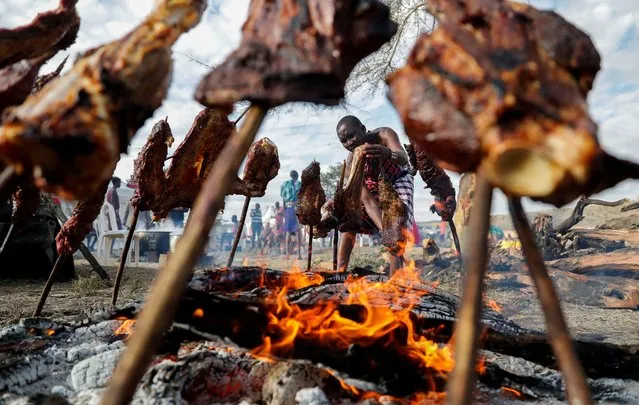
David Pariken 46, of the indigenous Maasai community, roasts meat at the inaugural Maa Cultural Week dubbed The Maa-Festival aimed to promote peace, tourism, and cultural exchange as the wildebeests (Connochaetes taurinus) make their annual cross border migration at the Sekenani village, in the Maasai Mara National Reserve, in Narok County, Kenya on August 22, 2023. (Photo by Thomas Mukoya/Reuters)

David Pariken 46, of the indigenous Maasai community, roasts meat at the inaugural Maa Cultural Week dubbed The Maa-Festival aimed to promote peace, tourism, and cultural exchange as the wildebeests (Connochaetes taurinus) make their annual cross border migration at the Sekenani village, in the Maasai Mara National Reserve, in Narok County, Kenya on August 22, 2023. (Photo by Thomas Mukoya/Reuters)
Details
07 Sep 2023 02:53:00
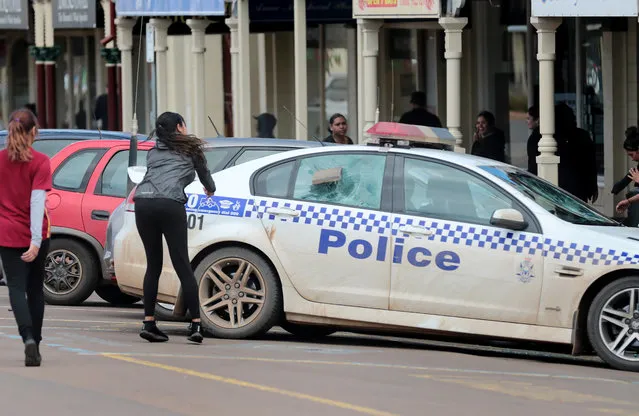
“After the death of a teenager (14-year-old Elijah Doughty), hundreds of Indigenous locals took to the streets of Kalgoorlie to vent their anger. Danella Bevis captures the grief and outrage of a family and a community. There is raw aggression in an eruption of racial tensions and violence, and in stark contrast she concludes the narrative with a moment of quiet beauty at a dusk vigil”. (Photo by Danella Bevis/The Walkley Foundation)

“After the death of a teenager (14-year-old Elijah Doughty), hundreds of Indigenous locals took to the streets of Kalgoorlie to vent their anger. Danella Bevis captures the grief and outrage of a family and a community. There is raw aggression in an eruption of racial tensions and violence, and in stark contrast she concludes the narrative with a moment of quiet beauty at a dusk vigil”. (Photo by Danella Bevis/The Walkley Foundation)
Details
17 Oct 2016 10:20:00
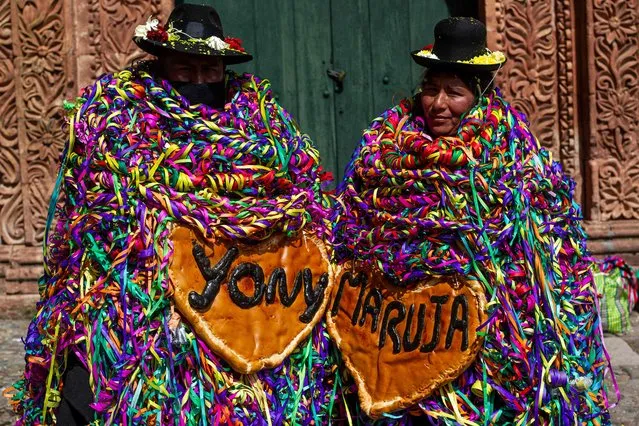
Aymara indigenous people celebrate the “Roscasiri”, the change of command of local authorities, in Pomata District, one of seven districts of the Chucuito Province in the Puno Region, southern Peru, on January 1, 2022. This ancient Aymara event, in which people adorn themselves with breads and fruits that represent abundance for the new year, celebrates the change of command of local authorities. (Photo by Carlos Mamani/AFP Photo)

Aymara indigenous people celebrate the “Roscasiri”, the change of command of local authorities, in Pomata District, one of seven districts of the Chucuito Province in the Puno Region, southern Peru, on January 1, 2022. This ancient Aymara event, in which people adorn themselves with breads and fruits that represent abundance for the new year, celebrates the change of command of local authorities. (Photo by Carlos Mamani/AFP Photo)
Details
03 Jan 2022 08:44:00
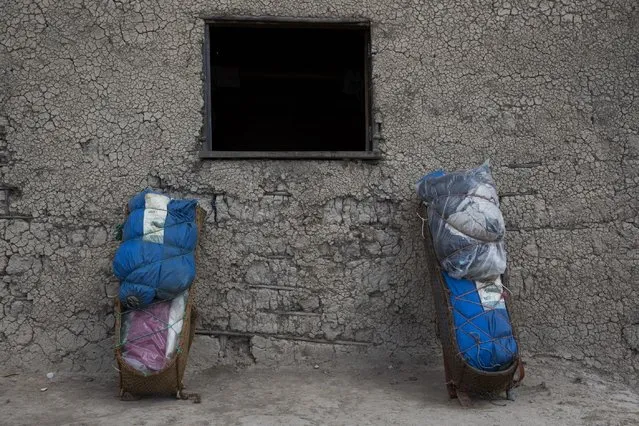
Indigenous woven backpacks called guayare are seen in front of a house in Paraitepui village, before a walking excursion to Mount Roraima, near Venezuela's border with Brazil January 13, 2015. A mysterious table-topped mountain on the Venezuela-Brazil border that perplexed 19th century explorers and inspired “The Lost World” novel is attracting ever more modern-day adventurers. (Photo by Carlos Garcia Rawlins/Reuters)

Indigenous woven backpacks called guayare are seen in front of a house in Paraitepui village, before a walking excursion to Mount Roraima, near Venezuela's border with Brazil January 13, 2015. A mysterious table-topped mountain on the Venezuela-Brazil border that perplexed 19th century explorers and inspired “The Lost World” novel is attracting ever more modern-day adventurers. (Photo by Carlos Garcia Rawlins/Reuters)
Details
04 Feb 2015 12:09:00
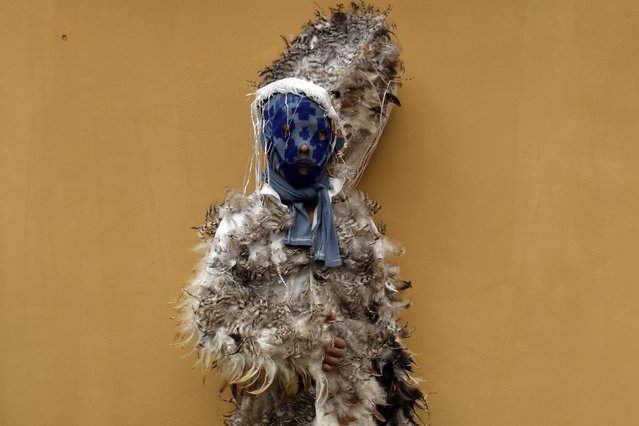
Francisco Solano poses for a photo in his bird-feather suit after attending a Mass commemorating the feast day of St. Francis Solano, in Emboscada, Paraguay, Friday, July 24, 2015. Some 500 people attended the festivity - a mix of indigenous and Guarani Indian beliefs. The festival begins with a Mass, continues with a procession of the diminutive wooden statue of St. Francis, and ends with people dancing in suits made with black, white, brown and grey feathers. (Photo by Jorge Saenz/AP Photo)

Francisco Solano poses for a photo in his bird-feather suit after attending a Mass commemorating the feast day of St. Francis Solano, in Emboscada, Paraguay, Friday, July 24, 2015. Some 500 people attended the festivity – a mix of indigenous and Guarani Indian beliefs. The festival begins with a Mass, continues with a procession of the diminutive wooden statue of St. Francis, and ends with people dancing in suits made with black, white, brown and grey feathers. (Photo by Jorge Saenz/AP Photo)
Details
26 Jul 2015 10:58:00
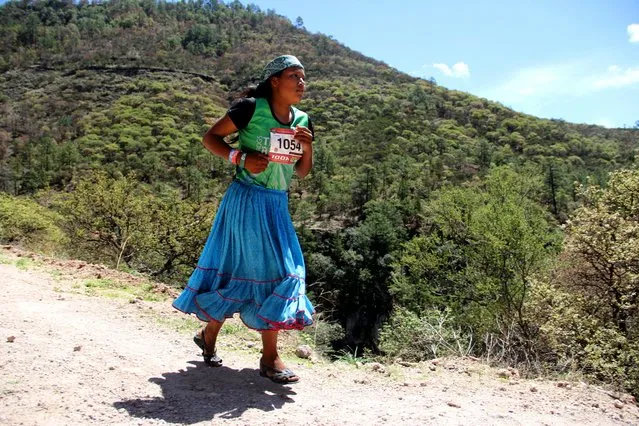
A Raramuris indigenous woman takes part in the “Ultra maraton de los Canones 2017” (Ultra marathon of the Canyons), at La Sinforosa Canyon, in Guachochi, Chihuahua state, Mexico on July 15, 2017. More than 600 participants from different countries take part in the 63 and 100 kilometers races, along the Tarahumara mountain range. (Photo by Herika Martinez/AFP Photo)

A Raramuris indigenous woman takes part in the “Ultra maraton de los Canones 2017” (Ultra marathon of the Canyons), at La Sinforosa Canyon, in Guachochi, Chihuahua state, Mexico on July 15, 2017. More than 600 participants from different countries take part in the 63 and 100 kilometers races, along the Tarahumara mountain range. (Photo by Herika Martinez/AFP Photo)
Details
17 Jul 2017 08:21:00
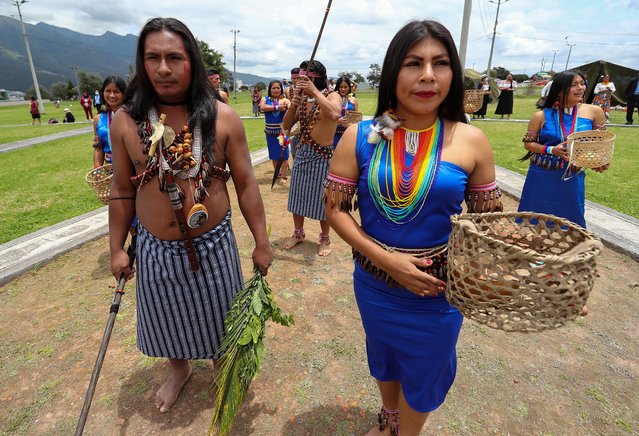
Ecuadorian indigenous people celebrate the festival of the moon or Kulla Raymi, in Quito, Ecuador, 21 September 2021. A circle on the ground made up of fruits and inside the Andean symbol of the chacana, multinational geometric flags and a cross that symbolizes the four cardinal points, were the setting in which the festival of the moon, the Kulla, was commemorated this Tuesday. Raymi, on a hill in Quito. It is one of the four most significant festivities of the Andean agroecological calendar, which commemorates the beginning of life and exalts women as the maximum representation of fertility. (Photo by Jose Jacome/EPA/EFE)

Ecuadorian indigenous people celebrate the festival of the moon or Kulla Raymi, in Quito, Ecuador, 21 September 2021. A circle on the ground made up of fruits and inside the Andean symbol of the chacana, multinational geometric flags and a cross that symbolizes the four cardinal points, were the setting in which the festival of the moon, the Kulla, was commemorated this Tuesday. Raymi, on a hill in Quito. It is one of the four most significant festivities of the Andean agroecological calendar, which commemorates the beginning of life and exalts women as the maximum representation of fertility. (Photo by Jose Jacome/EPA/EFE)
Details
22 Sep 2021 09:01:00
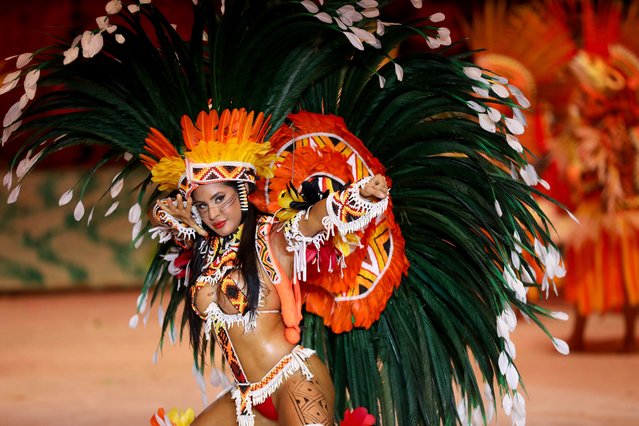
A member of the Boi Bumba Garantido association performs during the Boi Bumba folklore festival at the Bumbodromo in Parintins, Amazonas State, Brazil, on June 28, 2024. Parintins is well-known internationally for its Boi Bumba folklore festival, which lasts for three days in late June and whose themes, costumes, and songs are based on indigenous cultures of the Amazon rainforest. (Photo by Michael Dantas/AFP Photo)

A member of the Boi Bumba Garantido association performs during the Boi Bumba folklore festival at the Bumbodromo in Parintins, Amazonas State, Brazil, on June 28, 2024. Parintins is well-known internationally for its Boi Bumba folklore festival, which lasts for three days in late June and whose themes, costumes, and songs are based on indigenous cultures of the Amazon rainforest. (Photo by Michael Dantas/AFP Photo)
Details
23 Oct 2025 04:17:00