Loading...
Done
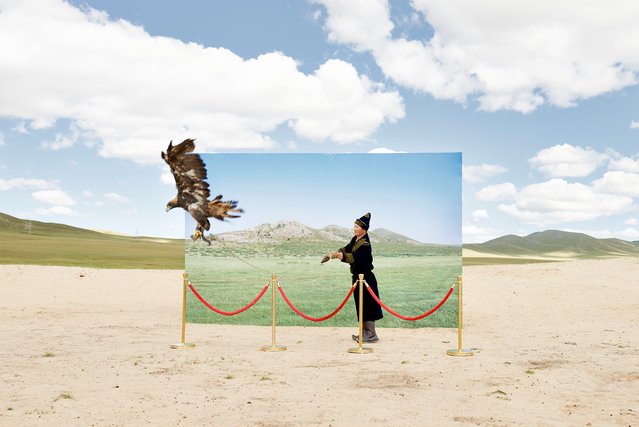
Up to 35% of Mongolians still live a nomadic life, depending on their land to survive. But environmental changes, particularly desertification, means this way of life is under threat. Korean photographer Daesung Lee’s Futuristic Archaeology images show billboard-size backdrops of lush steppe contrasting with actual scenery as former nomads enact scenes of hunting, herding and Mongolian wrestling. (Photo by Daesung Lee)

Up to 35% of Mongolians still live a nomadic life, depending on their land to survive. But environmental changes, particularly desertification, means this way of life is under threat. Korean photographer Daesung Lee’s Futuristic Archaeology images show billboard-size backdrops of lush steppe contrasting with actual scenery as former nomads enact scenes of hunting, herding and Mongolian wrestling. (Photo by Daesung Lee)
Details
24 Nov 2016 08:01:00
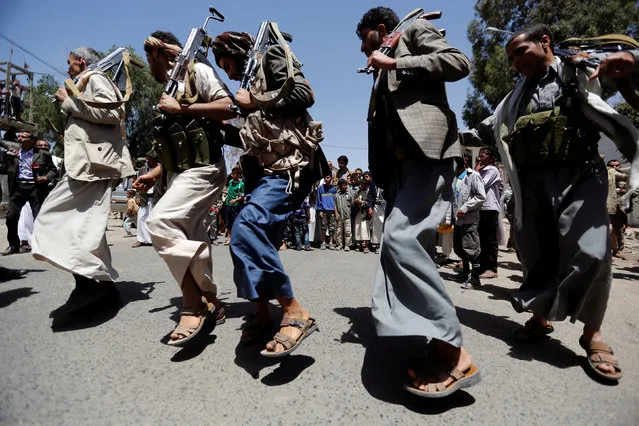
Tribesmen loyal to the Houthi movement perform the Baraa dance during a gathering to show support to the movement in Sanaa, Yemen, May 19, 2016. Bara or Baraa dance is one of the several traditional outdoor dances performed by men in the country of Yemen. Bara dance literally means a dagger dance, where each dancer holds a dagger. The style of the Bara dance differs from tribe to tribe. It is performed on special occasions. (Photo by Khaled Abdullah/Reuters)

Tribesmen loyal to the Houthi movement perform the Baraa dance during a gathering to show support to the movement in Sanaa, Yemen, May 19, 2016. Bara or Baraa dance is one of the several traditional outdoor dances performed by men in the country of Yemen. Bara dance literally means a dagger dance, where each dancer holds a dagger. The style of the Bara dance differs from tribe to tribe. It is performed on special occasions. (Photo by Khaled Abdullah/Reuters)
Details
20 May 2016 12:44:00
In this June 29, 2015 photo, forlorn buildings are seen at Hashima Island, commonly known as Gunkanjima, which means “Battleship Island”, off Nagasaki, Nagasaki Prefecture, southern Japan. (Photo by Eugene Hoshiko/AP Photo)

In this June 29, 2015 photo, forlorn buildings are seen at Hashima Island, commonly known as Gunkanjima, which means “Battleship Island”, off Nagasaki, Nagasaki Prefecture, southern Japan. The island is one of 23 old industrial facilities seeking UNESCO's recognition as world heritage “Sites of Japan's Meiji Industrial Revolution” meant to illustrate Japan's rapid transformation from a feudal farming society into an industrial power at the end of the 19th century. UNESCO's World Heritage Committee is expected to approve the proposal during a meeting being held in Bonn, Germany, through July 9. (Photo by Eugene Hoshiko/AP Photo)
Details
01 Jul 2015 13:41:00
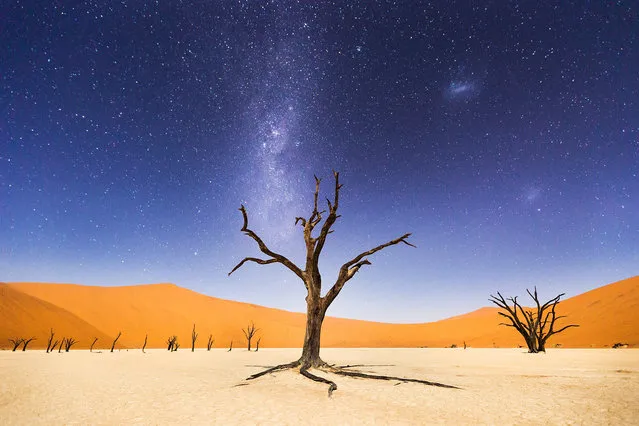
Merit: A Night at Deadvlei. The night before returning to Windhoek, we spent several hours at Deadveli. The moon was bright enough to illuminate the sand dunes in the distance, but the skies were still dark enough to clearly see the milky way and magellanic clouds. Deadveli means “dead marsh. (Photo and caption by Beth McCarley/National Geographic Traveler Photo Contest)

Merit: A Night at Deadvlei. The night before returning to Windhoek, we spent several hours at Deadveli. The moon was bright enough to illuminate the sand dunes in the distance, but the skies were still dark enough to clearly see the milky way and magellanic clouds. Deadveli means “dead marsh. The camelthorn trees are believed to be about 900 years old, but have not decomposed because the environment is so dry. (Photo and caption by Beth McCarley/National Geographic Traveler Photo Contest)
Details
04 Aug 2015 11:50:00
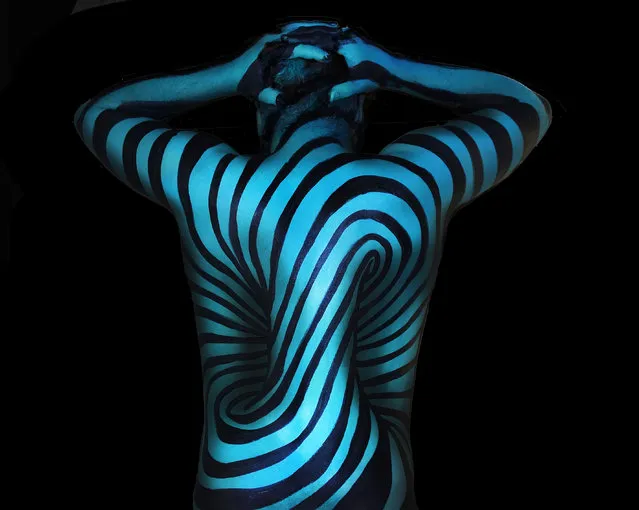
A talented body painter has created a series of mind-bending illusions that cover entire torsos. Natalie Fletcher’s work are enough to make people double-take, the spiraling patterns of some appearing to fade into the abyss. In other works, the artists designs look as though they are never ending, while some show body parts appearing to protrude from models chests. The idea behind the ongoing series came to Natalie, 30, as a means of keeping entertained during the winter months. Here: Optical illusion bodypaint. (Photo by Natalie Fletcher/Cater News)

A talented body painter has created a series of mind-bending illusions that cover entire torsos. Natalie Fletcher’s work are enough to make people double-take, the spiraling patterns of some appearing to fade into the abyss. In other works, the artists designs look as though they are never ending, while some show body parts appearing to protrude from models chests. The idea behind the ongoing series came to Natalie, 30, as a means of keeping entertained during the winter months. Here: Optical illusion bodypaint. (Photo by Natalie Fletcher/Cater News)
Details
13 Apr 2016 09:17:00
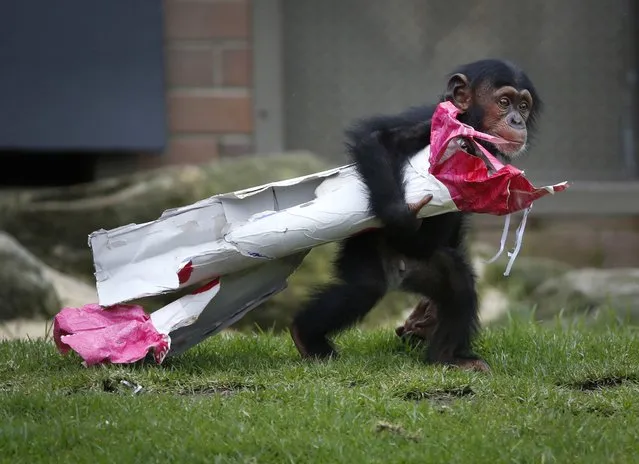
A 13-month-old chimp named Fumo carries a “Christmas present” of food treats in wrapping paper under his arm during a Christmas-themed feeding time at Sydney's Taronga Park Zoo, December 9, 2014. Fumo, meaning “chief” or “spear” in Swahili, is one of the latest additions to the zoo's successful primate breeding program. (Photo by Jason Reed/Reuters)

A 13-month-old chimp named Fumo carries a “Christmas present” of food treats in wrapping paper under his arm during a Christmas-themed feeding time at Sydney's Taronga Park Zoo, December 9, 2014. Fumo, meaning “chief” or “spear” in Swahili, is one of the latest additions to the zoo's successful primate breeding program. (Photo by Jason Reed/Reuters)
Details
09 Dec 2014 09:32:00
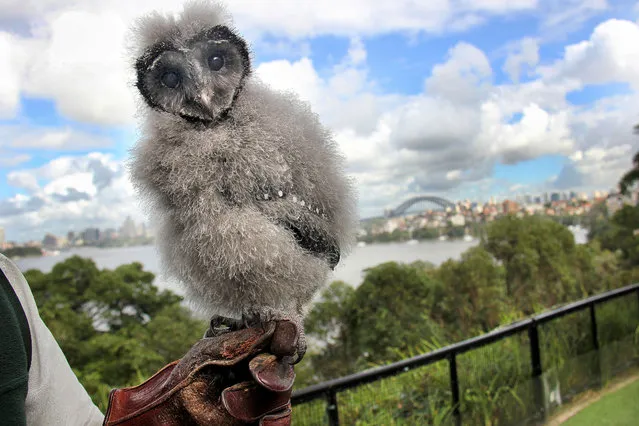
An adorable baby owl has proved to be a real heart-breaker thanks to its heart-shaped head. Although Griffin the Lesser Sooty Owl might look like a feather duster, the tiny eight-week old chick will soon be ready to fly. And the heart outline that surrounds his giant eyes and beak means he is set to be the star of the bird show at Taronga Zoo, Sydney. (Photo by Caters News Agency)

An adorable baby owl has proved to be a real heart-breaker thanks to its heart-shaped head. Although Griffin the Lesser Sooty Owl might look like a feather duster, the tiny eight-week old chick will soon be ready to fly. And the heart outline that surrounds his giant eyes and beak means he is set to be the star of the bird show at Taronga Zoo, Sydney. (Photo by Caters News Agency)
Details
16 May 2015 13:51:00
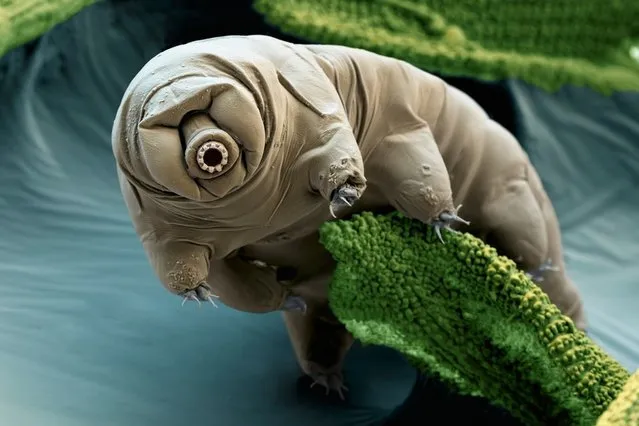
Tardigrades (commonly known as waterbears or moss piglets). (Photo by SPL/East News)

“Tardigrades (commonly known as waterbears or moss piglets) are small, water-dwelling, segmented animals with eight legs. Tardigrades were first discovered in 1773 by Johann August Ephraim Goeze, who called them kleiner Wasserbär, meaning “little water bear” in German. The name Tardigrada means “slow walker” and was given by Lazzaro Spallanzani in 1777. The name water bear comes from the way they walk, reminiscent of a bear's gait. The biggest adults may reach a body length of 1.5 millimetres (0.059 in), the smallest below 0.1 mm. Freshly hatched tardigrades may be smaller than 0.05 mm”. – Wikipedia. Photo: Tardigrades. (Photo by SPL/East News)
Details
26 Sep 2012 09:55:00