Loading...
Done
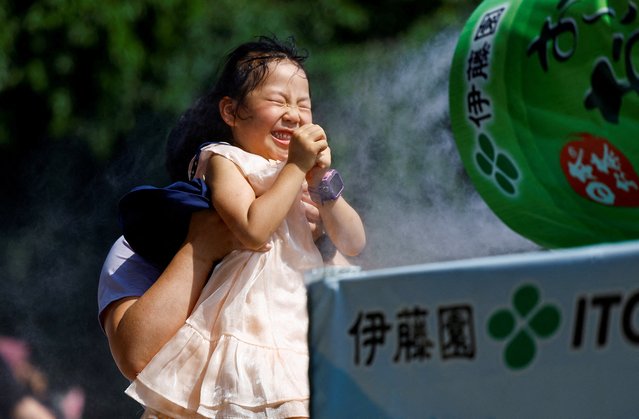
A child reacts as a family takes a break next to a cooling mist at the Sensoji temple as Japanese government issued heat stroke alerts in 39 of the country's 47 prefectures in Tokyo, Japan on July 22, 2024. (Photo by Issei Kato/Reuters)

A child reacts as a family takes a break next to a cooling mist at the Sensoji temple as Japanese government issued heat stroke alerts in 39 of the country's 47 prefectures in Tokyo, Japan on July 22, 2024. (Photo by Issei Kato/Reuters)
Details
29 Jul 2024 03:37:00
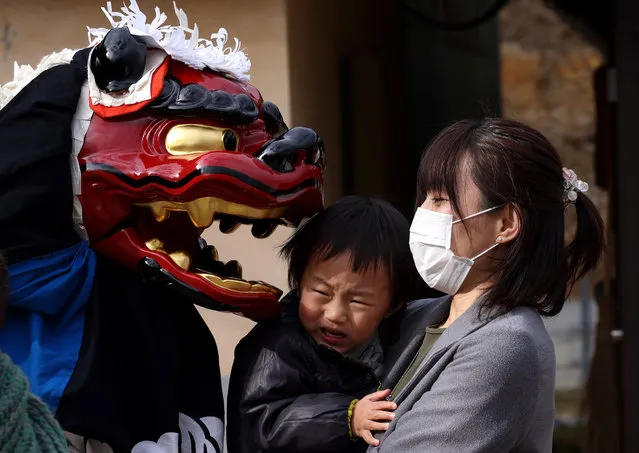
A performer wearing a lion mask performs the Ise Daikagura lion dance at the remote village of Yamanawa on February 08, 2021 in Ryuo, Japan. Ise Daikagura is a group of traditional Lion Dance performers who pray in front of farmers houses and businesses for good grain harvests and disease-free lives. Performers play sacred music using drums and flutes with two lion mask dancers. A lion mask is considered a symbol of God, who enters the house and performs in front of the Shinto God, a statue placed inside the house, mostly in the kitchen. These prayers are called “Kamodo Barai”. After the prayers, they are gifted with money, rice, sake and Japanese sweets from the householders. A group can travel for more than one hundred days to thousands of households and businesses throughout rural-villages in western Japan, and pray to those who are unable to visit the country’s most sacred shrine, the Grand Ise Shrine in Mie Prefecture. The group started its performance in the Edo era between 1603 to 1868 according to Japanese history. The Japanese government designated it as an important folk cultural national property in 1981. (Photo by Buddhika Weerasinghe/Getty Images)

A performer wearing a lion mask performs the Ise Daikagura lion dance at the remote village of Yamanawa on February 08, 2021 in Ryuo, Japan. Ise Daikagura is a group of traditional Lion Dance performers who pray in front of farmers houses and businesses for good grain harvests and disease-free lives. (Photo by Buddhika Weerasinghe/Getty Images)
Details
18 Feb 2021 09:27:00
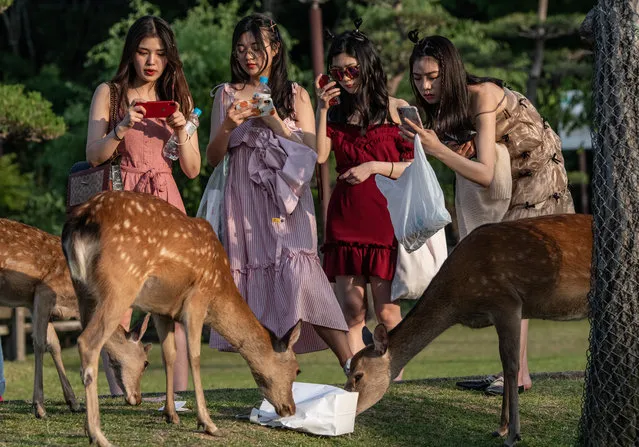
Tourists take photographs as a wild sika deer eats a bag on June 6, 2019 in Nara, Japan. Nara's free-roaming deer have become a huge attraction for tourists. However, an autopsy on a deer that was recently found dead near one of the city's famous temples discovered 3.2kg of plastic in its stomach and caused concern at the effect of tourism as Japan struggles to cope with a huge increase in domestic and international tourists. Alongside a growing Japanese tendency to holiday domestically, a record 31 million people visited the country in 2018 up 8.7 percent from the previous year, with many people now worrying about the environmental impact caused by such large visitor numbers. (Photo by Carl Court/Getty Images)

Tourists take photographs as a wild sika deer eats a bag on June 6, 2019 in Nara, Japan. Nara's free-roaming deer have become a huge attraction for tourists. However, an autopsy on a deer that was recently found dead near one of the city's famous temples discovered 3.2kg of plastic in its stomach and caused concern at the effect of tourism as Japan struggles to cope with a huge increase in domestic and international tourists. (Photo by Carl Court/Getty Images)
Details
19 Jun 2019 00:03:00
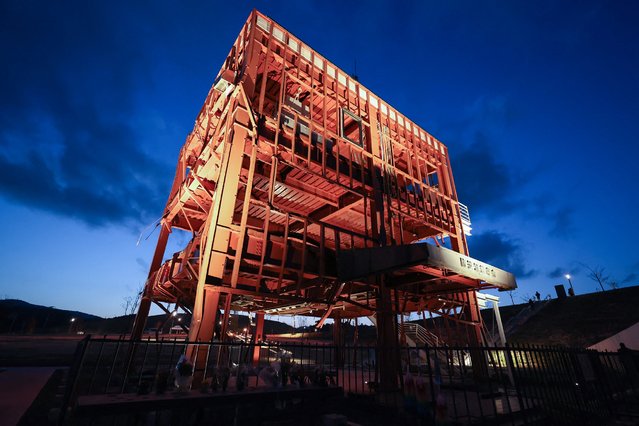
This photo taken on March 10, 2025 shows the former disaster prevention office building in Minamisanriku Town, Miyagi Prefecture, lit up on the eve of the 14th anniversary of the 2011 earthquake and tsunami disaster. (Photo by JIJI Press/AFP Photo)

This photo taken on March 10, 2025 shows the former disaster prevention office building in Minamisanriku Town, Miyagi Prefecture, lit up on the eve of the 14th anniversary of the 2011 earthquake and tsunami disaster. (Photo by JIJI Press/AFP Photo)
Details
14 Apr 2025 03:54:00
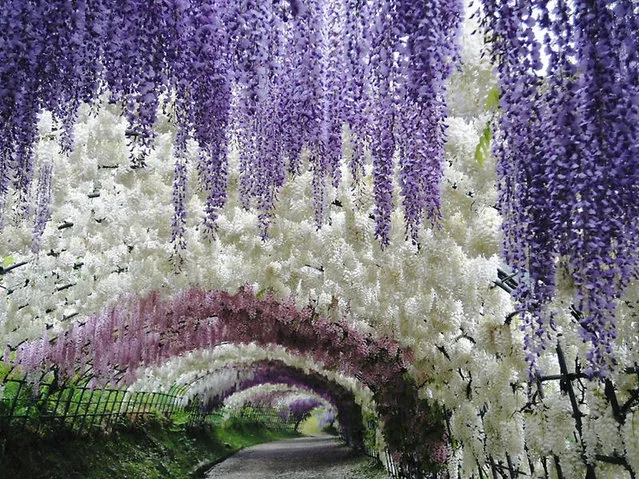
Kawachi Fuji Garden In Japan

Wisteria Tunnel is located at the Kawachi Fuji Gardens in Kitakyushu, Japan. Flowering wisteria blooms hang to create rows bursting with color overhead and dappled shadows below.
Details
21 Jan 2013 12:52:00
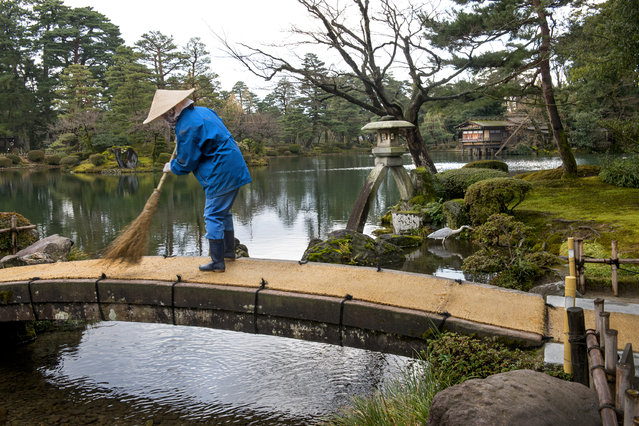
A groundskeeper uses a bamboo broom at Kasumigaike Pond at Kenrokuen Garden in Kanazawa, Japan on January 12, 2016. The japanese garden, located next to Kanazawa Castle, encompasses over 28 acres in downtown Kanazawa. With two ponds, rolling hills with streams and bridges, is considered a strolling-style landscape garden. It's regarded as one of the top three most beautiful gardens in Japan. (Photo by Linda Davidson/The Washington Post)

A groundskeeper uses a bamboo broom at Kasumigaike Pond at Kenrokuen Garden in Kanazawa, Japan on January 12, 2016. The japanese garden, located next to Kanazawa Castle, encompasses over 28 acres in downtown Kanazawa. With two ponds, rolling hills with streams and bridges, is considered a strolling-style landscape garden. It's regarded as one of the top three most beautiful gardens in Japan. (Photo by Linda Davidson/The Washington Post)
Details
03 Feb 2016 13:36:00
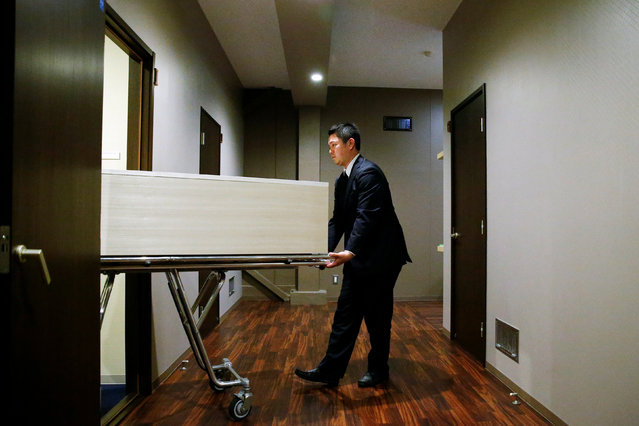
A staff member removes a coffin from a room of the “Corpse Hotel” in Kawasaki, Japan, April 20, 2016. (Photo by Thomas Peter/Reuters)

A staff member removes a coffin from a room of the “Corpse Hotel” in Kawasaki, Japan, April 20, 2016. Many so-called corpse hotels have emerged as a flourishing business in the city following a crunch in crematoriums. Families can rent a room in Sousou on a daily charge of 9,000 Japanese yen (£58, €74, $84) to keep the body of the deceased relative for up to four days until they find a crematorium. (Photo by Thomas Peter/Reuters)
Details
30 Apr 2016 09:46:00
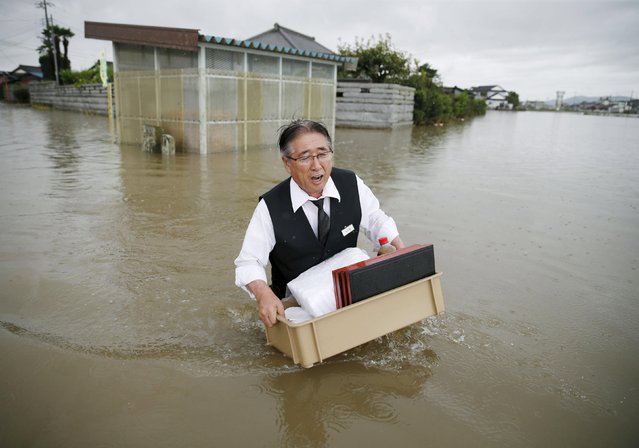
A man holding a tray of belongings wades through a road at an area flooded by the Omoigawa river, caused by typhoon Etau in Oyama, Tochigi prefecture, Japan, in this photo taken by Kyodo September 10, 2015. (Photo by Reuters/Kyodo News)

A man holding a tray of belongings wades through a road at an area flooded by the Omoigawa river, caused by typhoon Etau in Oyama, Tochigi prefecture, Japan, in this photo taken by Kyodo September 10, 2015. (Photo by Reuters/Kyodo News)
Details
11 Sep 2015 12:31:00