A protestor interrupts Canadian singer-songwriter Avril Lavigne speaking onstage at the 2023 JUNO Awards at Rogers Place on March 13, 2023 in Edmonton, Canada. (Photo by Dale MacMillan/Getty Images)
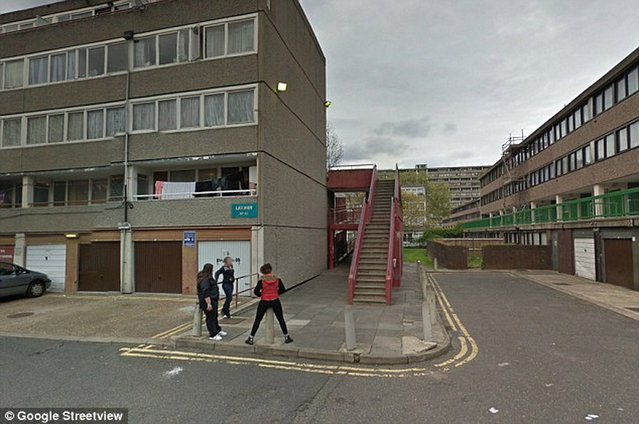
Take a walk on the wild side around some of the most down right dangerous places in the world - and all without leaving your desk, courtesy of Google Street View. Since 2007, Google's amazing technology has given people the chance to visit the Eiffel Tower, peer out over San Francisco's Golden Gate Bridge or walk along a beach in the Bahamas. But as well as mapping the tourist-friendly hotspots, Google also ventured into places you really wouldn't want to find yourself. Here is a collection of some the most notorious areas captured by the infamous roaming camera cars from around the UK and the world.
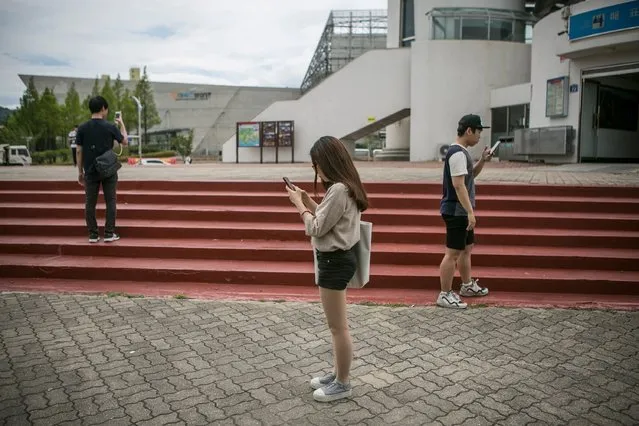
South Korean youths play Pokemon Go on July 15, 2016 in Sokcho, South Korea. South Korea is not one of the initial Pokemon Go released countries, nor is the game likely to be released officially any time soon as the South Korean government does not allow Google to use its map; however, South Korean game enthusiasts are now visiting a handful of loophole areas in the north eastern side of the country near the border of North Korea to join the global frenzy of Pokemon Go. (Photo by Jean Chung/Getty Images)
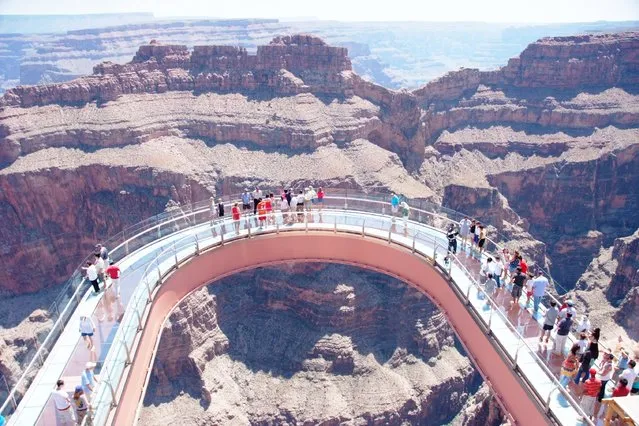
The Grand Canyon Skywalk is a transparent horseshoe-shaped cantilever bridge and tourist attraction in Arizona near the Colorado River on the edge of a side canyon in the Grand Canyon West area of the main canyon. USGS topographic maps show the elevation at the Skywalk's location as 4,770 ft (1,450 m) and the elevation of the Colorado River in the base of the canyon as 1,160 ft (350 m), and they show that the height of the precisely vertical drop directly under the skywalk is between 500 ft (150 m) and 800 ft (240 m).
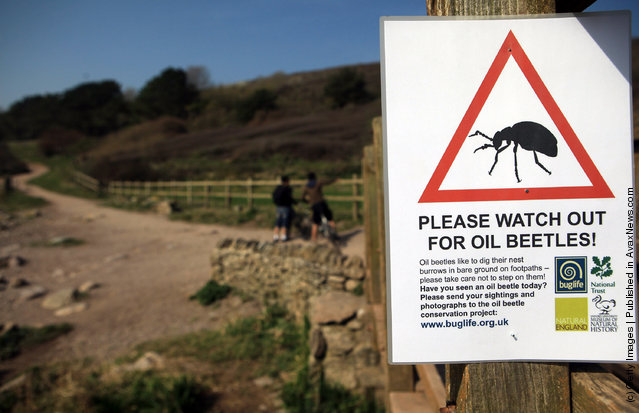
People enjoy the fine weather on the coast at Wembury during the first ever nationwide survey to map the location of the threatened and creatures on March 24, 2011 in near Plymouth, England. Often found on the coast, and particularly in the south west of England, the number of oil beetle species found in the UK has halved in the last 100 years and the survey will help establish the whereabouts of the remaining four species and boost efforts to secure their future. The survey is being launched today by Buglife: The Invertebrate Trust and the National Trust in partnership with Natural England and Oxford University Museum of Natural History. (Photo by Matt Cardy/Getty Images)
Sarah Gibbons grades a new batch of Maple Syrup at Gibbons Family Farm in Frankville, Ontario, Canada, 31 March 2014. The annual maple syrup season marks the end of the often brutal central Canadian winters and heralds the beginning of spring. The maple tree, whose leaf dominates the Canada's flag, plays both a symbolic and practical role in the identity of Canadians who produce around 95 percent of the world's supply of maple syrup. (Photo by Stephen Morrison/EPA)
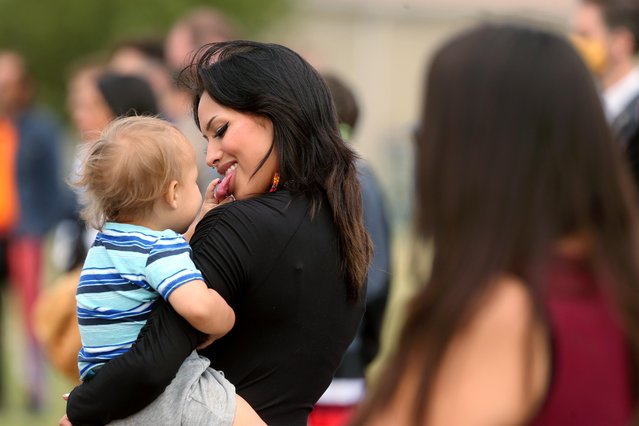
Youth council member Mia Buckles plays with 18-month-old Kobe Buckles-Benson as Canada's Prime Minister Justin Trudeau visits the Cowessess First Nation, where a search had found 751 unmarked graves from the former Marieval Indian Residential School near Grayson, Saskatchewan, Canada on July 6, 2021. (Photo by Shannon VanRaes/Reuters)
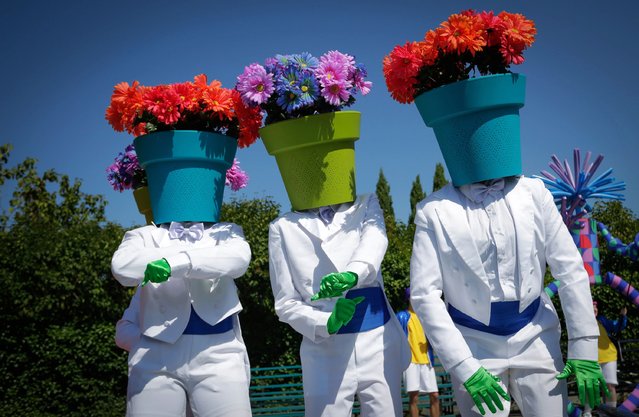
Performers dressed with flower pots on their heads perform during a media preview of the Pacific National Exhibition Fair in Vancouver, British Columbia, Canada, August 15, 2024. Marking its 114th year, the Pacific National Exhibition (PNE) Fair, one of the longest running events in Canada, runs from Aug. 17 to Sept. 2 here this year. (Photo by Xinhua News Agency/Rex Features/Shutterstock)