Loading...
Done
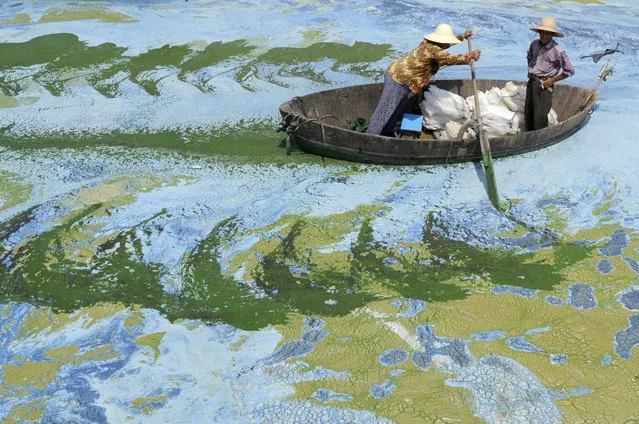
Fishermen row a boat in the algae-filled Chaohu Lake in Hefei, Anhui province, June 19, 2009. The country has invested 51 billion yuan ($7.4 billion) towards the construction of 2,712 projects for the treatment of eight rivers and lakes including Huaihe River, Haihe River, Liaohe River, Chaohu Lake, Dianchi Lake, Songhua River, the Three Gorges region of the Yangtze River and its upstream area, Xinhua News Agency reported. (Photo by Jianan Yu/Reuters)

Growing cities, overuse of fertilizers and factory wastewater have degraded China's water supplies to the extent that half the nation's rivers and lakes are severely polluted. China aims to spend $850 billion to improve filthy water supplies over the next decade, but even such huge outlays may do little to reverse damage caused by decades of pollution and overuse in Beijing's push for rapid economic growth. Photo: Fishermen row a boat in the algae-filled Chaohu Lake in Hefei, Anhui province, June 19, 2009. (Photo by Jianan Yu/Reuters)
Details
03 Aug 2014 08:01:00
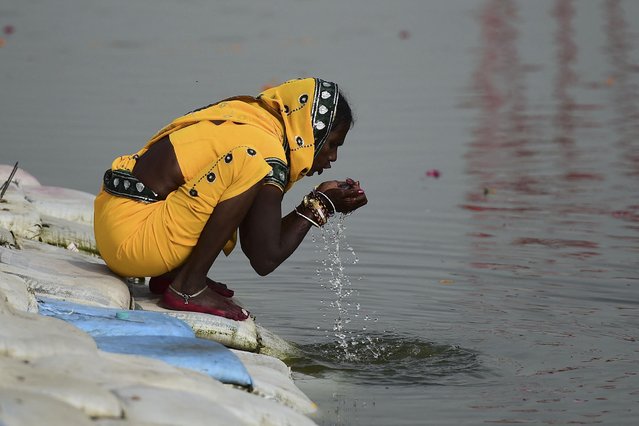
A Hindu devotee drinks water from the Ganges River at the Sangam area, the confluence of rivers Ganges, Yamuna, and the mythical Saraswati, in Allahabad on March 16, 2021. (Photo by Sanjay Kanojia/AFP Photo)

A Hindu devotee drinks water from the Ganges River at the Sangam area, the confluence of rivers Ganges, Yamuna, and the mythical Saraswati, in Allahabad on March 16, 2021. (Photo by Sanjay Kanojia/AFP Photo)
Details
24 Mar 2021 10:21:00
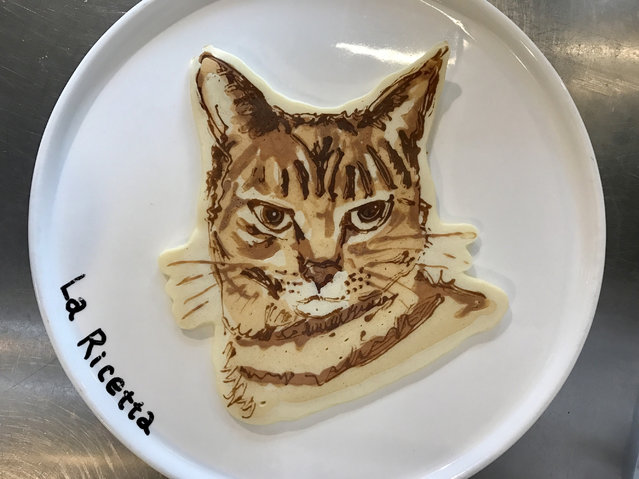
A pancake that looks like a cat, in Zama City, Japan. (Photo by Keisuke Inagaki/Barcroft Images)

As pancake day has creped up on us once again, a Japanese chef has combined our favourite things; cute animals and sugar. Keisuke Inagaki has been a chef at his restaurant La Ricetta in Zama City, Japan, for the last 18 years. He rose to Instagram fame from his Pokemon and anime pancake art, and the time around heis created a lifelike animal series. The 46-year-old chef began making pancakes in 2011 to raise spirits after the devastating nuclear disaster in Fukushima, Japan. Here: A pancake that looks like a cat, in Zama City, Japan. (Photo by Keisuke Inagaki/Barcroft Images)
Details
02 Mar 2017 00:03:00
Staff of a boat restaurant on the Taedong River line up at the entrance as they wait to greet customers Sunday, June 18, 2017, in Pyongyang, North Korea. The boat is berthed along the river, which is the fifth longest river on the Korean Peninsula and runs through the country's capital, Pyongyang. (Photo by Wong Maye-E/AP Photo)

Staff of a boat restaurant on the Taedong River line up at the entrance as they wait to greet customers Sunday, June 18, 2017, in Pyongyang, North Korea. The boat is berthed along the river, which is the fifth longest river on the Korean Peninsula and runs through the country's capital, Pyongyang. (Photo by Wong Maye-E/AP Photo)
Details
29 Jun 2017 07:59:00
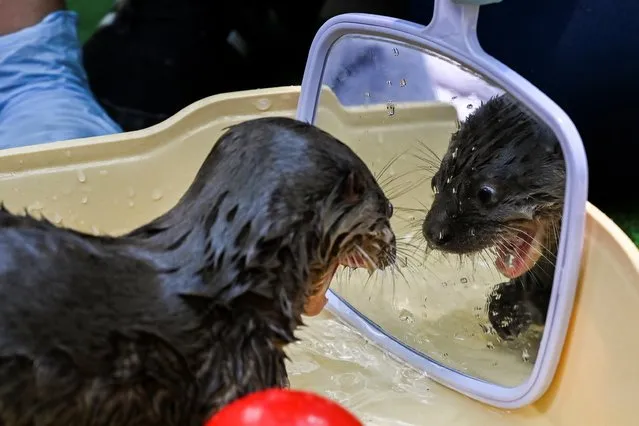
A river otter (lontra longicaudis) of 6-weeks-old looks in the mirror during a bath in the Animal Welfare Unit of the Zoo in Cali, Colombia, on October 22, 2019. The baby otter was found abandoned brought to the Cali Zoo for breeding, for its extensive experience in raising these species. According to the International Union for Conservation of Nature the river otter (lontra longicaudis) are in danger of extinction, because of mining, agriculture, pollution of rivers and housing construction in their habitat. (Photo by Luis Robayo/AFP Photo)

A river otter (lontra longicaudis) of 6-weeks-old looks in the mirror during a bath in the Animal Welfare Unit of the Zoo in Cali, Colombia, on October 22, 2019. The baby otter was found abandoned brought to the Cali Zoo for breeding, for its extensive experience in raising these species. According to the International Union for Conservation of Nature the river otter (lontra longicaudis) are in danger of extinction, because of mining, agriculture, pollution of rivers and housing construction in their habitat. (Photo by Luis Robayo/AFP Photo)
Details
27 Oct 2019 00:03:00
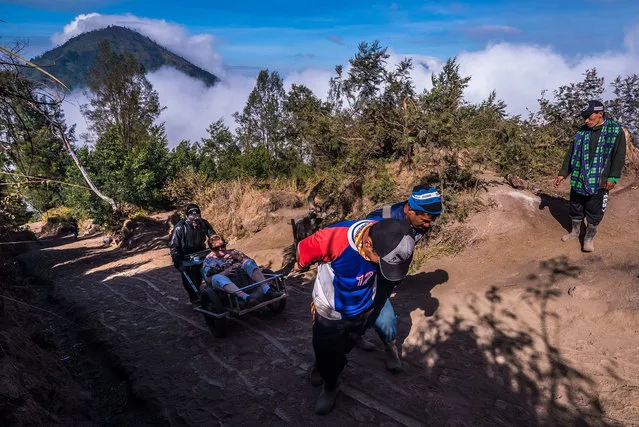
Miners pulling up lazy tourists to the rim of Kawah Ijen (Ijen Volcano), East Java, Indonesia on September 21, 2017. They will earn as much as they would bring down a load of sulfur. Nomadic Explorer, Cultural Lifestyle Photographer Claudio Sieber captured striking images of miners working at Ijen volcanic range in East Java, Indonesia. The sulphur miners risk their lives daily as they climb the active volcano carrying heavy loads, which they sell to sugar refineries. Shortly after midnight curious tourists are flocking in hundreds through the gate of Ijen's foothills to be right on time, driven by the images others took before them. Kawah Ijen is the one of the world's largest acidic volcanic crater lake; famous for its turquoise color as well as the unreal atmosphere it offers during darkness. A dusty path zigzags 3 kilometers up to the crater rim. This doesn't mean anything challenging; in particular, special sights have to be deserved anyway. The irritating smell of sulfur announces the near of the crater's existence. Arriving on the crater's rim the reward for the torture becomes visible. Blue fire darts its tongues through the fumes of sulfur dioxide. Somehow, the spectacle isn't as romantic as expected, since it is also the rough working space of approx. 150 sulfur miners who start their shift at 1 am. Lately, harvesting the abundance of devil's gold received international attention. This did obviously not really improve a miner's lifestyle; neither did it contribute to a better wage. (Photo by Claudio Sieber/Barcroft Images)

Miners pulling up lazy tourists to the rim of Kawah Ijen (Ijen Volcano), East Java, Indonesia on September 21, 2017. They will earn as much as they would bring down a load of sulfur. Nomadic Explorer, Cultural Lifestyle Photographer Claudio Sieber captured striking images of miners working at Ijen volcanic range in East Java, Indonesia. The sulphur miners risk their lives daily as they climb the active volcano carrying heavy loads, which they sell to sugar refineries. (Photo by Claudio Sieber/Barcroft Images)
Details
02 Oct 2017 08:31:00
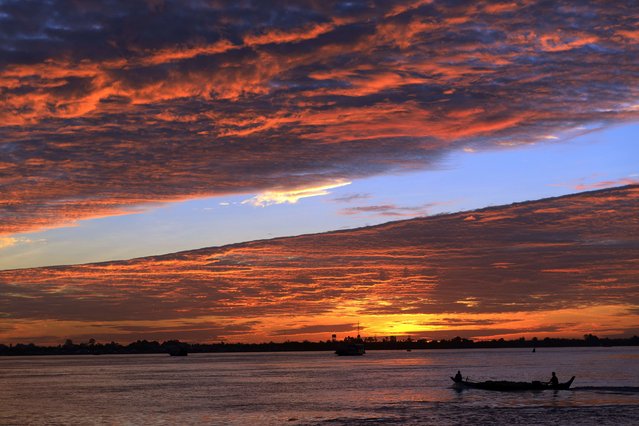
A boat commutes across the Mekong river in Phnom Penh on August 8, 2014. The Mekong is the world's twelth longest river running from the Tibetan Plateau through China's Yunnan province, Myanmar, Laos, Thailand, Cambodia and Vietnam. (Photo by Tang Chhin Sothy/AFP Photo)

A boat commutes across the Mekong river in Phnom Penh on August 8, 2014. The Mekong is the world's twelth longest river running from the Tibetan Plateau through China's Yunnan province, Myanmar, Laos, Thailand, Cambodia and Vietnam. (Photo by Tang Chhin Sothy/AFP Photo)
Details
09 Aug 2014 12:41:00
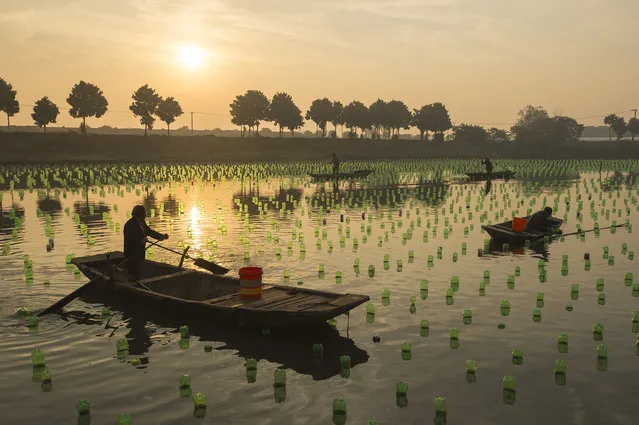
Local people check the growth of mussels at a river in Haian County on November 2, 2017 in Nantong, Jiangsu Province of China. Fish, shrimp, crab and mussel farming cleans the river and increases the villagers' income at Haian county in Jiangsu. (Photo by VCG/VCG via Getty Images)

Local people check the growth of mussels at a river in Haian County on November 2, 2017 in Nantong, Jiangsu Province of China. Fish, shrimp, crab and mussel farming cleans the river and increases the villagers' income at Haian county in Jiangsu. (Photo by VCG/VCG via Getty Images)
Details
03 Nov 2017 07:51:00