Loading...
Done
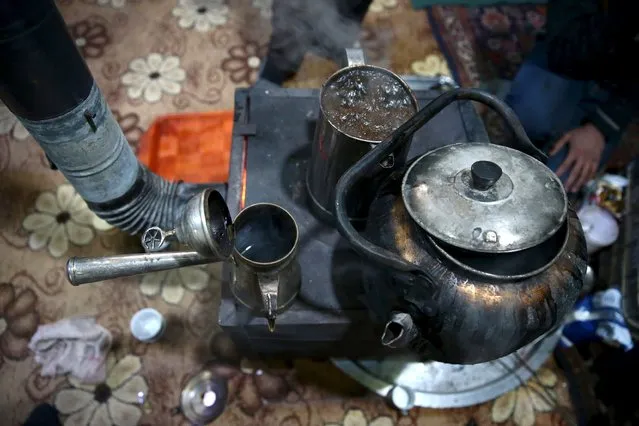
Guests brew coffee during a wedding ceremony for a Free Syrian Army fighter in the town of Douma, eastern Ghouta in Damascus, Syria January 19, 2016. (Photo by Bassam Khabieh/Reuters)

Guests brew coffee during a wedding ceremony for a Free Syrian Army fighter in the town of Douma, eastern Ghouta in Damascus, Syria January 19, 2016. (Photo by Bassam Khabieh/Reuters)
Details
21 Jan 2016 12:52:00
A seagull files over a man sitting at a coffee shop backdropped by the Bosporus Strait in Istanbul, Tuesday, November 17, 2020. (Photo by Emrah Gurel/AP Photo)

A seagull files over a man sitting at a coffee shop backdropped by the Bosporus Strait in Istanbul, Tuesday, November 17, 2020. (Photo by Emrah Gurel/AP Photo)
Details
05 Dec 2020 00:05:00
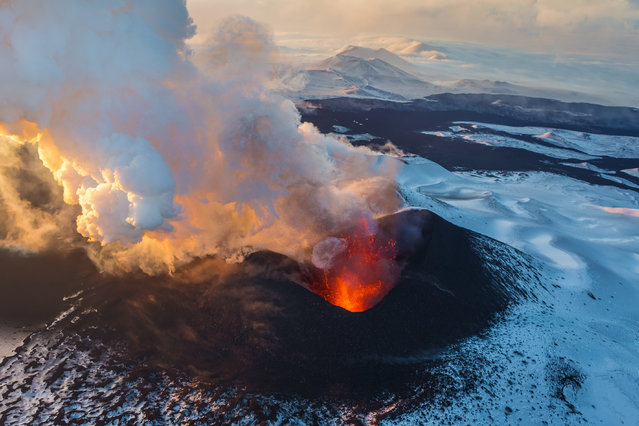
These are the explosive images of some of the world's most ASH-stonishing volcanic eruptions. Spectacular snaps capture lava spewing down the side of Kilauea, ash spitting from craters and plumes of smoke rising thousands of feet in the air. Here: Volcano Plosky Tolbachik, Kamchatcka, Russia. (Photo by Airpano/Caters News)

These are the explosive images of some of the world's most ASH-stonishing volcanic eruptions. Spectacular snaps capture lava spewing down the side of Kilauea, ash spitting from craters and plumes of smoke rising thousands of feet in the air. Russian non-profit AirPano travel the globe taking the breath-taking panoramic images, compiled in this series displaying their most stunning volcanic shoots. Included in the set – which spans four continents – are images from across the United States, Iceland, Russia, Ethiopia and Indonesia. To capture the 360-degree images, AirPano photographers spend around two hours in a helicopter, sending out drones to capture the action below. Here: Volcano Plosky Tolbachik, Kamchatcka, Russia. (Photo by Airpano/Caters News)
Details
15 Jul 2015 10:36:00
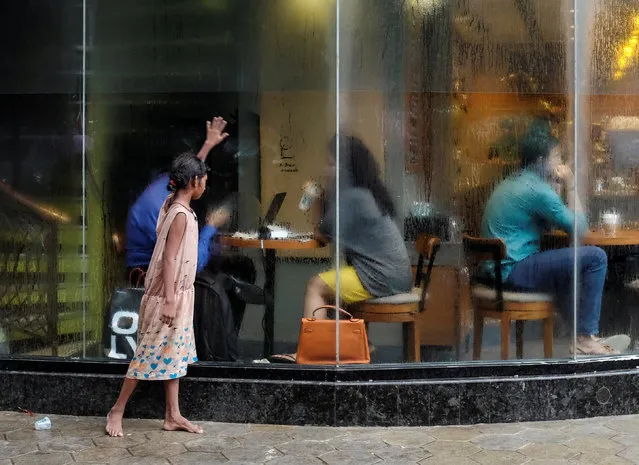
A homeless girl asks for alms outside a coffee shop in Mumbai, India, June 24, 2016. (Photo by Danish Siddiqui/Reuters)

A homeless girl asks for alms outside a coffee shop in Mumbai, India, June 24, 2016. (Photo by Danish Siddiqui/Reuters)
Details
30 Jun 2016 11:46:00
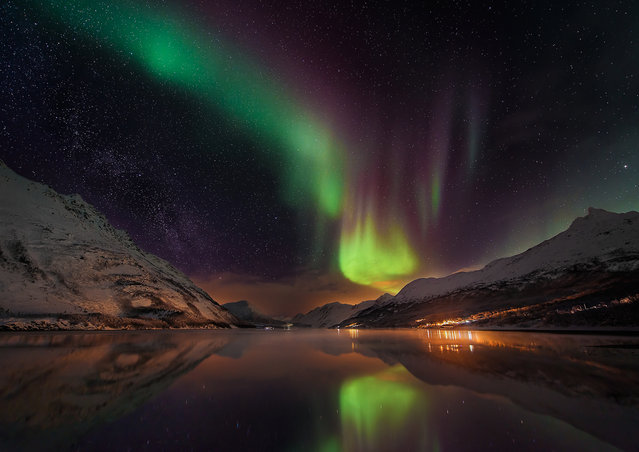
Some of the best entries so far in the 2016 Insight Astronomy Photographer of the Year competition. There are two weeks left to enter, and the winners will be announced in September. Here: Aurora over Laksvatn Fjord, Laksvatn, Norway. The aurora borealis dances in the skies over the town of Laksvatn, with the Milky Way to the left. The image is a single shot with no compositing, only post-processing to bring out the aurora, and some colour corrections. (Photo by Matt Walford/National Maritime Museum)

Some of the best entries so far in the 2016 Insight Astronomy Photographer of the Year competition. There are two weeks left to enter, and the winners will be announced in September. Here: Aurora over Laksvatn Fjord, Laksvatn, Norway. The aurora borealis dances in the skies over the town of Laksvatn, with the Milky Way to the left. The image is a single shot with no compositing, only post-processing to bring out the aurora, and some colour corrections. The photographer Matt Walford said: “I love the way the northern lights look like they are just wistfully dancing over the fjord, framed by the mountains on either side”. (Photo by Matt Walford/National Maritime Museum)
Details
01 Jul 2016 12:13:00
Customers drink a coffee as several cats roam at Cat Cafe Melbourne on July 25, 2014 in Melbourne, Australia. Cat Cafe Melbourne is Australias first cat cafe. The cafe has several cats from rescue shelters which live at the premises. Patrons can watch and play with the cats while enjoying a coffee. Cat Cafes are becoming known world wide, the first opening in Taiwan in 1998. (Photo by Scott Barbour/Getty Images)

Customers drink a coffee as several cats roam at Cat Cafe Melbourne on July 25, 2014 in Melbourne, Australia. Cat Cafe Melbourne is Australias first cat cafe. The cafe has several cats from rescue shelters which live at the premises. Patrons can watch and play with the cats while enjoying a coffee. Cat Cafes are becoming known world wide, the first opening in Taiwan in 1998. (Photo by Scott Barbour/Getty Images)
Details
27 Jul 2014 11:24:00
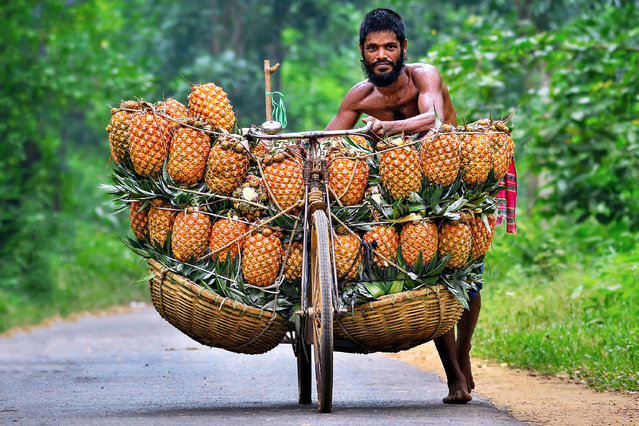
Cyclists desperately try to keep their heavily-laden bicycles upright as they arrive at a market with baskets full of pineapples on August 23, 2018. The men travel up to 12 and a half miles with two baskets tied to the sides of their bikes, carrying between 50 and 100 pineapples to sell. Each of the bicycles is so heavily laden with fruit it is impossible for the men to actually ride their bikes, instead having to walk alongside them. When they arrive at the market place in Madhupur, Bangladesh, buyers will pay up to 30 Taka for a pineapple – the equivalent of around 28 pence. (Photo by Abdul Momin/Solent News & Photo Agency UK)

Cyclists desperately try to keep their heavily-laden bicycles upright as they arrive at a market with baskets full of pineapples on August 23, 2018. The men travel up to 12 and a half miles with two baskets tied to the sides of their bikes, carrying between 50 and 100 pineapples to sell. Each of the bicycles is so heavily laden with fruit it is impossible for the men to actually ride their bikes, instead having to walk alongside them. When they arrive at the market place in Madhupur, Bangladesh, buyers will pay up to 30 Taka for a pineapple – the equivalent of around 28 pence. (Photo by Abdul Momin/Solent News & Photo Agency UK)
Details
21 Sep 2018 00:03:00
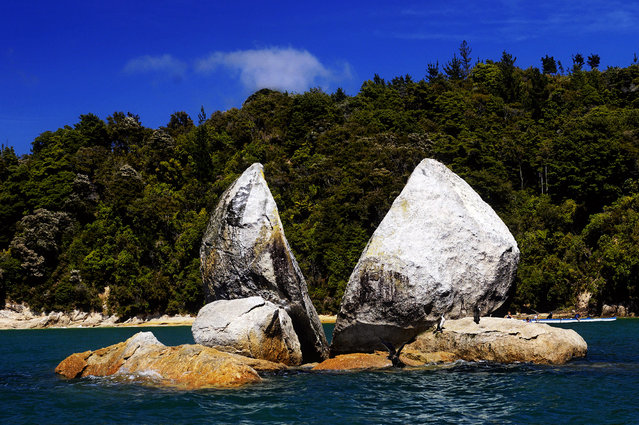
Split Apple Rock

Split Apple Rock is a geological rock formation in The Tasman Bay off the northern coast of the South Island of New Zealand. Made of granite, it is in the shape of an apple which has been cut in half. It is a popular tourist attraction in the waters of the Tasman Sea approximately 50 metres off the coast between Kaiteriteri and Marahau. The rock sits in shallow water at low tide and is accessible by wading. It is also a point of interest for the many tourist boats and pleasure craft which operate along the shores of the Abel Tasman National Park. The cleft to produce two sides of the 'apple' was a natural occurrence. It is unknown when this happened and therefore the cleaving of the rock has attracted mythological explanations.
Details
19 Oct 2013 10:58:00