Loading...
Done
The 33rd All Women Lifeguard Tournament held at Sandy Hook Gateway National Recreation Area in Sandy Hook New Jersey. Wednesday, July 26th, 2017 (Photo by Anthony Causi)

The 33rd All Women Lifeguard Tournament held at Sandy Hook Gateway National Recreation Area in Sandy Hook New Jersey. Wednesday, July 26th, 2017 (Photo by Anthony Causi)
Details
29 Jul 2017 07:48:00
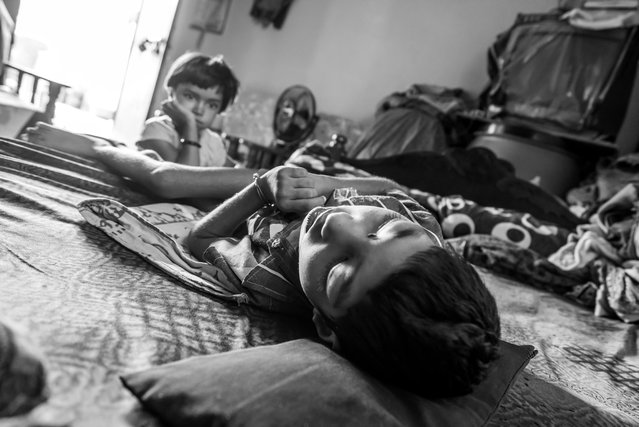
Unnati, 6 years old, at home with his sister Ishika, 4 years old, in the Mahamai Ka Bagh neighborhood. Unnati was born to parents contaminated by a carcinogenic and mutagenic water supply. This year marks the 31st anniversary of the 1984 Union Carbide gas tragedy that killed thousands of citizens of Bhopal within 72 hours and has gone on to claim thousands more as a result of the polluted environment. (Photo by Giles Clarke/Getty Images)

Unnati, 6 years old, at home with his sister Ishika, 4 years old, in the Mahamai Ka Bagh neighborhood. Unnati was born to parents contaminated by a carcinogenic and mutagenic water supply. This year marks the 31st anniversary of the 1984 Union Carbide gas tragedy that killed thousands of citizens of Bhopal within 72 hours and has gone on to claim thousands more as a result of the polluted environment. (Photo by Giles Clarke/Getty Images)
Details
04 Dec 2015 08:01:00
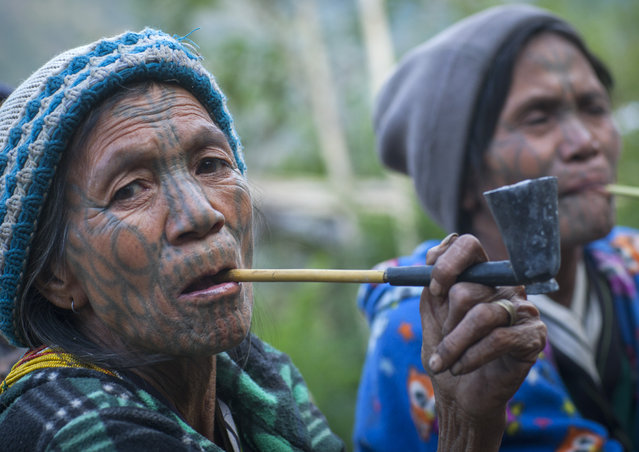
A group of tattooed women from the Muun tribe who inhabit the hills of the Arakan state. The design, known as the letter B-pattern, is common in the Mindat area. It is composed of dots, lines and occasionally circles, in February, 2015, in Myanmar, Burma. (Photo by Eric Lafforgue/Barcroft Media)

A group of tattooed women from the Muun tribe who inhabit the hills of the Arakan state. The design, known as the letter B-pattern, is common in the Mindat area. It is composed of dots, lines and occasionally circles, in February, 2015, in Myanmar, Burma. With spider webs, B-patterns and crossed lines painstakingly inked on their faces these stunning photographs show the tattooed women of Burma. French photographer Eric Lafforgue travelled to the Chin, Rakhine and Arakan states of northwestern Myanmar to capture the rare facial designs. (Photo by Eric Lafforgue/Barcroft Media)

Details
16 Mar 2015 10:54:00
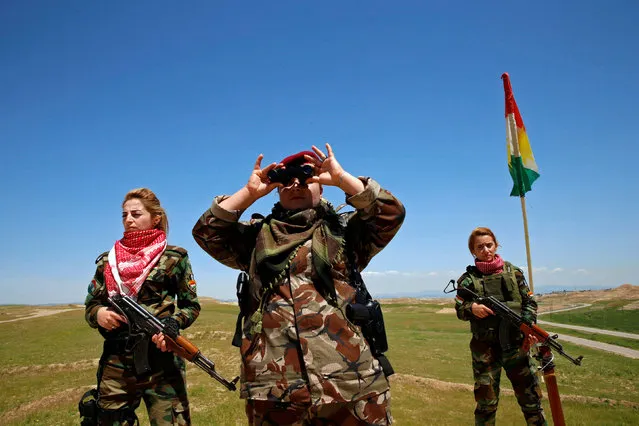
Iraqi Kurdish female fighter Haseba Nauzad looks through a pair of binoculars during a deployment near the frontline of the fight against Islamic State militants in Nawaran near Mosul, Iraq, April 20, 2016. (Photo by Ahmed Jadallah/Reuters)

Iraqi Kurdish female fighter Haseba Nauzad looks through a pair of binoculars during a deployment near the frontline of the fight against Islamic State militants in Nawaran near Mosul, Iraq, April 20, 2016. (Photo by Ahmed Jadallah/Reuters)
Details
05 May 2016 14:00:00
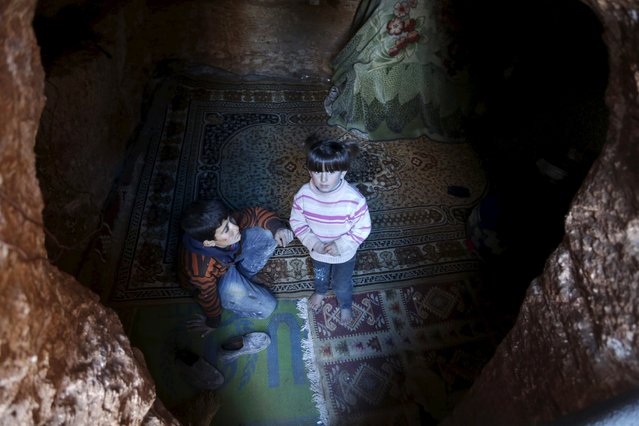
Internally displaced Syrian children stand at the entrance of their makeshift shelter that is an underground cave in Om al-Seer, southern Idlib countryside, Syria December 26, 2015. (Photo by Khalil Ashawi/Reuters)

Internally displaced Syrian children stand at the entrance of their makeshift shelter that is an underground cave in Om al-Seer, southern Idlib countryside, Syria December 26, 2015. (Photo by Khalil Ashawi/Reuters)
Details
28 Dec 2015 08:01:00
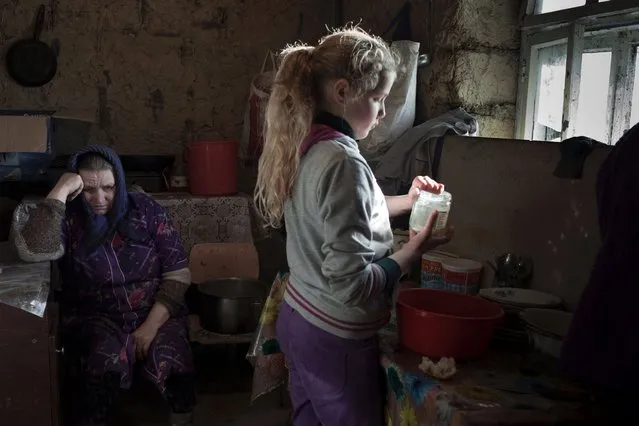
According to the U.S. government, Moldova, one of the poorest countries in Europe, depends on about $1.6 billion annually sent back from the roughly one million Moldovans who left for work in in Europe, Russia, and other former Soviet Bloc countries. Photographer Myriam Meloni went to Moldova to document what she refers to as “social orphans” – children whose parents have emigrated to another country in search of a job and a better future for their families. Here: Lulia is seen washing dishes in her grandmother's house, where she lives. (Photo by Myriam Meloni)

According to the U.S. government, Moldova, one of the poorest countries in Europe, depends on about $1.6 billion annually sent back from the roughly one million Moldovans who left for work in in Europe, Russia, and other former Soviet Bloc countries. Photographer Myriam Meloni went to Moldova to document what she refers to as “social orphans” – children whose parents have emigrated to another country in search of a job and a better future for their families. Here: Lulia is seen washing dishes in her grandmother's house, where she lives. (Photo by Myriam Meloni)
Details
12 Mar 2016 14:57:00
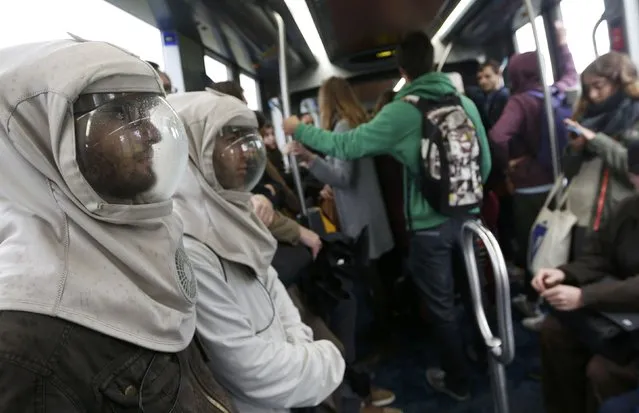
French twins Thomas and Vincent (L) Seris take the tram in Bordeaux, November 12, 2014. Born with Xeroderma Pigmentosum (XP), the twins cannot be exposed to the sun and its ultraviolet (UV) light, which could provoke precocious cancers due to an autosomal recessive genetic disorder of DNA repair. (Photo by Regis Duvignau/Reuters)

French twins Thomas and Vincent (L) Seris take the tram in Bordeaux, November 12, 2014. Born with Xeroderma Pigmentosum (XP), the twins cannot be exposed to the sun and its ultraviolet (UV) light, which could provoke precocious cancers due to an autosomal recessive genetic disorder of DNA repair. Colloquially referred to as Children of the Night (Les Enfants de la Lune) the Seris twins are among 70 to 80 people in France who suffer from the genetic defect. The French association “Les Enfants de la Lune” reports that there are between five and ten thousand such cases in the world. Thomas and Vincent have been testing a new protective mask for the last year which is transparent and ventilated and developed by several hospitals in France. (Photo by Regis Duvignau/Reuters)
Details
01 Feb 2015 10:27:00
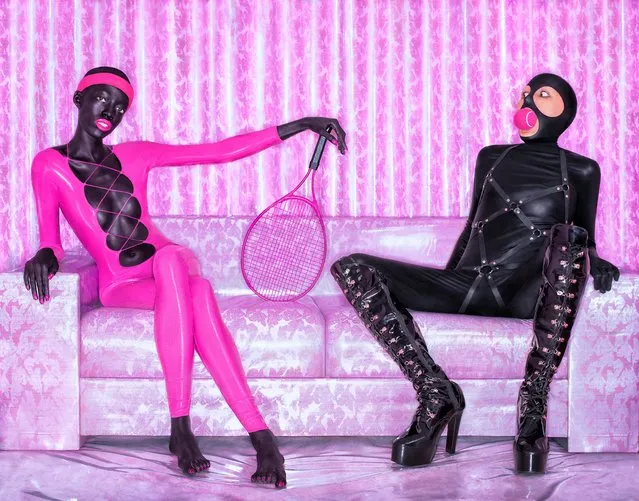
Black women in Brazil sit at the intersection of racism and misogyny, and have in recent years been at the forefront of a movement that challenges issues ranging from sexual and domestic violence to police brutality and stereotyping. Kolor Collective considers itself to be a part of this movement and questions expectations imposed on black women with satirical and subversive images, as seen here. (Photo by Kolor Art Collective/The Guardian)

Photographer Pol Kurucz’s vivid collection of photos explores issues faced by black Brazilian women, from political misrepresentation to unrealistic beauty standards. Kolor Collective is a Rio de Janeiro-based creative group that challenges the struggle faced by black women in Brazil through theatrical and provocative art. It was founded in 2015 by Franco-Hungarian photographer Pol Kurucz, who often touches on his own experiences of discrimination to call out sensitive social problems. (Photo by Kolor Art Collective/The Guardian)
Details
28 Dec 2016 07:24:00