Loading...
Done
Competitors bounce off the wall following their Men's 60m Heat on day one of the World Athletics Indoor Championships Nanjing 2025 at Nanjing Youth Olympic Games Sports Park on March 21, 2025 in Nanjing, China. (Photo by Cameron Spencer/Getty Images)

Competitors bounce off the wall following their Men's 60m Heat on day one of the World Athletics Indoor Championships Nanjing 2025 at Nanjing Youth Olympic Games Sports Park on March 21, 2025 in Nanjing, China. (Photo by Cameron Spencer/Getty Images)
Details
01 Apr 2025 03:34:00
Officer cadets at Sandhurst military academy celebrate completing the Sovereign's Parade which see's them become commissioned officers in the army on April 11, 2025. The parade marks the completion of 44 weeks of intensive training for the Officer Cadets of Commissioning Course 242, all of whom will officially hold HM the King's Commission as of the stroke of midnight on the day of the parade. In addition, there are 26 international cadets from 18 countries. (Photo by Times photographer Richard Pohle)

Officer cadets at Sandhurst military academy celebrate completing the Sovereign's Parade which see's them become commissioned officers in the army on April 11, 2025. The parade marks the completion of 44 weeks of intensive training for the Officer Cadets of Commissioning Course 242, all of whom will officially hold HM the King's Commission as of the stroke of midnight on the day of the parade. In addition, there are 26 international cadets from 18 countries. (Photo by Times photographer Richard Pohle)
Details
20 Apr 2025 03:07:00
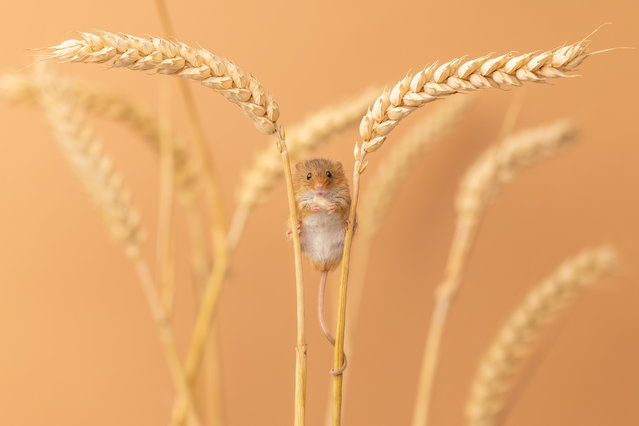
Stunning image capture the moment a tiny harvest mouse uses wheat stems as stilts as he munches on a kernel in UK in August 2025. The minute-mouse, who weighs as much as a 2p coin and is only two-inches-long, uses his prehensile tail to keep himself perfectly level. (Photo by Tony Nellis/South West News Service)

Stunning image capture the moment a tiny harvest mouse uses wheat stems as stilts as he munches on a kernel in UK in August 2025. The minute-mouse, who weighs as much as a 2p coin and is only two-inches-long, uses his prehensile tail to keep himself perfectly level. (Photo by Tony Nellis/South West News Service)
Details
24 Aug 2025 04:16:00
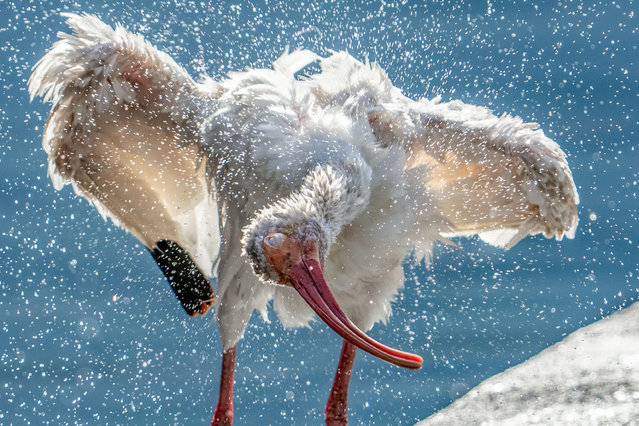
A white ibis takes a shower at Lake Eola in Orlando, Florida, US on September 29, 2025. (Photo byRonen Tivony/NurPhoto/Rex Features/Shutterstock)

A white ibis takes a shower at Lake Eola in Orlando, Florida, US on September 29, 2025. (Photo byRonen Tivony/NurPhoto/Rex Features/Shutterstock)
Details
12 Oct 2025 04:36:00
A woman plays with a kitten inside of a line house in downtown Shanghai April 12, 2015. (Photo by Carlos Barria/Reuters)

A woman plays with a kitten inside of a line house in downtown Shanghai April 12, 2015. (Photo by Carlos Barria/Reuters)
Details
24 Apr 2015 10:55:00


Artwork by Ruth Bellotti & Steve Rosewell called “Soldier Scale 1:1” is seen at the 2008 Sculpture by the Sea launch at Mark's Park, Bondi on October 15, 2008 in Sydney, Australia. (Photo by Gaye Gerard/Getty Images)
Details
10 Jul 2011 09:15:00
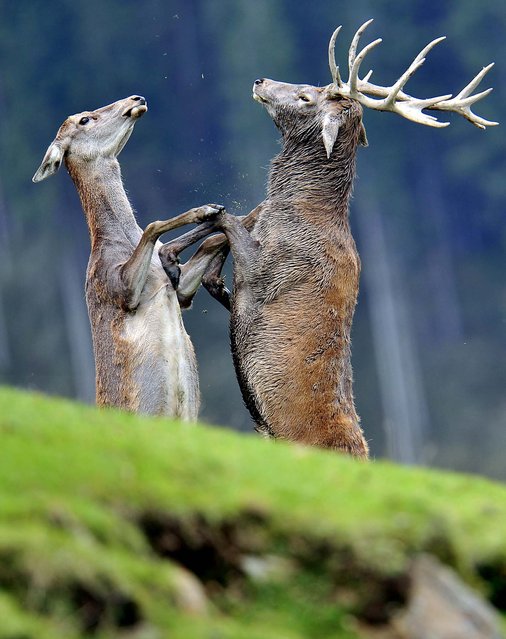
Two stags fight in a wildlife park in Aurach near Kitzbuehel, in the Austrian province of Tyrol. (Photo by Kerstin Joensson/Associated Press)

Two stags fight in a wildlife park in Aurach near Kitzbuehel, in the Austrian province of Tyrol. (Photo by Kerstin Joensson/Associated Press)
Details
30 Mar 2015 10:00:00
“Cassowaries are large, flightless birds related to emus and (more distantly) to ostriches, rheas, and kiwis”, writes Olivia Judson in the September issue of National Geographic magazine. (Photo by Christian Ziegler/National Geographic)

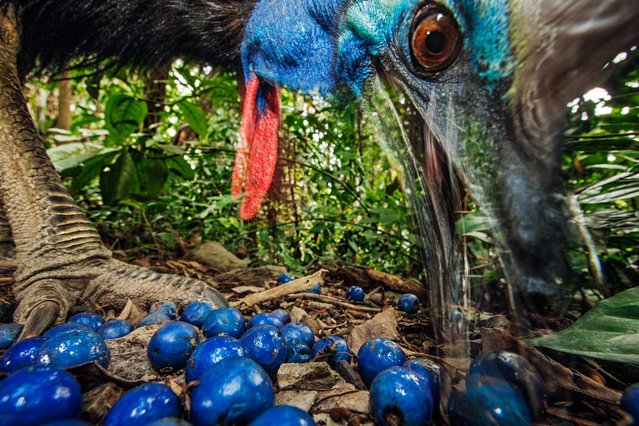
“Cassowaries are large, flightless birds related to emus and (more distantly) to ostriches, rheas, and kiwis”, writes Olivia Judson in the September issue of National Geographic magazine. How large? People-size: Adult males stand well over five foot five and top 110 pounds. Females are even taller, and can weigh more than 160 pounds. Dangerous when roused, they’re shy and peaceable when left alone. But even birds this big and tough are prey to habitat loss. The dense New Guinea and Australia rain forests where they live have dwindled. Today cassowaries might number 1,500 to 2,000. And because they help shape those same forests – by moving seeds from one place to another – “if they vanish”, Judson writes, “the structure of the forest would gradually change” too. (Photo by Christian Ziegler/National Geographic)

Details
06 Jan 2014 12:21:00