Loading...
Done
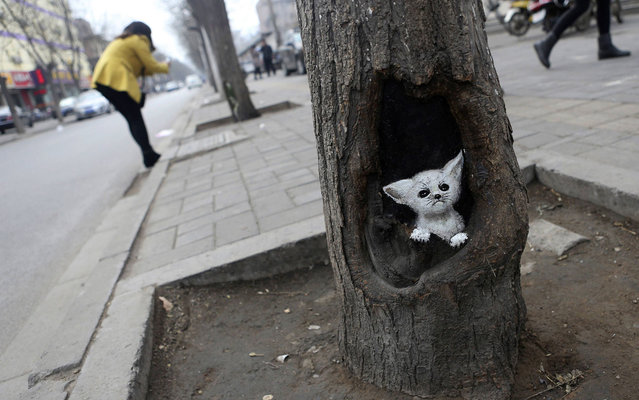
An image of a Fennec fox painted on a tree hole by Wang Yue is seen in Shijiazhuang, on March 13, 2013. Wang Yue, a senior at Dalian Industry University, uses her paintbrush to turn ugly tree holes into lovely views in Shijiazhuang, capital city of Hebei Province, China. Wang and her companions call the tree-hole paintings “meitu”, which means “beautiful journey”. The paintings on the trees have brightened the city during the dull, grey winter. (Photo by Pillar Lee/Reuters)

An image of a Fennec fox painted on a tree hole by Wang Yue is seen in Shijiazhuang, on March 13, 2013. Wang Yue, a senior at Dalian Industry University, uses her paintbrush to turn ugly tree holes into lovely views in Shijiazhuang, capital city of Hebei Province, China. Wang and her companions call the tree-hole paintings “meitu”, which means “beautiful journey”. The paintings on the trees have brightened the city during the dull, grey winter. (Photo by Pillar Lee/Reuters)

P.S. All pictures are presented in high resolution. To see Hi-Res images – just TWICE click on any picture. In other words, click small picture – opens the BIG picture. Click BIG picture – opens VERY BIG picture (if available; this principle works anywhere on the site AvaxNews).
Details
16 Mar 2013 11:27:00
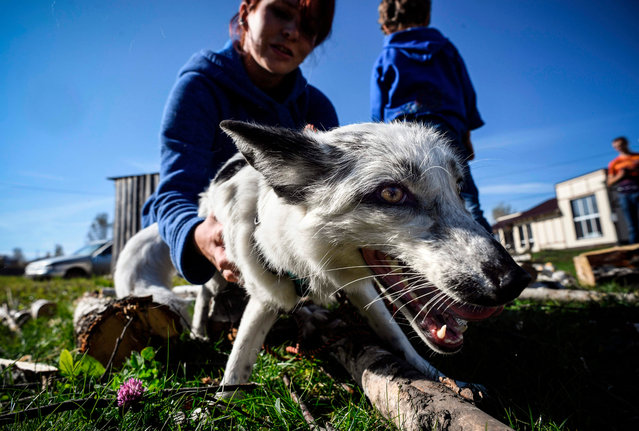
Tatyana Abramova, 33, plays with her home fox Plombir at her countryside house outside Siberian city of Novosibirsk on September 12, 2020. The official start of the Soviet experiment to better understand the domestication of animals by humans began in 1959, and was initiated by geneticists Dmitri Beliaiev and Lioudmila Trout on a farm in Akademgorodok, the scientific center of excellence in Siberia. Their primary objective was to domesticate foxes, to understand how the ancestor of wolves, another canine, evolved into a loyal and loving dog. And understand what this domestication tells us about the genetic evolution of species. (Photo by Alexander Nemenov/AFP Photo)

Tatyana Abramova, 33, plays with her home fox Plombir at her countryside house outside Siberian city of Novosibirsk on September 12, 2020. The official start of the Soviet experiment to better understand the domestication of animals by humans began in 1959, and was initiated by geneticists Dmitri Beliaiev and Lioudmila Trout on a farm in Akademgorodok, the scientific center of excellence in Siberia. Their primary objective was to domesticate foxes, to understand how the ancestor of wolves, another canine, evolved into a loyal and loving dog. And understand what this domestication tells us about the genetic evolution of species. (Photo by Alexander Nemenov/AFP Photo)
Details
25 Oct 2020 00:05:00
Nature – first prize, stories. Pandemic Pigeons – A Love Story. The photographer’s daughter, Merel, cowers after Dollie flies past and perches on the balcony before entering the house in Vlaardingen in the Netherlands on 6 April 2020. “She’s still frightened when Dollie suddenly lands on the balcony railing. I hide my smile behind the camera, as I try to comfort her by saying they won’t hurt you. “I thought he was going to attack me”, she replies. As the nesting pigeons keep coming back to our place, slowly my girls have started to appreciate them – perhaps not as much as I do, but it’s a start”. (Photo by Jasper Doest/World Press Photo 2021)

Nature – first prize, stories. Pandemic Pigeons – A Love Story. The photographer’s daughter, Merel, cowers after Dollie flies past and perches on the balcony before entering the house in Vlaardingen in the Netherlands on 6 April 2020. “She’s still frightened when Dollie suddenly lands on the balcony railing. I hide my smile behind the camera, as I try to comfort her by saying they won’t hurt you. “I thought he was going to attack me”, she replies. As the nesting pigeons keep coming back to our place, slowly my girls have started to appreciate them – perhaps not as much as I do, but it’s a start”. (Photo by Jasper Doest/World Press Photo 2021)
Details
17 Apr 2021 09:30:00
A love story with two log choppers. “In 1993, I was working on a project about life in the Olomouc region of Czechoslovakia. One day, I came to the village of Dlouhá Loučka-Křivá and went into a courtyard where I saw two old people, a husband and wife, sawing firewood for winter. They were working quietly, concentrating. I watched them fetch a beam from a wrecked barn, but they didn’t discuss how they planned to carry it to the saw. The woman faced one way, the man the other. When they realised, the woman eventually turned and followed her husband. The picture I took is the picture of many relationships – when each partner wants something different, but they have to come to an agreement, pull together eventually”. (Photo by Jindrich Streit)

A love story with two log choppers. “In 1993, I was working on a project about life in the Olomouc region of Czechoslovakia. One day, I came to the village of Dlouhá Loučka-Křivá and went into a courtyard where I saw two old people, a husband and wife, sawing firewood for winter. They were working quietly, concentrating. I watched them fetch a beam from a wrecked barn, but they didn’t discuss how they planned to carry it to the saw. The woman faced one way, the man the other. When they realised, the woman eventually turned and followed her husband. The picture I took is the picture of many relationships – when each partner wants something different, but they have to come to an agreement, pull together eventually”. (Photo by Jindrich Streit)
Details
04 Aug 2016 12:34:00
Palestinian barber Ramadan Odwan styles and straightens the hair of a customer with fire at his salon in Rafah, in the southern Gaza Strip February 2, 2017. In Ramadan Odwan's barbershop in Gaza, hair isn't just blow-dried, it's blowtorch-dried. “People have gone crazy about it, many people are curious to go through the experience and they are not afraid”, he told Reuters. “People here love adventures”. Odwan, 37, is not the first stylist in the world to use flame to straighten hair, but his craft is unique in the Gaza Strip. In his salon in the southern Gaza town of Rafah, Odwan applied what he described as a protective liquid coating to a customer's hair – he declined to disclose its contents – before aiming for the head and pressing the button on a small blowtorch. “I control how long I apply fire, I keep it on and off for 10 seconds or 15 seconds. It is completely safe and I have not encountered any accident since I started it two months ago”, Odwan added. Odwan charges 20 shekels ($5.20) for a haircut and fire-straightening. A barber for the past 18 years, he said part of the reason he uses the technique is to show that Palestinian barbers are as “professional as those out there around the world”. (Photo by Ibraheem Abu Mustafa/Reuters)

Palestinian barber Ramadan Odwan styles and straightens the hair of a customer with fire at his salon in Rafah, in the southern Gaza Strip February 2, 2017. In Ramadan Odwan's barbershop in Gaza, hair isn't just blow-dried, it's blowtorch-dried. “People have gone crazy about it, many people are curious to go through the experience and they are not afraid”, he told Reuters. “People here love adventures”. (Photo by Ibraheem Abu Mustafa/Reuters)
Details
11 Feb 2017 00:05:00
Two women cry in grief after armed assailants in a motorcycle shot their loved one in a main thoroughfare on July 23, 2016 in Manila, Philippines. The victim was an alleged drug peddler a claim disputed by his wife and maintained her husband is nothing more than a pedicab driver plying his trade when he was shot in front of her. Philippine President Rodrigo Duterte declared a war on crime and drugs after winning the presidential elections on May 9, 2016. President Duterte has recently been living up to his nickname, 'The Punisher', as Philippine police have been conducting night time drug raids on almost a daily basis. With reports of at least 300 drug related deaths since the start of July, Human rights groups and the Catholic church have objected to the use of brutal force by the Police. (Photo by Dondi Tawatao/Getty Images)

Two women cry in grief after armed assailants in a motorcycle shot their loved one in a main thoroughfare on July 23, 2016 in Manila, Philippines. The victim was an alleged drug peddler a claim disputed by his wife and maintained her husband is nothing more than a pedicab driver plying his trade when he was shot in front of her. Philippine President Rodrigo Duterte declared a war on crime and drugs after winning the presidential elections on May 9, 2016. President Duterte has recently been living up to his nickname, “The Punisher”, as Philippine police have been conducting night time drug raids on almost a daily basis. (Photo by Dondi Tawatao/Getty Images)
Details
15 Oct 2016 10:56:00
GIF Art By James Kerr

James Kerr started his project “Scorpion Dagger” without any real direction, except for the intention to make one GIF everyday(ish) for one year. He had been making collages for some time and “Scorpion Dagger” started out to be a test of discipline and a way for him to learn how to animate. Making GIFs was a logical evolution to him. The project represents many different things to him, the works from which he draws upon are so powerful and inspirational to him, that he is now nearly obsessed with repurposing them to share his vision of the world, and perhaps inspire people to look at art differently. The project is tremendously personal to him, it’s a lot more than the humor that’s at its surface and he is still trying to work out what “Scorpion Dagger” really is.


Details
19 Dec 2013 10:31:00
Dan surrounded by seven days of her own rubbish in Pasadena, California. (Photo by Gregg Segal/Barcroft Media)

Dan surrounded by seven days of her own rubbish in Pasadena, California. If you've never thought about how much rubbish you throw away an honest photographic series will open your eyes. Men, women, couples and families with young children have been photographed lying on their backs surrounded by a week's worth of their own rubbish – from old cartons of milk, used nappies and even tampons. The startling series “Seven Days of Garbage” by Californian photographer Gregg Segal is an unforgettable reminder of the amount of waste a human collects in just seven days. (Photo by Gregg Segal/Barcroft Media)
Details
16 Jul 2014 14:41:00