Loading...
Done
Yolaina Chavez Talavera, 31, a firefighter, poses for a photograph in front of a truck at a fire station in Managua, Nicaragua, February 22, 2017. “In my early days as a female firefighter, men, my team mates, thought that I would not last long in the organisation due to the hard training. However, in practice I showed them that I am able to take on tasks at the same level as men. I think women must fight to break through in all areas, in the midst of the machismo that still persists in Nicaragua and in Hispanic countries”, Talavera said. (Photo by Oswaldo Rivas/Reuters)

Wednesday March 8 marks International Women's Day, with festivals, concerts and exhibitions among the numerous events planned around the world to celebrate the achievements of women in society. The annual event has been held since the early 1900s and traditionally promotes a different theme each year, with this year's edition calling on people to #BeBoldForChange and push for a more gender-inclusive working world. Reuters photographers have been speaking with women in a range of professions around the world about their experiences of gender inequality. Here: Yolaina Chavez Talavera, 31, a firefighter, poses for a photograph in front of a truck at a fire station in Managua, Nicaragua, February 22, 2017. (Photo by Oswaldo Rivas/Reuters)
Details
04 Mar 2017 00:06:00
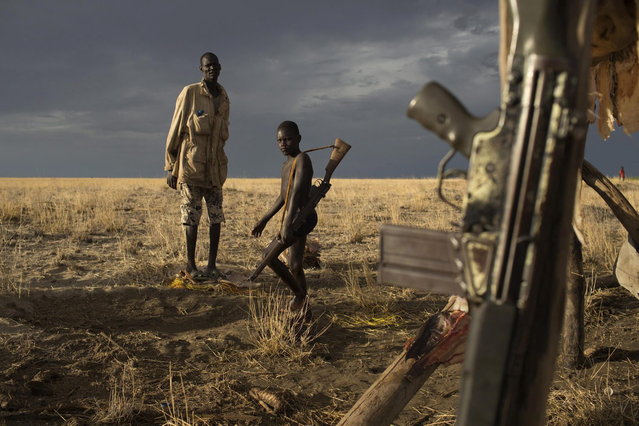
A Turkana man and a boy carrying a gun look on as a G3 battle rifle hangs from a structure used to dry fish at a fishing camp on the shores of Lake Turkana, some kilometres from Todonyang near the Kenya-Ethiopia border in northwestern Kenya October 12, 2013. (Photo by Siegfried Modola/Reuters)

A Turkana man and a boy carrying a gun look on as a G3 battle rifle hangs from a structure used to dry fish at a fishing camp on the shores of Lake Turkana, some kilometres from Todonyang near the Kenya-Ethiopia border in northwestern Kenya October 12, 2013The Turkana are traditionally nomadic pastoralists, but they have seen the pasture that they need to feed their herds suffer from recurring droughts and many have turned to fishing. However, Lake Turkana is overfished, and scarcity of food and pastureland is fuelling long-standing conflict with Ethiopian indigenous Dhaasanac, who have seen grazing grounds squeezed by large-scale government agricultural schemes in southern Ethiopia. The Dhaasanac now venture ever deeper into Kenyan territory in search of fish and grass, clashing with neighbours. Fighting between the communities has a long history, but the conflict has become ever more fatal as automatic weapons from other regional conflicts seep into the area. While the Turkana region is short of basics like grass and ground-water, it contains other resources including oil reserves and massive, newly discovered underground aquifers. (Photo by Siegfried Modola/Reuters)
Details
05 Dec 2013 12:08:00


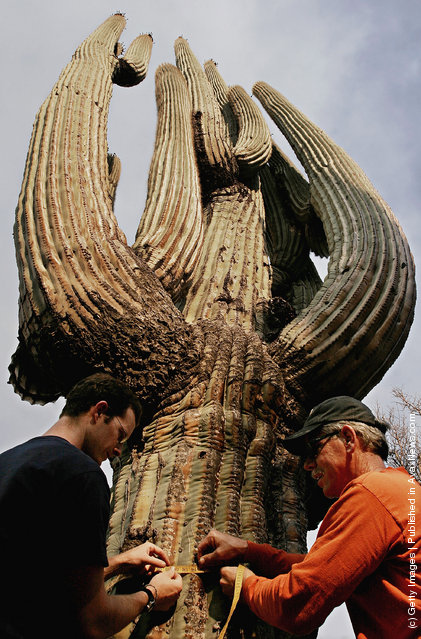
“The saguaro (scientific name Carnegiea gigantea) is a large, tree-sized cactus species in the monotypic genus Carnegiea. It is native to the Sonoran Desert in the U.S. state of Arizona, the Mexican state of Sonora, a small part of Baja California in the San Felipe Desert and an extremely small area of California, U.S. The saguaro blossom is the State Wildflower of Arizona”. – Wikipedia

Photo: Daniel Appel (L), a firefighter with Engine 84 from the Lassen National Forest in California and Mike Hallen, (R), Arizona representative of the National Register of Big Trees, measure the circumference of this Saguaro cactus called the "Grand One," in the Tonto National Forest on July 1, 2005 35 miles north of Phoenix, near Carefree, Arizona. The cactus, estimated to be more than 200 years old, measures a circumference of 7 feet, 10 inches (2.4 meters) and stands 46 feet high (14 meters). The cactus was burned in the Cave Creek Complex fire and may not survive. It was once the largest Saguaro in the world, two others have been found recently that have tied it's measurements. The fire has burned more than 214,000 acres of the Sonoran desert. (Photo by Jeff Topping/Getty Images)
Details
26 Jul 2011 12:27:00
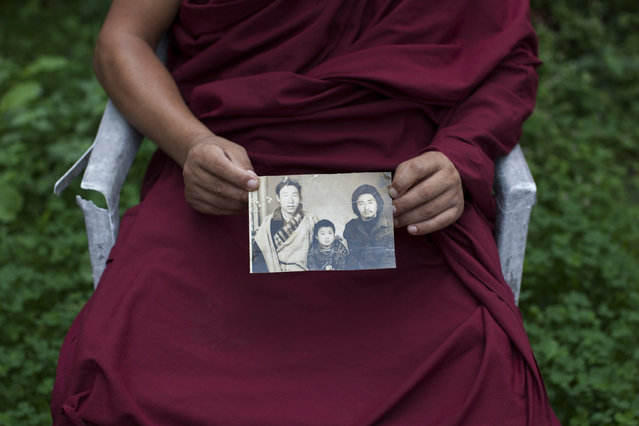
In this Saturday, September 27, 2014 photo, Tibetan monk Dorjee, 38, displays a photograph of his father, left, and himself, center, taken in Tibet, in Dharamsala, India. Dorjee said he held back his tears when he spoke with his parents on the phone after a separation period of 27 years. He exchanged a few words with his father but said his mother fainted on hearing his voice. (Photo by Tsering Topgyal/AP Photo)

“When I was 8 years old, my parents paid a smuggler to take me across the Himalayas, a weekslong walk over the mountains from Tibet to India. It was a trek that tens of thousands of other Tibetans have taken since the Dalai Lama fled a failed 1959 uprising against Chinese rule. My parents must have had their reasons to send me here; they must have had the best of intentions. But 18 years later, I still don't know why they did it. They are not political people. They are small farmers who raise barley and a few yak in a rural area not far from Lhasa, the Tibetan capital. I have not seen them since I left...”. – Tsering Topgyal via The Associated Press. (Photo by Tsering Topgyal/AP Photo)
Details
05 Nov 2014 12:27:00
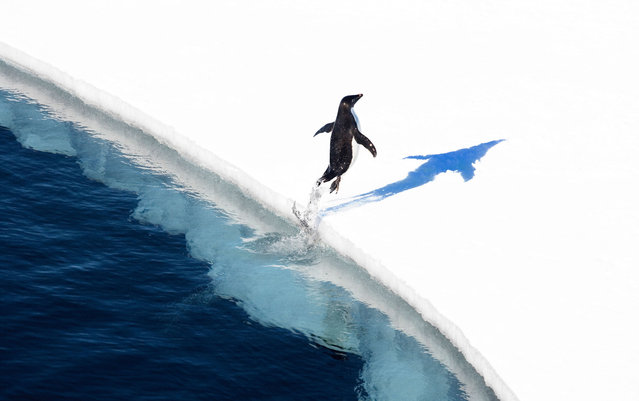
This undated handout photo received from the Antarctic Ocean Alliance on October 28, 2016 shows a adelie penguin jumping onto the ice in the Ross Sea in Antarctica. The world's largest marine reserve aimed at protecting the pristine wilderness of Antarctica will be created after a “momentous” agreement was finally reached on October 28, 2016 with Russia dropping its long-held opposition. A remote and largely pristine stretch of ocean off Antarctica received international protection on Friday, becoming the world's largest marine reserve as a broad coalition of countries came together to protect 598,000 square miles of water. The new marine protected area in the Ross Sea was created by a unanimous decision of the international body that oversees the waters around Antarctica – the Commission for the Conservation of Antarctic Marine Living Resources – and was announced at the commission's annual meeting in Tasmania. The commission comprises 24 countries, including the United States, and the European Union. (Photo by John Weller/AFP Photo/Antarctic Ocean Alliance)

This undated handout photo received from the Antarctic Ocean Alliance on October 28, 2016 shows a adelie penguin jumping onto the ice in the Ross Sea in Antarctica. The world's largest marine reserve aimed at protecting the pristine wilderness of Antarctica will be created after a “momentous” agreement was finally reached on October 28, 2016 with Russia dropping its long-held opposition. (Photo by John Weller/AFP Photo/Antarctic Ocean Alliance)
Details
29 Oct 2016 11:43:00
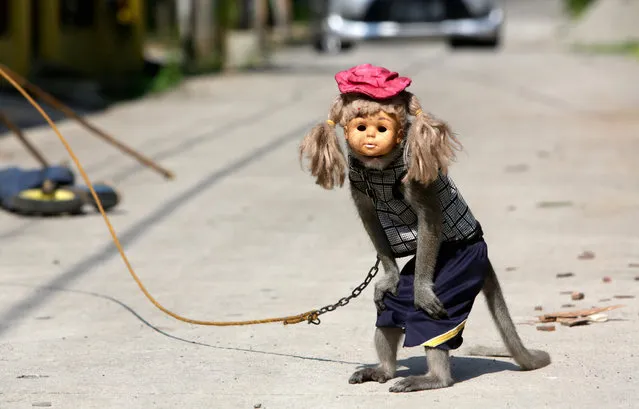
A chained male monkey in a costume and wearing a toy mask performs at a street in Depok, West Java, Indonesia, 30 September 2021. A performing monkey in a street, known as “Topeng Monyet” (lit. Monkey Mask), is a popular form of cheap entertainment in Indonesia, especially on the island of Java. During a street monkey show, a trainer issues orders by pulling the chain tied around the primate's neck, forcing it to perform tricks such as wearing a mask or riding a toy motorcycle. The Indonesian government in 2013 banned the Topeng Monyet in the capital Jakarta to improve public order and ending animal abuse. However, monkey performances are still popular in several other parts of the country, such as West Java, especially after the government lowered the level of Enforcement of Restrictions on Community Activities (PPKM) in a number of areas during the COVID-19 pandemic. (Photo by Adi Weda/EPA/EFE)

A chained male monkey in a costume and wearing a toy mask performs at a street in Depok, West Java, Indonesia, 30 September 2021. A performing monkey in a street, known as “Topeng Monyet” (lit. Monkey Mask), is a popular form of cheap entertainment in Indonesia, especially on the island of Java. (Photo by Adi Weda/EPA/EFE)
Details
16 Oct 2021 09:08:00
Girls of University of Cincinnati Stage Grecian Games on April 29, 1921. Garbed in costumes of ancient Greece, fair students of the University of Cincinnati, Ohio arranged a set of Grecian Games for the benefit of the University athletic fund. All of the girl students of the University, who take a great interest in outdoor games and athletics, took part in the games. The fund was greatly increased through the staging of the unique attraction and the girls purpose to give a return engagement. The accompanying photographs show the girl contestants in their Grecian costumes. Photo shows the start of the 100 yard dash. (Photo by Bettmann Archive/Getty Images)

Girls of University of Cincinnati Stage Grecian Games on April 29, 1921. Garbed in costumes of ancient Greece, fair students of the University of Cincinnati, Ohio arranged a set of Grecian Games for the benefit of the University athletic fund. All of the girl students of the University, who take a great interest in outdoor games and athletics, took part in the games. The fund was greatly increased through the staging of the unique attraction and the girls purpose to give a return engagement. The accompanying photographs show the girl contestants in their Grecian costumes. Photo shows the start of the 100 yard dash. (Photo by Bettmann Archive/Getty Images)
Details
09 May 2021 08:10:00
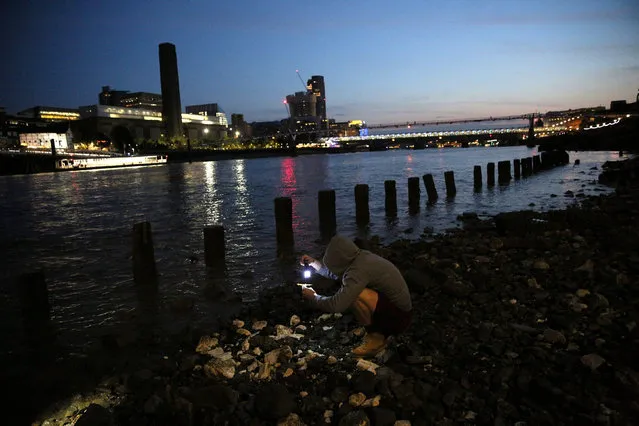
A mudlark uses a torch to look for items on the bank of the River Thames in London, Britain June 06, 2016. Mudlarking is believed to trace its origins to the 18th and 19th century, when scavengers searched the Thames' shores for items to sell. These days, history and archaeology fans are the ones hoping to find old relics such as coins, ceramics, artifacts or everyday items from across centuries. They wait for the low tide and then scour specific areas of exposed shores. "If you're in a field you could be out all day long, with the river you're restricted to about two or three hours," mudlark Nick Stevens said. While many just use the naked eye for their searches, others rely on metal detectors for which a permit from the Port of London Authority is needed. Digging also requires consent. (Photo by Neil Hall/Reuters)

A mudlark uses a torch to look for items on the bank of the River Thames in London, Britain June 06, 2016. Mudlarking is believed to trace its origins to the 18th and 19th century, when scavengers searched the Thames' shores for items to sell. These days, history and archaeology fans are the ones hoping to find old relics such as coins, ceramics, artifacts or everyday items from across centuries. their finds with the Portable Antiquities Scheme. Any item over 300 years old must be recorded. (Photo by Neil Hall/Reuters)
Details
27 Aug 2016 10:43:00