Loading...
Done
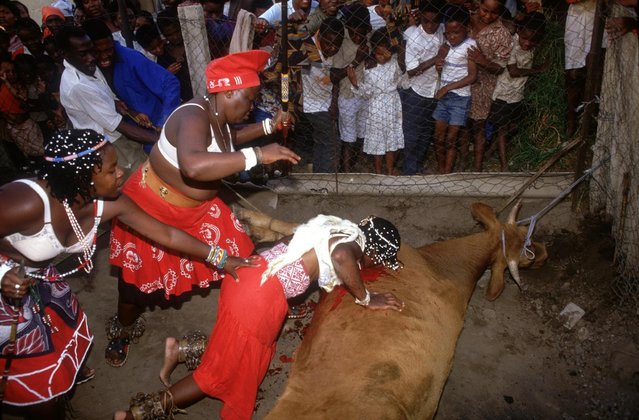
South African Sangomas are wizards and witches who are supposedly chosen by their ancestors to follow a traditional training and go through a rite of passage after which they become Sangomas and can cure and help people. They are so respected and trusted that western medical authorities have actually advised the government of South Africa to develop its cooperation with Sangomas in order to improve hygiene and health among the population. Today is graduation day for Trissa, 25, a Sangoma student in Tembisa, near Pretoria. Thanks to the help of the spirits of her ancestors, she has found a cow that had been hidden. The cow has then been killed by Sangoma Thelma and Trissa is now drinking its blood, thus becoming a Sangoma and changing her name to Nomadlozi. Location: Tembisa, near Pretoria, South Africa. (Photo by Patrick Durand/Sygma via Getty Images)

South African Sangomas are wizards and witches who are supposedly chosen by their ancestors to follow a traditional training and go through a rite of passage after which they become Sangomas and can cure and help people. They are so respected and trusted that western medical authorities have actually advised the government of South Africa to develop its cooperation with Sangomas in order to improve hygiene and health among the population. (Photo by Patrick Durand/Sygma via Getty Images)
Details
24 Feb 2017 00:05:00
View of an American marine as he lies in a foxhole and whistles at a husky, one of the scouting dogs used during the landing on Guam, August 1944. (Photo by W. Eugene Smith/Time & Life Pictures/Getty Images)

View of an American marine as he lies in a foxhole and whistles at a husky, one of the scouting dogs used during the landing on Guam, August 1944. (Photo by W. Eugene Smith/Time & Life Pictures/Getty Images)
Details
25 Feb 2017 00:04:00
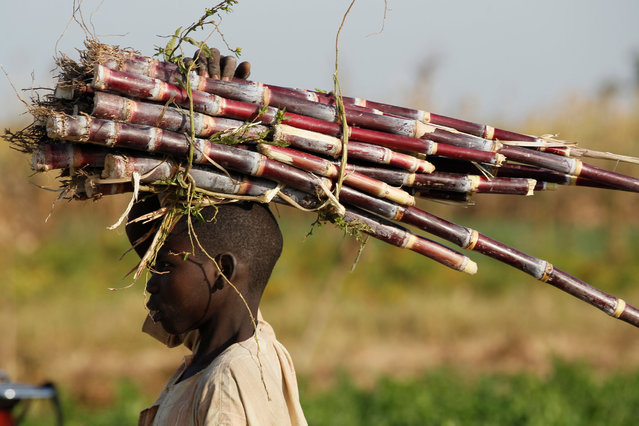
A boy carries sugar cane through a farm on the outskirt of Zaria in Nigeria's northern state of Kaduna November 15, 2016. (Photo by Akintunde Akinleye/Reuters)

A boy carries sugar cane through a farm on the outskirt of Zaria in Nigeria's northern state of Kaduna November 15, 2016. (Photo by Akintunde Akinleye/Reuters)
Details
05 Dec 2016 11:17:00
A woman looks at head of bluefin tuna on display in front of a store at Tsukiji fish market in Tokyo, Monday, February 19, 2018.  The large bluefin are particularly valuable in Japan, where they are considered a premium sushi and sashimi fish. A single fish sold for more than $1.75 million at an auction in Japan in 2013. (Photo by Koji Sasahara/AP Photo)

A woman looks at head of bluefin tuna on display in front of a store at Tsukiji fish market in Tokyo, Monday, February 19, 2018. The large bluefin are particularly valuable in Japan, where they are considered a premium sushi and sashimi fish. A single fish sold for more than $1.75 million at an auction in Japan in 2013. (Photo by Koji Sasahara/AP Photo)
Details
06 Mar 2018 00:05:00
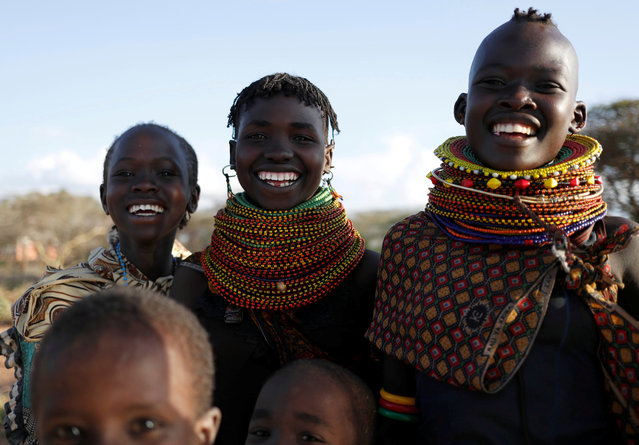
Young Turkana tribeswomen sing in a village near Baragoy, Kenya August 6, 2017. (Photo by Goran Tomasevic/Reuters)

Young Turkana tribeswomen sing in a village near Baragoy, Kenya August 6, 2017. Kenyans are due to go to the polls on Aug. 8. to vote in presidential elections after a tightly-fought race between President Uhuru Kenyatta and main opposition leader Raila Odinga. (Photo by Goran Tomasevic/Reuters)
Details
08 Aug 2017 07:05:00
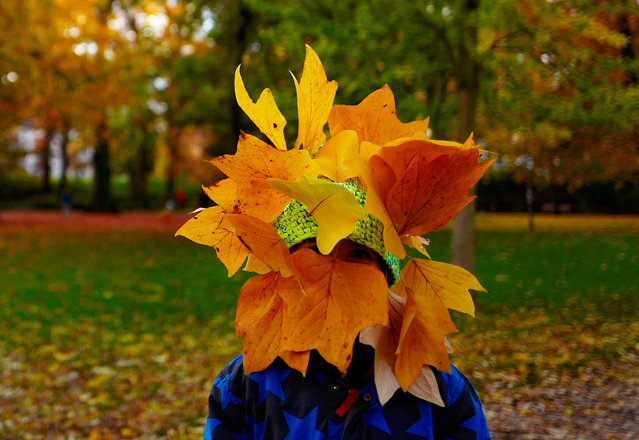
A boy covers his head with fallen leaves as he enjoys a stroll with his family in a park in downtown Frankfurt, Germany, November 6, 2016. (Photo by Kai Pfaffenbach/Reuters)

A boy covers his head with fallen leaves as he enjoys a stroll with his family in a park in downtown Frankfurt, Germany, November 6, 2016. (Photo by Kai Pfaffenbach/Reuters)
Details
14 Sep 2017 07:56:00
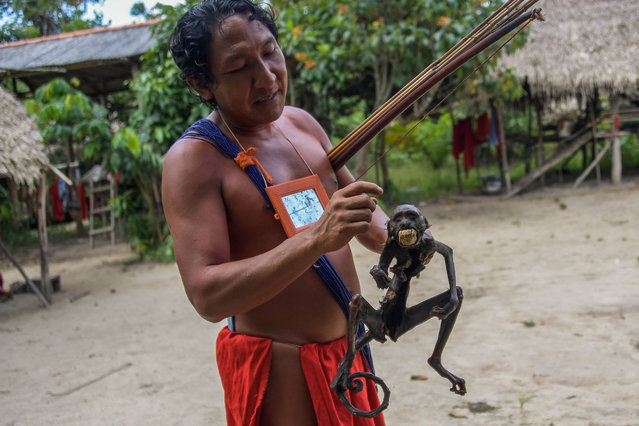
Chieftain Japarupi Waiapi shows a roasted monkey -part of Waiapi's diet, also based in Manioc and fruits- at the reserve in Amapa state in Brazil on October 13, 2017. When Waiapis walks into the Amazon forest surrounding their village, they do not see trees, but a kind of shopping mall providing medicine, food, shelter, tools and weapons  all under the eye of multiple spirits. (Photo by Apu Gomes/AFP Photo)

Chieftain Japarupi Waiapi shows a roasted monkey -part of Waiapi's diet, also based in Manioc and fruits- at the reserve in Amapa state in Brazil on October 13, 2017. When Waiapis walks into the Amazon forest surrounding their village, they do not see trees, but a kind of shopping mall providing medicine, food, shelter, tools and weapons all under the eye of multiple spirits. (Photo by Apu Gomes/AFP Photo)
Details
27 Oct 2017 08:39:00
In this August 17, 2016, photo, from left to right, Chhering Chodom, 60, Tashi Yangzom, 50, Lobsang Chhering, 27, and Dorje Tandup, 58, drink milk tea on the side of the road. For centuries, the sleepy valley nestled in the Indian Himalayas remained a hidden Buddhist enclave forbidden to outsiders. Enduring the harsh year-round conditions of the high mountain desert, the people of Spiti Valley lived by a simple communal code – share the Earth's bounty, be hospitable to neighbors, and eschew greed and temptation at all turns. That's all starting to change, for better or worse. Since India began allowing its own citizens as well as outsiders to visit the valley in the early 1990s, tourism and trade have boomed. And the marks of modernization, such as solar panels, asphalt roads and concrete buildings, have begun to appear around some of the villages that dot the remote landscape at altitudes above 4,000 meters (13,000 feet). (Photo by Thomas Cytrynowicz/AP Photo)

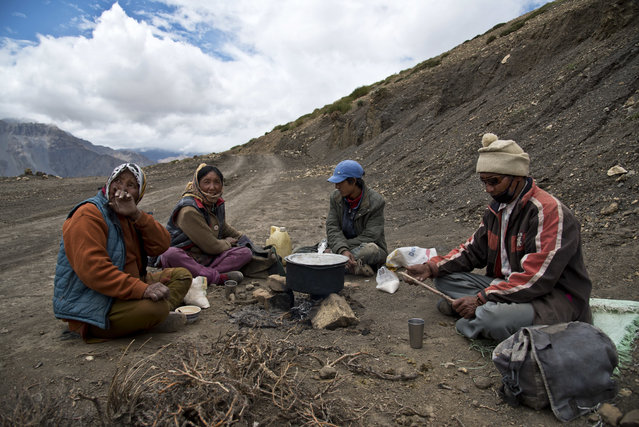
In this August 17, 2016, photo, from left to right, Chhering Chodom, 60, Tashi Yangzom, 50, Lobsang Chhering, 27, and Dorje Tandup, 58, drink milk tea on the side of the road. For centuries, the sleepy valley nestled in the Indian Himalayas remained a hidden Buddhist enclave forbidden to outsiders. Enduring the harsh year-round conditions of the high mountain desert, the people of Spiti Valley lived by a simple communal code – share the Earth's bounty, be hospitable to neighbors, and eschew greed and temptation at all turns. That's all starting to change, for better or worse. (Photo by Thomas Cytrynowicz/AP Photo)
Details
15 Sep 2016 09:22:00