Loading...
Done
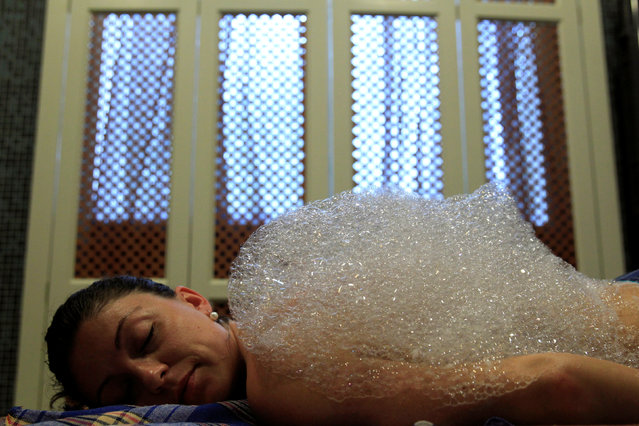
A woman is having a massage at the Lukacs Bath in Budapest, Hungary June 28, 2016. (Photo by Bernadett Szabo/Reuters)

A woman is having a massage at the Lukacs Bath in Budapest, Hungary June 28, 2016. Hungary's capital owes its popularity as a tourist destination partly to its numerous hot springs and bathing culture which have drawn visitors to the area since Roman times. Bath houses range from large, ornate 19th-century buildings like the Gellert and the Szechenyi to tiny Ottoman Turkish-era hamams, some of them more than 500 years old. (Photo by Bernadett Szabo/Reuters)
Details
20 Jul 2016 10:05:00
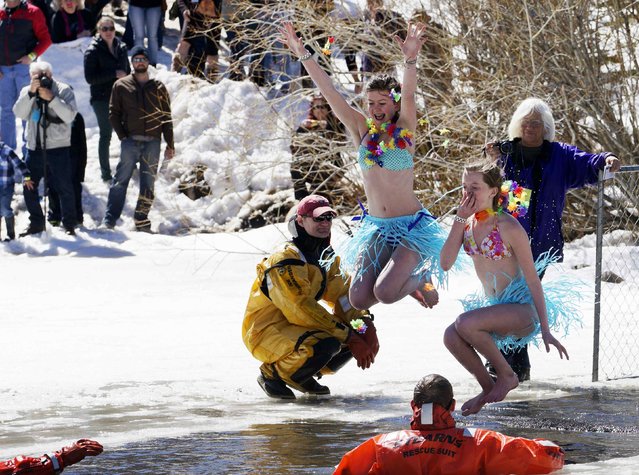
Two women jump into a frozen pond as they compete in the Polar Plunge at Frozen Dead Guy Days in Nederland, Colorado March 14, 2015. (Photo by Rick Wilking/Reuters)

Two women jump into a frozen pond as they compete in the Polar Plunge at Frozen Dead Guy Days in Nederland, Colorado March 14, 2015. The winter festival in the small mountain town commemorates the 1994 discovery of the corpse of Bredo Morstol, which is now housed in a shed on dry ice above the town. (Photo by Rick Wilking/Reuters)
Details
16 Mar 2015 10:37:00
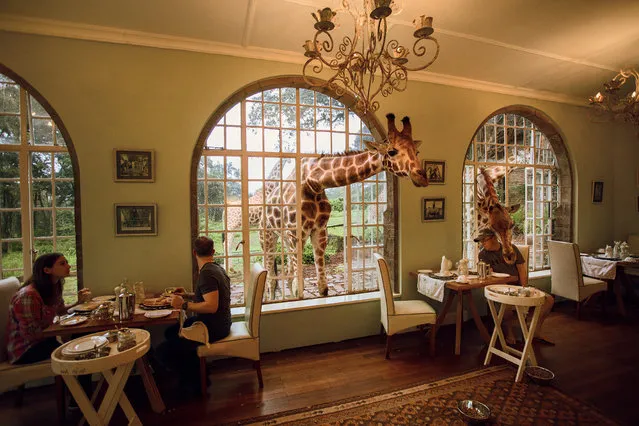
The giraffes visit twice a day searching for food, before returning to the forest. Although still wild animals, they have become accustomed to receiving treats from residents and guests. (Photo by Klaus Thymann)

Situated 10km outside Nairobi city centre, this private giraffe sanctuary is centred around a colonial manor house named Giraffe Manor. Living within the grounds is a herd of rare Rothschild giraffe. The giraffes visit twice a day searching for food, before returning to the forest. Although still wild animals, they have become accustomed to receiving treats from residents and guests. (Photo by Klaus Thymann)
Details
28 Jan 2016 12:36:00
Local residents dressed in costumes perform during celebrations for the Malanka holiday in the village of Krasnoilsk in the Chernivtsi region of Ukraine, January 14, 2016. The Malanka traditional holiday is more popular in the western regions of the country and is also known as the Old New Year celebrated on January 13 and 14 - St. Basil's and St. Melania's Day, according to the old Julian calendar. During the celebrations, youngsters and adults wear traditional carnival costumes and masks, and visit local houses while singing carols, playing pranks or performing short plays. (Photo by Valentyn Ogirenko/Reuters)

Local residents dressed in costumes perform during celebrations for the Malanka holiday in the village of Krasnoilsk in the Chernivtsi region of Ukraine, January 14, 2016. The Malanka traditional holiday is more popular in the western regions of the country and is also known as the Old New Year celebrated on January 13 and 14 – St. Basil's and St. Melania's Day, according to the old Julian calendar. During the celebrations, youngsters and adults wear traditional carnival costumes and masks, and visit local houses while singing carols, playing pranks or performing short plays. (Photo by Valentyn Ogirenko/Reuters)
Details
16 Jan 2016 08:04:00
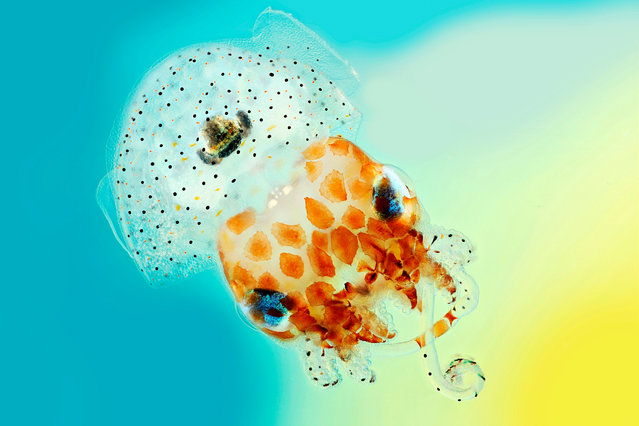
With its huge eyes, comical name and diminutive size, Mark R. Smith’s image of a baby Hawaiian bobtail squid can’t help but raise a smile. A curiously endearing creature, the cephalopod is just 1.5cm across, its mantle cavity bearing more than a passing resemblance to a rather natty shower cap. But it is also a beautiful example of symbiosis – nature’s version of “I’ll scratch your back if you scratch mine” – for on the underside of the squid is a light organ which houses bioluminescent bacteria. The squid offers the bacteria protection and food, while the bacteria emit a glow – a handy trait that the squid uses to offset its silhouette, helping it to evade predators in the depths below. Mark R. Smith’s entry combines several images of a Hawaiian bobtail squid with different focus lengths to create a final picture with greater depth of field than normal. (Photo by Mark R. Smith/Wellcome Images/Macroscopic Solutions)

With its huge eyes, comical name and diminutive size, Mark R. Smith’s image of a baby Hawaiian bobtail squid can’t help but raise a smile. A curiously endearing creature, the cephalopod is just 1.5cm across, its mantle cavity bearing more than a passing resemblance to a rather natty shower cap. But it is also a beautiful example of symbiosis – nature’s version of “I’ll scratch your back if you scratch mine” – for on the underside of the squid is a light organ which houses bioluminescent bacteria. The squid offers the bacteria protection and food, while the bacteria emit a glow – a handy trait that the squid uses to offset its silhouette, helping it to evade predators in the depths below. Mark R. Smith’s entry combines several images of a Hawaiian bobtail squid with different focus lengths to create a final picture with greater depth of field than normal. (Photo by Mark R. Smith/Wellcome Images/Macroscopic Solutions)
Details
08 Mar 2017 00:05:00
A Palestinian father evacuates his wounded daughter from the rubble of a destroyed house after an Israeli air strike in Gaza City, 16 May 2021. A total of 174 people have been killed in Israeli raids on Gaza, including 47 children and 29 women, the Palestinian Ministry of Health said on Sunday. In response violent confrontations between Israeli security forces and Palestinians in Jerusalem, various Palestinian militant factions in Gaza launched rocket attacks on Israel since 10 May, resulting in retaliatory strikes by Israel on Gaza. (Photo by Haitham Imad/EPA/EFE)

A Palestinian father evacuates his wounded daughter from the rubble of a destroyed house after an Israeli air strike in Gaza City, 16 May 2021. A total of 174 people have been killed in Israeli raids on Gaza, including 47 children and 29 women, the Palestinian Ministry of Health said on Sunday. In response violent confrontations between Israeli security forces and Palestinians in Jerusalem, various Palestinian militant factions in Gaza launched rocket attacks on Israel since 10 May, resulting in retaliatory strikes by Israel on Gaza. (Photo by Haitham Imad/EPA/EFE)
Details
17 May 2021 07:52:00
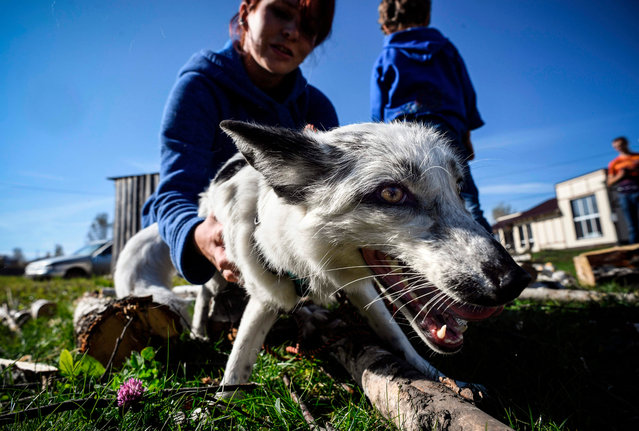
Tatyana Abramova, 33, plays with her home fox Plombir at her countryside house outside Siberian city of Novosibirsk on September 12, 2020. The official start of the Soviet experiment to better understand the domestication of animals by humans began in 1959, and was initiated by geneticists Dmitri Beliaiev and Lioudmila Trout on a farm in Akademgorodok, the scientific center of excellence in Siberia. Their primary objective was to domesticate foxes, to understand how the ancestor of wolves, another canine, evolved into a loyal and loving dog. And understand what this domestication tells us about the genetic evolution of species. (Photo by Alexander Nemenov/AFP Photo)

Tatyana Abramova, 33, plays with her home fox Plombir at her countryside house outside Siberian city of Novosibirsk on September 12, 2020. The official start of the Soviet experiment to better understand the domestication of animals by humans began in 1959, and was initiated by geneticists Dmitri Beliaiev and Lioudmila Trout on a farm in Akademgorodok, the scientific center of excellence in Siberia. Their primary objective was to domesticate foxes, to understand how the ancestor of wolves, another canine, evolved into a loyal and loving dog. And understand what this domestication tells us about the genetic evolution of species. (Photo by Alexander Nemenov/AFP Photo)
Details
25 Oct 2020 00:05:00
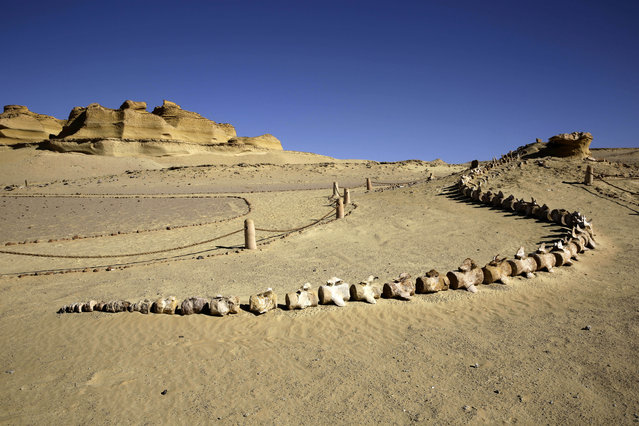
Fossilized whale bones are on display  outside the Wati El Hitan Fossils and Climate Change Museum, a UNESCO natural World Heritage site, on the opening day, in the Fayoum oasis, Egypt, Thursday, January 14, 2016. Egypt has cut the ribbon on the Middle East's first fossil museum housing the world's largest intact skeleton of a "walking whale" in an attempt to attract much-needed tourists driven off by recent militant attacks. The construction of the much-hyped Fossils and Climate Change Museum was covered a 2 billion euros (2. 17 billion dollars) grant from Italy, according to Italian Ambassador Maurizio Massari. (Photo by Thomas Hartwell/AP Photo)

Fossilized whale bones are on display outside the Wati El Hitan Fossils and Climate Change Museum, a UNESCO natural World Heritage site, on the opening day, in the Fayoum oasis, Egypt, Thursday, January 14, 2016. Egypt has cut the ribbon on the Middle East's first fossil museum housing the world's largest intact skeleton of a "walking whale" in an attempt to attract much-needed tourists driven off by recent militant attacks. The construction of the much-hyped Fossils and Climate Change Museum was covered a 2 billion euros (2. 17 billion dollars) grant from Italy, according to Italian Ambassador Maurizio Massari. Its centerpiece is an intact, 37-million-year-old and 20-meter-long skeleton of a legged form of whale that testifies to how modern-day whales evolved from land mammals. The sand-colored, dome-shaped museum is barely discernible in the breathtaking desert landscape that stretches all around. (Photo by Thomas Hartwell/AP Photo)
Details
16 Jan 2016 08:06:00