Loading...
Done
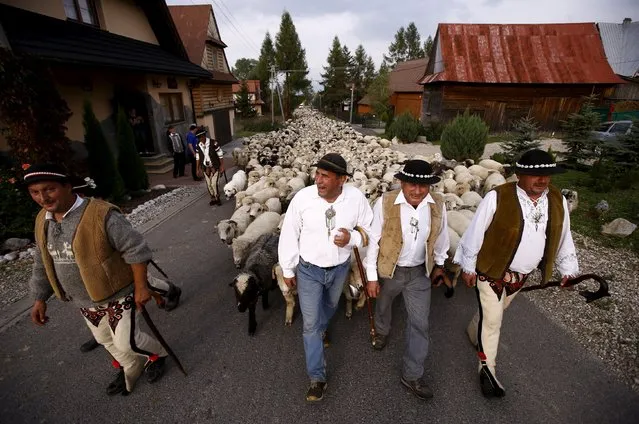
Shepherds walk with sheep through the village on their way home during autumn redyk in Gron, Tatra Mountains region of southern Poland, October 6, 2015. (Photo by Kacper Pempel/Reuters)

Shepherds walk with sheep through the village on their way home during autumn redyk in Gron, Tatra Mountains region of southern Poland, October 6, 2015. Redyk is a traditional, kilometres-long march of highlanders with flocks of sheep, which takes place twice a year: in the spring at the start of the grazing season, and in the autumn at season's end. (Photo by Kacper Pempel/Reuters)
Details
19 Oct 2015 08:01:00
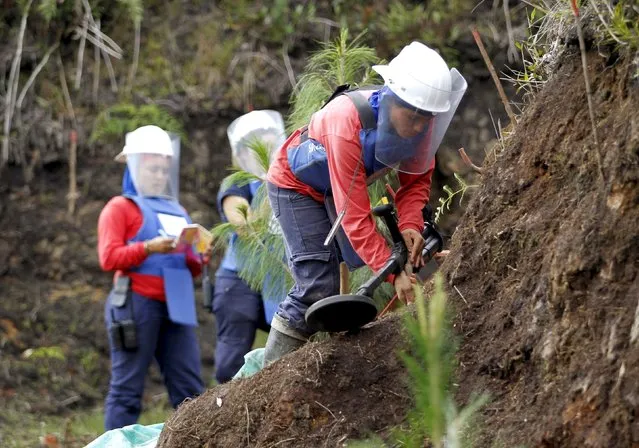
Natalia Arango works with her mine detector in a zone of landmines planted by rebels groups near Sonson in Antioquia province, November 19, 2015. (Photo by Fredy Builes/Reuters)

Natalia Arango works with her mine detector in a zone of landmines planted by rebels groups near Sonson in Antioquia province, November 19, 2015. Women's work takes on a nontraditional meaning for fifteen Colombian women who work to rid the Antioquia Mountains of deadly landmines as the country edges closer to a peace agreement with Marxist rebels to end over a decade of conflict which has claimed 220,000 lives. (Photo by Fredy Builes/Reuters)
Details
27 Nov 2015 04:44:00
Women, who are members of Saaed group, prepare food to be given out as Iftar meals for the poor and internally displaced Syrians during the month of Ramadan in Damascus, Syria June 18, 2016. (Photo by Omar Sanadiki/Reuters)

Women, who are members of Saaed group, prepare food to be given out as Iftar meals for the poor and internally displaced Syrians during the month of Ramadan in Damascus, Syria June 18, 2016. Iftar (or Fatoor) is the evening meal when Muslims end their daily Ramadan fast at sunset. Muslims break their fast at the time of the call to prayer for the evening prayer. (Photo by Omar Sanadiki/Reuters)
Details
20 Jun 2016 12:12:00
Bioluminescent sea fireflies glittering like diamonds on the rocks and sand. Okayama, Japan. July 2016. (Photo by Trevor Williams/Jonathan Galione/Getty Images)

Those lights are actually bioluminescent shrimp, better known as sea fireflies, or, in Japan, as “umibotaru”. Visible every year from May until the end of October, they live in the sand around very shallow sea water and are often seen floating between the extremes of high and low tides. Here: Bioluminescent sea fireflies glittering like diamonds on the rocks and sand. Okayama, Japan. July 2016. (Photo by Trevor Williams/Jonathan Galione/Getty Images)
Details
23 Aug 2016 10:13:00
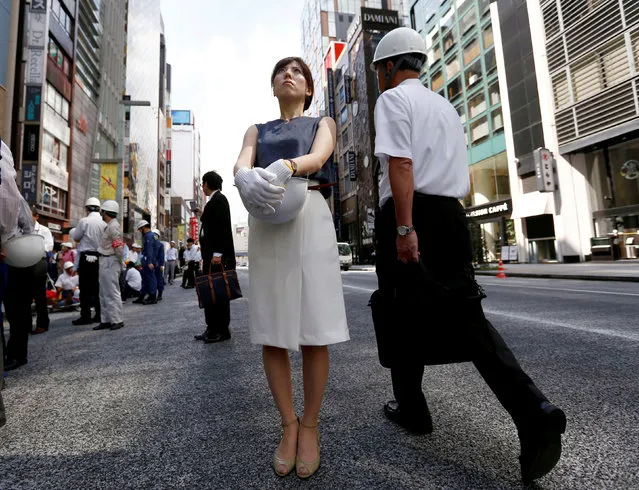
People wearing and holding helmets take part in a drill simulating a 7.2 magnitude earthquake in Tokyo, Japan, August 26, 2016. (Photo by Kim Kyung-Hoon/Reuters)

People wearing and holding helmets take part in a drill simulating a 7.2 magnitude earthquake in Tokyo, Japan, August 26, 2016. The drill was held in Ginza, a high-end shopping and business district, and held ahead of the 93rd anniversary of the Great Kanto Earthquake of 1923 which claimed at least 100,000 casualties. It was one of the largest natural disasters in recorded history and since 1960, September 1st, and the period around that date has been declared as national disaster prevention awareness period. (Photo by Kim Kyung-Hoon/Reuters)
Details
27 Aug 2016 10:47:00
A heavily tattooed Japanese woman poses for photographs near Asakusa Temple during the third and final day of Sanja Festival, on May 20, 2018 in Tokyo, Japan. Sanja Festival is one of Japan's major festivals and is held annually in the Asakusa area of Tokyo. The three day event starts with a grand parade with people in traditional costumes performing dances before around a hundred mikoshi (portable shrines) from the local communities are carried to and from Asakusa Temple watched on by an audience of locals and tourists. (Photo by Carl Court/Getty Images)

A heavily tattooed Japanese woman poses for photographs near Asakusa Temple during the third and final day of Sanja Festival, on May 20, 2018 in Tokyo, Japan. Sanja Festival is one of Japan's major festivals and is held annually in the Asakusa area of Tokyo. (Photo by Carl Court/Getty Images)
Details
22 May 2018 07:21:00
Individuals and populations student winner. Limbing in the Tropics, photographed in Manaus, Brazil. While walking in the Amazon rainforest looking for bat roosts to set up mist nets to capture bats for scientific research, a faint and almost imperceptible noise suddenly caught this photographer’s attention. An anteater was climbing with exceptional ability in a tangled mess of branches and lianas. With an unbelievable calmness, the animal watched the photographer at work and seemed to enjoy being the subject of an impromptu photography session in the most biodiverse ecosystem on Earth. (Photo by Adrià López Baucells/University of Lisbon/British Ecological Society)

Individuals and populations student winner. Limbing in the Tropics, photographed in Manaus, Brazil. While walking in the Amazon rainforest looking for bat roosts to set up mist nets to capture bats for scientific research, a faint and almost imperceptible noise suddenly caught this photographer’s attention. An anteater was climbing with exceptional ability in a tangled mess of branches and lianas. (Photo by Adrià López Baucells/University of Lisbon/British Ecological Society)
Details
05 Dec 2018 00:03:00
We Build Tomorrow – Sagrada Familia 2026 ( VIDEO )

For more than a century, the Barcelona skyline has been graced (or marred, depending on who’s talking) by the spectacle of the Basilica designed by Anton Gaudi, first started in 1882. If you want to know what it’ll look like when finished, don’t fret — 2026 is right around the corner. Or you can watch this video, released last week on YouTube by Basílica de la Sagrada Família and titled simply “2026 We Build Tomorrow,” a 3-D artists’ rendering of the building stages through completion.
(If 144 years sounds like a long time to finish a cathedral, keep in mind that there were decades that they didn’t work on it — and that Notre Dame de Paris took 182 years, although the 13th century Parisians didn’t have diesel-powered industrial cranes.) Now, if only the video could show us what the admission and hours will be in 2026 (and how to avoid the inevitable long lines).
Details
11 Jan 2014 10:59:00