Loading...
Done
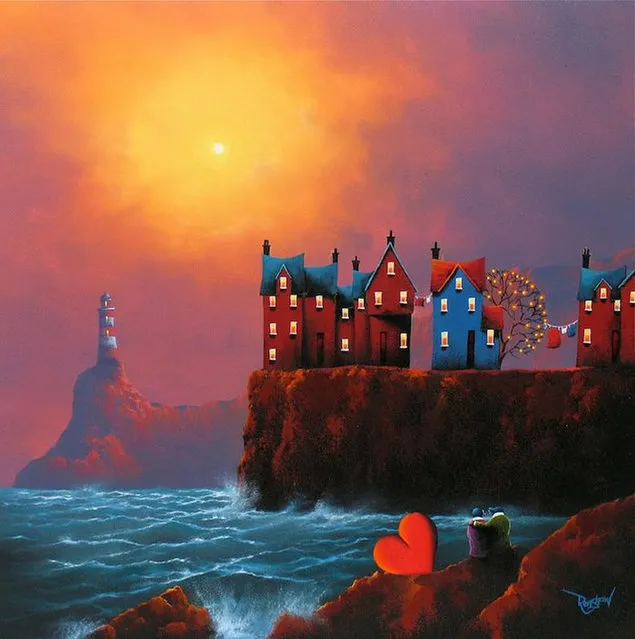
A Northern Romance Series By David Renshaw

Lovely is the correct work to describe this beautiful paintings series by David Renshaw from “Ted n’ Doris – A Northern Romance”. “Deep down I always knew what I wanted to do for a living and in my school years I remember my father teaching me some basic elements of drawing and I dreamed of one day becoming an artist. Being only really interested in art I left school and studied Graphic Design, after which I started work at a local art gallery as a picture framer. I continued to paint alongside my job, mainly developing techniques and ideas and in 2005 decided it was time to follow my dreams and dedicate myself to painting full time. I always try to make my work feel atmospheric, and I like to pay particular attention to sky and cloud formations as I consider this element of my work to be extremely important to the mood of the finished painting, whether it be a dramatic sunset or a misty moonlit night.”
Details
19 Oct 2013 11:48:00
While the lido was described as bringing “modernism to the masses” on the British coast it was just the latest example of a trend that had been developing since Victorian times – transforming seaside towns into resorts for leisure and entertainment. In the latter half of the nineteenth century, the fashion was for local authorities to build great piers stretching from the promenade out into the sea

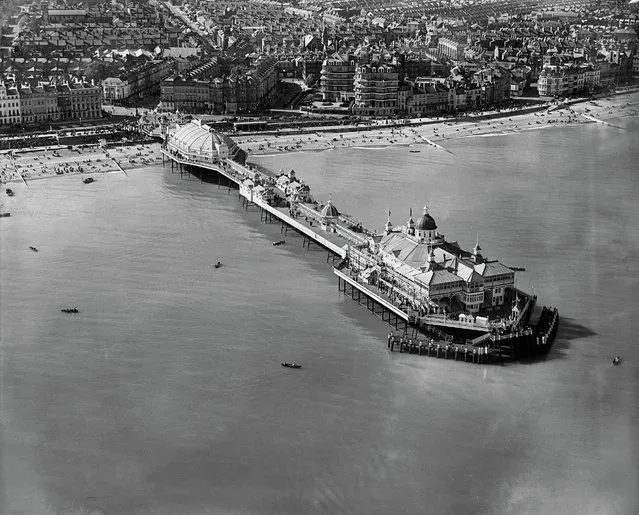
While the lido was described as bringing “modernism to the masses” on the British coast it was just the latest example of a trend that had been developing since Victorian times – transforming seaside towns into resorts for leisure and entertainment. In the latter half of the nineteenth century, the fashion was for local authorities to build great piers stretching from the promenade out into the sea. The Eastbourne Pier, pictured here in May 1931, was erected between 1866 and 1870 to an ingenious design by Eugenius Birch, which saw the structure sitting on special cups allowing the supporting struts to “move” in bad weather. Arranged on the pier's 1,000-foot length were kiosks, a theatre, a ballroom and a camera obscura. 1931. (Photo by Aerofilms Collection via “A History of Britain From Above”)
Details
25 Feb 2014 12:59:00


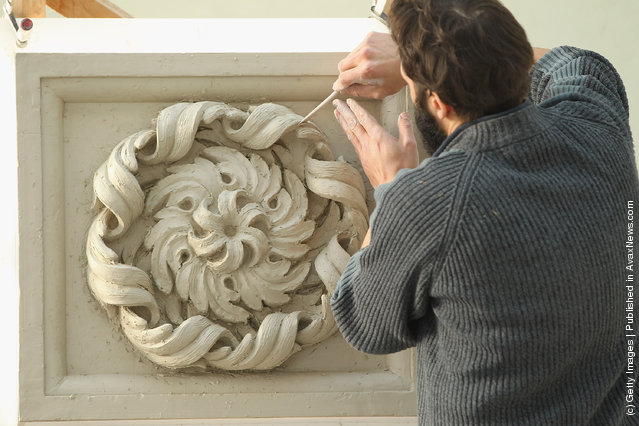
BERLIN, GERMANY - NOVEMBER 11: Sculptor Oleg Bessonov creates a rosette from clay at the Schlossbauhuette studio where a team of sculptors is creating decorative elements for the facade of the Berliner Schloss city palace on November 11, 2011 in Berlin, Germany. The Berliner Schloss was the residence of the Prussian Kaiser and was among the major architectural landmarks of Berlin until it was heavily damaged by Allied bombing in 1945. The communist authorities of East Berlin demolished the building in the 1950s, and today's Berlin government is pursuing an ambitious project to rebuild the palace according to a design by Italian architect Franco Stella, which will recreate the facade of the building but with a modern interior at a cost of approximately EUR 590 million. The Humboldt Forum, the foundation leading the project, has given the Schlossbauhuette sculptors the formidable task of recreating the hundreds of architectural elements that decorated the facade, and though some original pieces were saved, more often the sculptors have only old black and white photos as reference. (Photo by Sean Gallup/Getty Images)
Details
21 Nov 2011 11:22:00
In this Friday, March 3, 2017 photo, a ribbon on a staff member's outfit blows in the breeze as she arrives for the opening session of the Chinese People's Political Consultative Congress (CPPCC) at the Great Hall of the People in Beijing. (Photo by Mark Schiefelbein/AP Photo)

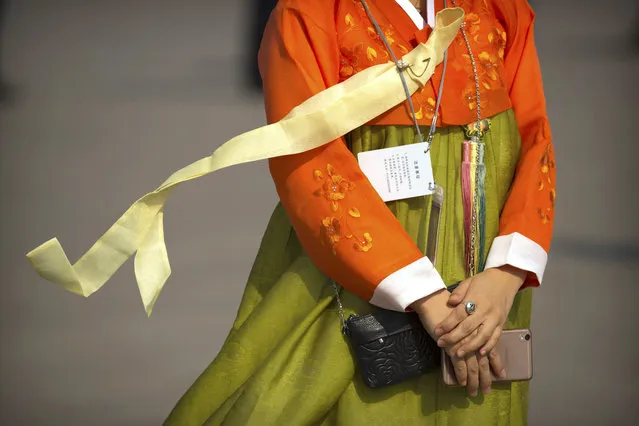
In this Friday, March 3, 2017 photo, a ribbon on a staff member's outfit blows in the breeze as she arrives for the opening session of the Chinese People's Political Consultative Congress (CPPCC) at the Great Hall of the People in Beijing. The annual session of China's ceremonial legislature is designed to awe onlookers with its size and sweep, yet the experience is also made up of tiny moments, details that point to the personalities of the participants and the event's unique, sometimes quirky, traits that a casual observer might easily miss. (Photo by Mark Schiefelbein/AP Photo)
Details
15 Mar 2017 00:05:00
Going nowhere in a hurry, this friendly Javan Tree frog can be seen casually hopping aboard the slow-paced snail who like a lonely highway trucker is only too happy to have the company.  These cute critters chew the fat until froggy reaches his destination and alights at the top of the branch. (Photo by Kurit Afsheen/Media Drum World)

Going nowhere in a hurry, this friendly Javan Tree frog can be seen casually hopping aboard the slow-paced snail who like a lonely highway trucker is only too happy to have the company. These cute critters chew the fat until froggy reaches his destination and alights at the top of the branch. Creative Designer and amateur photographer Kurit Afsheen (34) was able to capture this special sequence while out in his back garden in Ciledug, Indonesia. (Photo by Kurit Afsheen/Media Drum World)
Details
19 Jul 2015 09:17:00
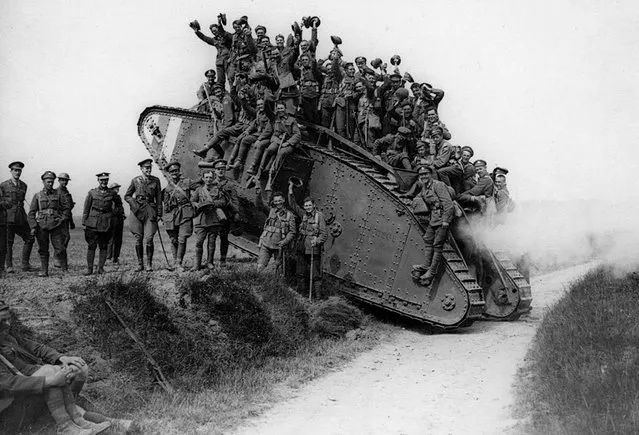
These black-and-white photos are taken from the new book “Armoured Warfare in the First World War 1916 – 1918” by Anthony Tucker-Jones and published by Pen & Sword Military. “Interestingly the British, French and Germans took completely different approaches with varying results”. The British military produced “Little Willie” in Autumn 1915 weighing 18 tonnes, which had a crew of two plus four gunners. “Inspired by a tracked artillery tractor “Little Willie” was referred to as a water tank – hence the name tank – to ensure secrecy”, said Anthony. “This led to the strange looking Mark I with its peculiar rhomboid shape, designed to cross trenches with guns in sponsons on either side. The Germans saw the tank as unchivalrous and were slow to grasp its utility. They favoured the Stormtrooper (specialist soldiers used to infiltrate enemy trenches) and artillery, not the tank”, said Anthony. “However, they didn’t hesitate to make use of captured British tanks. Although the tank helped secure victory and German soldiers dubbed it “Germany’s Downfall” the country was ultimately brought to its knees by the Allies blockade”. Here: British troops hitch a ride on a Mark IV after the massed tank fleet spearheading attack at Cambrai on November 20, 1917. (Photo by Anthony Tucker-Jones/Mediadrumworld.com)

These black-and-white photos are taken from the new book “Armoured Warfare in the First World War 1916 – 1918” by Anthony Tucker-Jones and published by Pen & Sword Military. Here: British troops hitch a ride on a Mark IV after the massed tank fleet spearheading attack at Cambrai on November 20, 1917. (Photo by Anthony Tucker-Jones/Mediadrumworld.com)
Details
23 Feb 2017 00:02:00
A performer wearing a lion mask performs the Ise Daikagura lion dance at the remote village of Yamanawa on February 08, 2021 in Ryuo, Japan. Ise Daikagura is a group of traditional Lion Dance performers who pray in front of farmers houses and businesses for good grain harvests and disease-free lives. Performers play sacred music using drums and flutes with two lion mask dancers. A lion mask is considered a symbol of God, who enters the house and performs in front of the Shinto God, a statue placed inside the house, mostly in the kitchen. These prayers are called “Kamodo Barai”. After the prayers, they are gifted with money, rice, sake and Japanese sweets from the householders. A group can travel for more than one hundred days to thousands of households and businesses throughout rural-villages in western Japan, and pray to those who are unable to visit the country’s most sacred shrine, the Grand Ise Shrine in Mie Prefecture. The group started its performance in the Edo era between 1603 to 1868 according to Japanese history. The Japanese government designated it as an important folk cultural national property in 1981. (Photo by Buddhika Weerasinghe/Getty Images)

A performer wearing a lion mask performs the Ise Daikagura lion dance at the remote village of Yamanawa on February 08, 2021 in Ryuo, Japan. Ise Daikagura is a group of traditional Lion Dance performers who pray in front of farmers houses and businesses for good grain harvests and disease-free lives. (Photo by Buddhika Weerasinghe/Getty Images)
Details
18 Feb 2021 09:27:00
Using body paint and a woodland like location, Gesine appears to have created a model to look just like a red panda, Dortmund, Germany, October, 2016. An artist brings animals to life using body paint and contorted models. At first glance, these images could be mistaken for portraits of wildlife in their natural habitat were created with paper and paint. However, they are actually the incredible works of illusion by talented body painter Gesine Marwedel, who paints models to creates realistic animals. Marwedel, 29, from Dortmund, Germany has always been fascinated by the concept of transferring her designs to human bodies and her latest project features models posing in contorted positions. One image appears to show an elegant swan in a park pond, whilst another picture shows a mother penguin and its chick in a snowy landscape. (Photo by Gesine Marwedel/Barcroft Images)

Using body paint and a woodland like location, Gesine appears to have created a model to look just like a red panda, Dortmund, Germany, October, 2016. An artist brings animals to life using body paint and contorted models. At first glance, these images could be mistaken for portraits of wildlife in their natural habitat were created with paper and paint. However, they are actually the incredible works of illusion by talented body painter Gesine Marwedel, who paints models to creates realistic animals. (Photo by Gesine Marwedel/Barcroft Images)
Details
20 Dec 2016 12:53:00