Loading...
Done
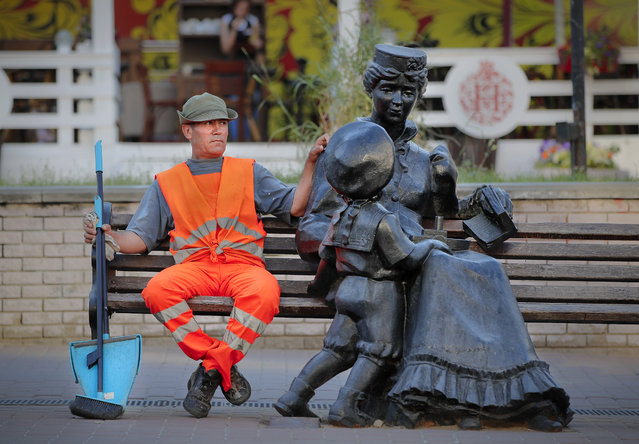
A municipal worker sits on a bench, next to a statue, in Nizhny Novgorod, Russia, during the 2018 soccer World Cup, Thursday, June 28, 2018. (Photo by Vadim Ghirda/AP Photo)

A municipal worker sits on a bench, next to a statue, in Nizhny Novgorod, Russia, during the 2018 soccer World Cup, Thursday, June 28, 2018. Nizhny Novgorod was a “closed city” during the Soviet era. It was known as Gorky until 1990 and it was here that dissident scientist Andrei Sakharov was held under house arrest. Now the city hosts six World Cup matches and is teeming with tourists. That was unthinkable in the Soviet era and even rare now in a city that is seldom visited by outsiders. (Photo by Vadim Ghirda/AP Photo)
Details
03 Jul 2018 00:03:00
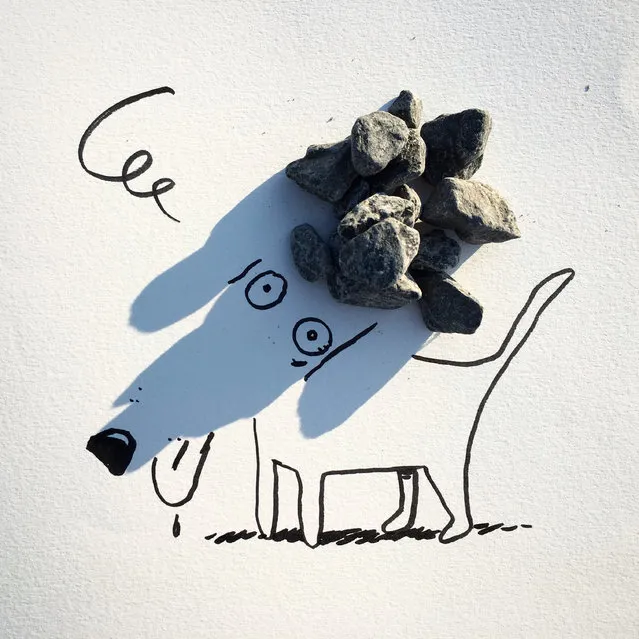
“Stonedog”. (Photo by Vincent Bal/The Guardian)

Earlier this year, Belgian film-maker and artist Vincent Bal stumbled upon an uncanny resemblance to an elephant in the shadow of his tea cup. This gave him the idea for Shadowology, a series of doodles that interact with the shadows of simple, everyday objects: a banknote, some ice cubes and a flower, for example, can turn into a church, a woman and a hippy. “I draw a few lines and I get my image. It’s really the shadows that inspire me”, Bal says. Here: “Stonedog”. (Photo by Vincent Bal/The Guardian)
Details
02 Oct 2016 08:28:00
European herring gulls at Llobregat Delta. (Photo by Xavi Bou/Rex Features/Shutterstock)

The Spanish photographer Xavi Bou digitally combines sequential pictures of birds to create a single image, or chronophotograph, that reveals the shapes of their flight paths against Catalonian skies. His work shows the variety and beauty to be found in the daily activities of the local birds, including spiralling storks, swooping starlings and giddy swifts. Here: European herring gulls at Llobregat Delta. (Photo by Xavi Bou/Rex Features/Shutterstock)
Details
13 Oct 2016 11:22:00
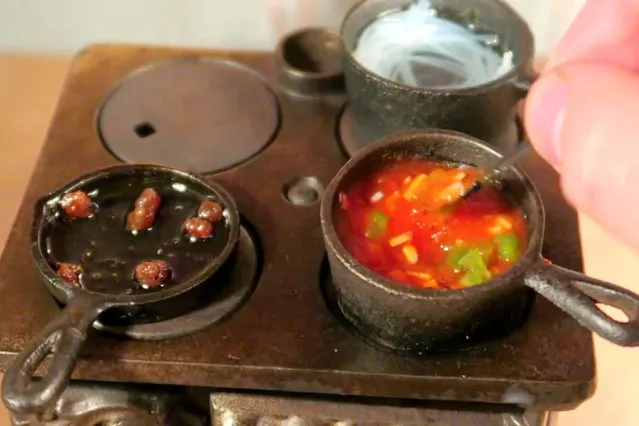
Jay cooks the ingredients of the tiny spaghetti on the tiny stove. (Photo by Jay Baron/Caters News)

Videographer Jay Baron, from Utah, spends up to nine hours cooking super small dishes and serving them up to his YouTube audience. The tiny portions feature cuisine from all over the world, from ultra-American apple pie to Japanese ramen. The 22-year-old confines himself to cooking in a 2ft by 2ft box, so the only heat he can use comes from a tea light. Here: Jay cooks the ingredients of the tiny spaghetti on the tiny stove. (Photo by Jay Baron/Caters News)
Details
26 Nov 2016 10:34:00
Architecture of Density #119, 2009. (Photo by Michael Wolf, courtesy of Flowers Gallery)

Hong Kong art gallery director Sarah Greene said that Wolf, known for his work depicting mega-cities, has died Tuesday, April 24, 2019 night at his home. She said he was 64. Wolf won first prize in the World Press Photo competition in 2005 and 2010. Here: Architecture of Density #119, 2009. (Photo by Michael Wolf, courtesy of Flowers Gallery)
Details
29 Apr 2019 00:03:00
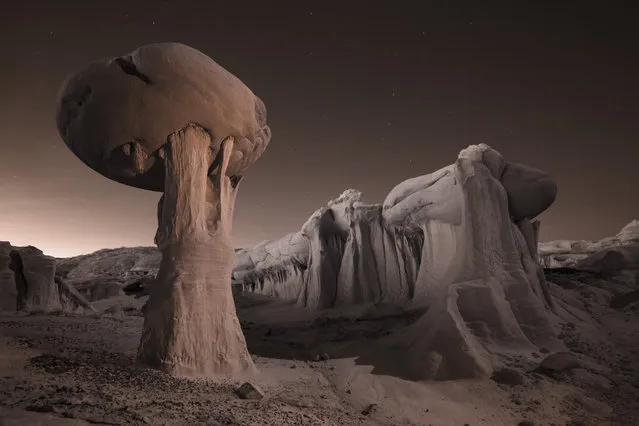
An infrared image at dusk of strange clay rock formations in Ah-Shi-Sle-Pah Wilderness in Farmington, New Mexico. (Photo by David Clapp/Barcroft Images)

The barren landscapes of the south-western US provided inspiration for photographer David Clapp. He visited Nevada, New Mexico, Utah and Arizona as part of his project on other-worldy locations, with surreal results. Here: An infrared image at dusk of strange clay rock formations in Ah-Shi-Sle-Pah Wilderness in Farmington, New Mexico. (Photo by David Clapp/Barcroft Images)
Details
31 May 2016 11:54:00
Spectacular images offering insight into the lives of the Huaorani people in the Ecuadorian Amazon have been revealed showing how they use traditional methods to hunt monkeys for food. The stunning pictures were taken by conservation photographer Pete Oxford from Torquay, Devon in the Ecuadorian Amazon. “The Huaorani Indians are a forest people highly in tune with their environment. Many are now totally acculturated since the 1950s by missionaries”, said Pete. “Today they face radical change to their culture to the proximity of oil exploration within their territory and the Yasuni National Park and Biosphere Reserve, they are vastly changed. Some still live very traditionally and for this shoot, through my Huaorani friend, a direct relative of those photographed he wanted to depict them as close to their original culture as possible. They still largely hunt with blow pipes and spears eating a lot of monkeys and peccaries”. The Huaorani are also known as the Waorani, Waodani or the Waos and are native Amerindians. Their lands are located between the Curaray and Napo rivers and speak the Huaorani language. Pete says that during his visit he was welcomed into the group and hopes that ancient cultures can be saved. Here: The tribe were seen celebrating after a hunter returned to camp with a wild pig. (Photo by Pete Oxford/Mediadrumworld.com)

Spectacular images offering insight into the lives of the Huaorani people in the Ecuadorian Amazon have been revealed showing how they use traditional methods to hunt monkeys for food. The stunning pictures were taken by conservation photographer Pete Oxford from Torquay, Devon in the Ecuadorian Amazon. Here: The tribe were seen celebrating after a hunter returned to camp with a wild pig. (Photo by Pete Oxford/Mediadrumworld.com)
Details
20 Jan 2017 07:58:00
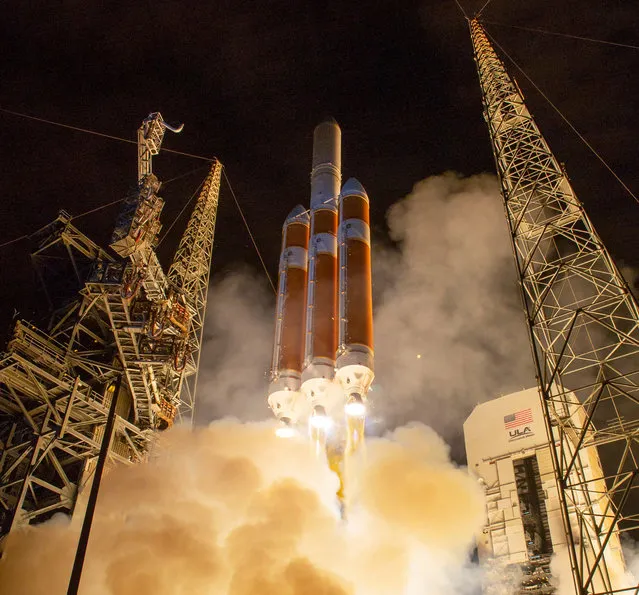
A handout photo made available by the NASA shows the United Launch Alliance Delta IV Heavy rocket launches NASA's Parker Solar Probe to touch the Sun, from Launch Complex 37 at Cape Canaveral Air Force Station, Florida, USA, 12 August 2018. Parker Solar Probe is humanity’s first-ever mission into a part of the Sun’s atmosphere called the corona. Here it will directly explore solar processes that are key to understanding and forecasting space weather events that can impact life on Earth. (Photo by Bill Ingalls/EPA-EFE/NASA)

A handout photo made available by the NASA shows the United Launch Alliance Delta IV Heavy rocket launches NASA's Parker Solar Probe to touch the Sun, from Launch Complex 37 at Cape Canaveral Air Force Station, Florida, USA, 12 August 2018. Parker Solar Probe is humanity’s first-ever mission into a part of the Sun’s atmosphere called the corona. Here it will directly explore solar processes that are key to understanding and forecasting space weather events that can impact life on Earth. (Photo by Bill Ingalls/EPA-EFE/NASA)
Details
13 Aug 2018 07:26:00