Loading...
Done
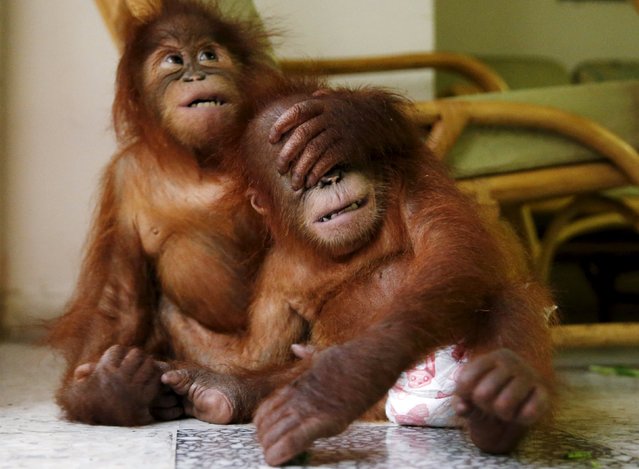
Two baby orangutans play with each other at the wildlife department in Kuala Lumpur, Malayasia, October 19, 2015. The Malaysian wildlife department in July seized two baby Sumatran orangutans, found in duffel bags, from traffickers who were attempting to sell them to buyers in Malaysia. According to local media, the orangutans will be returned to Medan, Indonesia on Tuesday. The illegal wildlife trade is estimated to be $8 billion a year worldwide, according to TRAFFIC, a wildlife trade monitoring network. (Photo by Olivia Harris/Reuters)

Two baby orangutans play with each other at the wildlife department in Kuala Lumpur, Malayasia, October 19, 2015. The Malaysian wildlife department in July seized two baby Sumatran orangutans, found in duffel bags, from traffickers who were attempting to sell them to buyers in Malaysia. According to local media, the orangutans will be returned to Medan, Indonesia on Tuesday. The illegal wildlife trade is estimated to be $8 billion a year worldwide, according to TRAFFIC, a wildlife trade monitoring network. (Photo by Olivia Harris/Reuters)
Details
24 Dec 2015 08:06:00
A picture made available on 09 September 2015 shows traditional mud men dancers from the Asaro District of Goroka in the Eastern Highlands Province of Papua New Guinea perform for the official opening of the Pacific Islands Forum in Port Moresby, Papua New Guinea, 08 September 2015. The Pacific Islands Forum goes from 07 to 11 September and discusses the regions vulnerability to Climate Change. (Photo by Mick Tsikas/EPA)

A picture made available on 09 September 2015 shows traditional mud men dancers from the Asaro District of Goroka in the Eastern Highlands Province of Papua New Guinea perform for the official opening of the Pacific Islands Forum in Port Moresby, Papua New Guinea, 08 September 2015. The Pacific Islands Forum goes from 07 to 11 September and discusses the regions vulnerability to Climate Change. (Photo by Mick Tsikas/EPA)
Details
10 Sep 2015 13:38:00
People play on a beach along the Arabian Sea on a hot summer day in Mumbai, India, April 29, 2016. (Photo by Danish Siddiqui/Reuters)

People play on a beach along the Arabian Sea on a hot summer day in Mumbai, India, April 29, 2016. (Photo by Danish Siddiqui/Reuters)
Details
02 May 2016 10:27:00
Mangli Munda poses on her wedding day with a stray dog in Jharkhand, India on August 30, 2014. An 18-year-old Indian girl has married a stray dog as a part of a tribal ritual designed to ward off an evil spell. (Photo by Barcroft Media/ABACAPress)

Mangli Munda poses on her wedding day with a stray dog in Jharkhand, India on August 30, 2014. An 18-year-old Indian girl has married a stray dog as a part of a tribal ritual designed to ward off an evil spell. Village elders hastily organised the wedding between Mangli Munda and the canine as the teenager is believed to be bringing bad luck to her community in a remote village in Jharkhand state. Mangli's father Sri Amnmunda agreed and even found a stray dog named Sheru as a match for his daughter. And while Mangli was a hesitant bride, she believes that the ceremony will help ensure that her future human husband will have a long life. (Photo by Barcroft Media/ABACAPress)
Details
04 Sep 2014 08:31:00
Planes land in fog at Heathrow Airport, west London, as heavy fog covers a many parts of the south east, on April 1, 2014. (Photo by Steve Parsons/PA Wire)

Planes land in fog at Heathrow Airport, west London, as heavy fog covers a many parts of the south east, on April 1, 2014. (Photo by Steve Parsons/PA Wire)
Details
05 Apr 2014 13:09:00
Belarusian workers works at a felt boot factory in Smilovichi, some 35km from Minsk, Belarus, 16 January 2012. (Photo by Tatyana Zenkovich/EPA)

The Smilovichi Felting Factory in Belarus was founded in 1928, when Smilovichi was a small Jewish settlement of craftsmen. Five of those craftsmen organized a small artel (a cooperative association of craftsmen who all live and work together), which produced warm boots called “valenki” for cold weather. Photo: Belarusian workers works at a felt boot factory in Smilovichi, some 35km from Minsk, Belarus, 16 January 2012. (Photo by Tatyana Zenkovich/EPA)
Details
18 Oct 2013 10:02:00
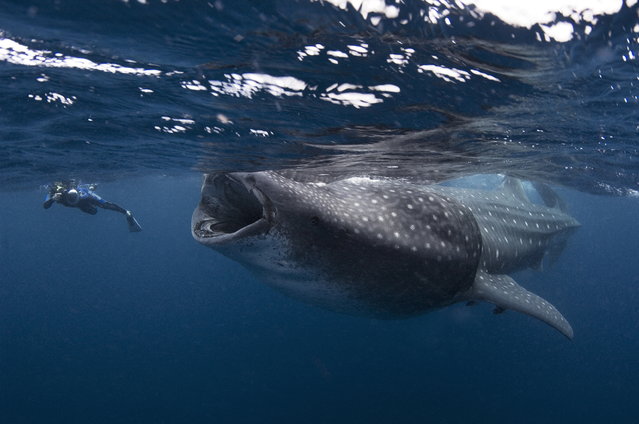
This diver almost got sucked into the mouth of a massive whale shark as it feeds on plankton. But far from staring into the jaws of death – the shark, which are the  sea's largest fish, is actually vegetarian. The relieved diver escaped from the encounter unscathed and continued to  enjoy the presence of the incredibly docile animals. The stunning photograph, by Mauricio Handler, was taken during a feeding session where more than 600 of the huge creatures  gathered to feed on tuna spawn. (Photo by Mauricio Handler/Daily Mail/Solent)

This diver almost got sucked into the mouth of a massive whale shark as it feeds on plankton. But far from staring into the jaws of death – the shark, which are the sea's largest fish, is actually vegetarian. The relieved diver escaped from the encounter unscathed and continued to enjoy the presence of the incredibly docile animals. The stunning photograph, by Mauricio Handler, was taken during a feeding session where more than 600 of the huge creatures gathered to feed on tuna spawn. (Photo by Mauricio Handler/Daily Mail/Solent)
Details
16 Feb 2014 12:23:00
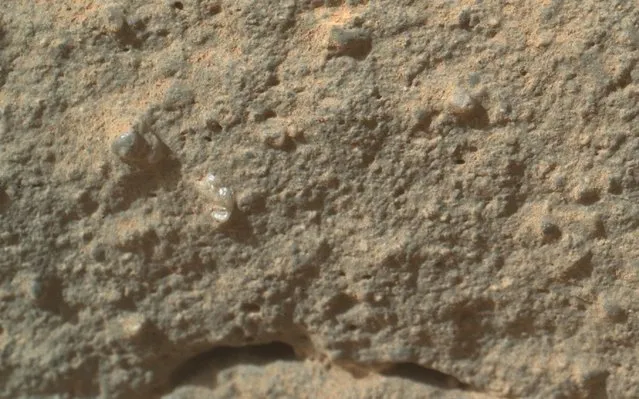
Scientists say that a “Martian flower”, seen here in an image from the Curiosity rover's Mars Hand Lens Imager, is a 2-millimeter-wide grain or pebble that's embedded in the surrounding rock. Another, darker-colored mineral grain can be seen above and to the left. (Photo by NASA)

“The scientists behind NASA's $2.5 billion Curiosity rover mission on Mars on Tuesday explained the nature of a tiny, gleaming "flower" embedded in Red Planet rock, and revealed where they'll be using the SUV-sized robot's drill for the first time”. – Alan Boyle via NBCNews.com

Photo: Scientists say that a “Martian flower”, seen here in an image from the Curiosity rover's Mars Hand Lens Imager, is a 2-millimeter-wide grain or pebble that's embedded in the surrounding rock. Another, darker-colored mineral grain can be seen above and to the left. (Photo by NASA)
Details
16 Jan 2013 11:12:00