Loading...
Done
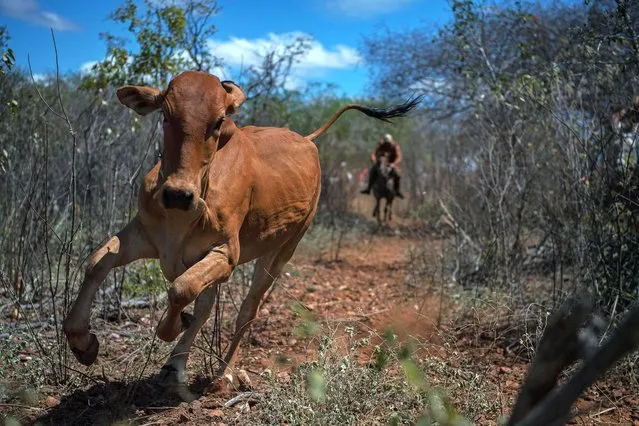
A young bull flees from a Brazilian vaqueiro, or cowboy, competing in the “Pega de Boi” (Ox Catch) tournament in Cabrobo, Pernambuco State, Brazil, on September 4, 2022. The riders compete in pairs to retrieve a cord from a bull which has been released and runs away from them and they are timed on how quickly they can return with the cord. The leather clothing provides them with protection from the dense savannah vegetation which contains a lot of large thorns. Riders have been known to die competing in the tournament (Photo by Carl de Souza/AFP Photo)

A young bull flees from a Brazilian vaqueiro, or cowboy, competing in the “Pega de Boi” (Ox Catch) tournament in Cabrobo, Pernambuco State, Brazil, on September 4, 2022. The riders compete in pairs to retrieve a cord from a bull which has been released and runs away from them and they are timed on how quickly they can return with the cord. The leather clothing provides them with protection from the dense savannah vegetation which contains a lot of large thorns. Riders have been known to die competing in the tournament (Photo by Carl de Souza/AFP Photo)
Details
25 Sep 2022 04:38:00
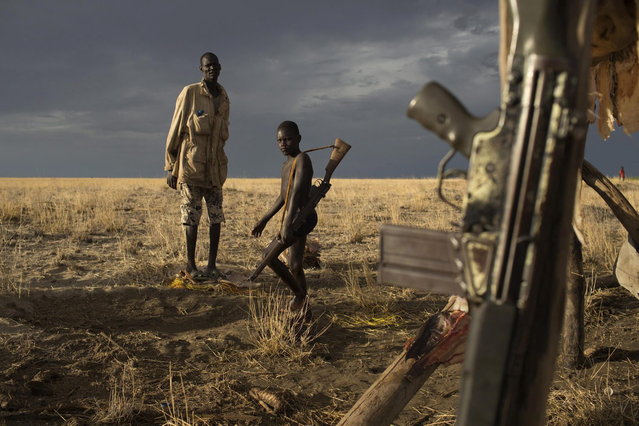
A Turkana man and a boy carrying a gun look on as a G3 battle rifle hangs from a structure used to dry fish at a fishing camp on the shores of Lake Turkana, some kilometres from Todonyang near the Kenya-Ethiopia border in northwestern Kenya October 12, 2013. (Photo by Siegfried Modola/Reuters)

A Turkana man and a boy carrying a gun look on as a G3 battle rifle hangs from a structure used to dry fish at a fishing camp on the shores of Lake Turkana, some kilometres from Todonyang near the Kenya-Ethiopia border in northwestern Kenya October 12, 2013The Turkana are traditionally nomadic pastoralists, but they have seen the pasture that they need to feed their herds suffer from recurring droughts and many have turned to fishing. However, Lake Turkana is overfished, and scarcity of food and pastureland is fuelling long-standing conflict with Ethiopian indigenous Dhaasanac, who have seen grazing grounds squeezed by large-scale government agricultural schemes in southern Ethiopia. The Dhaasanac now venture ever deeper into Kenyan territory in search of fish and grass, clashing with neighbours. Fighting between the communities has a long history, but the conflict has become ever more fatal as automatic weapons from other regional conflicts seep into the area. While the Turkana region is short of basics like grass and ground-water, it contains other resources including oil reserves and massive, newly discovered underground aquifers. (Photo by Siegfried Modola/Reuters)
Details
05 Dec 2013 12:08:00
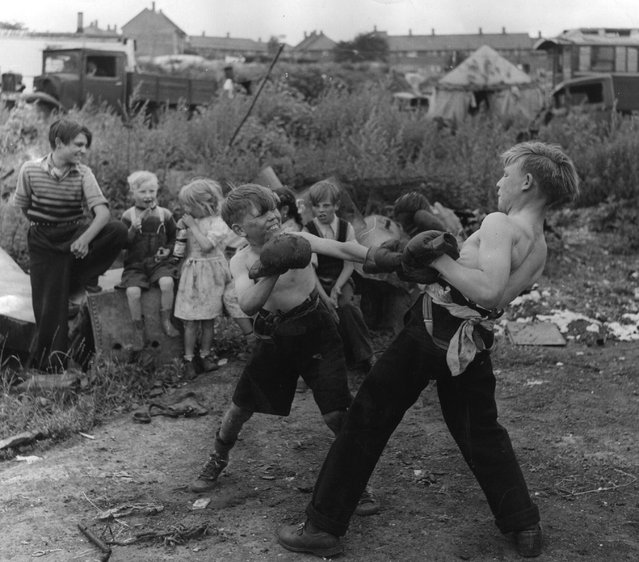
The unromantic gypsies. Children boxing in a gypsy camp in Kent, England on July 1, 1951. Like all boys these gypsy lads like to try their hand at boxing. Encouraged by their friends they fight it out on Corke's Meadow. Few Romanies now live a life of wandering romance. Most are like the three hundred squatters of Corke's Meadow, Kent, which is part of a “gypsy problem” that involves about 100,000 today. Of those about 25,000 can be rightly called gypsies, the rest are Mumpers and Posh-rats and Hobos. Corke's Meadow has both kinds. “Picture Post” cameraman Bert Hardy photographs the Corke's Meadow gypsies in their encampment. (Photo by Hulton-Deutsch Collection/Corbis via Getty Images)

The unromantic gypsies. Children boxing in a gypsy camp in Kent, England on July 1, 1951. Like all boys these gypsy lads like to try their hand at boxing. Encouraged by their friends they fight it out on Corke's Meadow. Few Romanies now live a life of wandering romance. Most are like the three hundred squatters of Corke's Meadow, Kent, which is part of a “gypsy problem” that involves about 100,000 today. Of those about 25,000 can be rightly called gypsies, the rest are Mumpers and Posh-rats and Hobos. Corke's Meadow has both kinds. “Picture Post” cameraman Bert Hardy photographs the Corke's Meadow gypsies in their encampment. (Photo by Hulton-Deutsch Collection/Corbis via Getty Images)
Details
12 Mar 2017 00:01:00
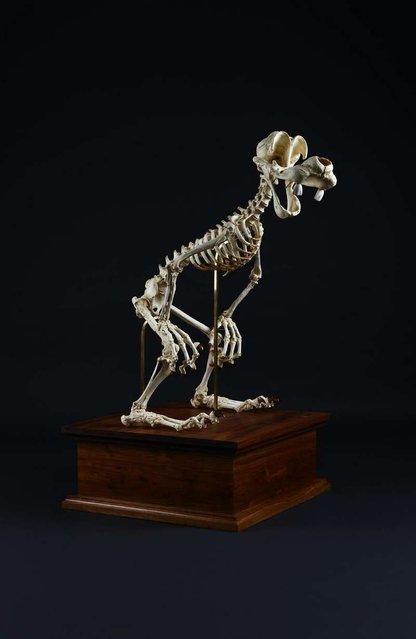
Cartoon Skeletons By Hyungkoo Lee

Korean artist Hyungkoo Lee has created a series (Homo Animatus) of works featuring skeletal representations of familiar cartoon characters. He uses resin, aluminum sticks, stainless steel wires, springs, and oil paint. If you look closely, you will see the bones of our favorite childhood friends like Canis Latrans Animatus (Wile E. Coyote), Geococcyx Animatus (Roadrunner), Lepus Animatus (Bugs Bunny), Felis Catus Animatus (Tom), Mus Animatus (Jerry), Anas Animatus (Donald Duck) and his three nephews, Animatus H, D and L ( Huey, Dewey and Louie)
Details
06 May 2013 12:42:00
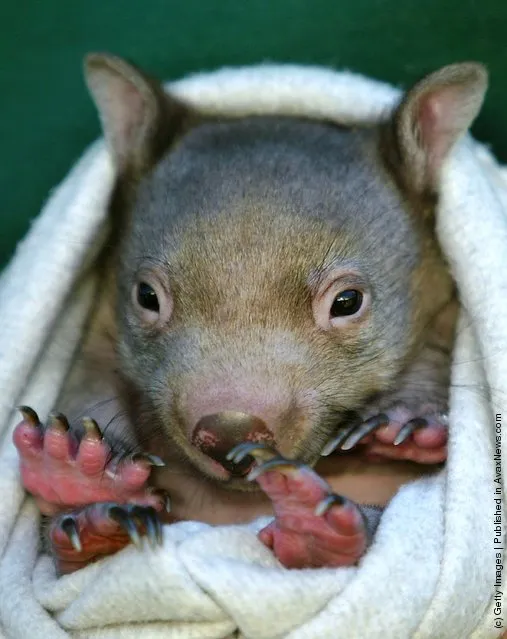
A baby Common Wombat

“Wombats are Australian marsupials; they are short-legged, muscular quadrupeds, approximately 1 metre (39 in) in length with a short, stubby tail. They are adaptable in their habitat tolerances, and are found in forested, mountainous, and heathland areas of south-eastern Australia, including Tasmania, as well as an isolated patch of about 300 ha in Epping Forest National Park in central Queensland”. – Wikipedia

Photo: “Abdul”, a baby Common Wombat, is one of the marsupials on show during the spring baby boom at Taronga Zoo September 1, 2005 in Sydney, Australia. “Abdul” was orphaned when his mother was killed by a car. (Photo by Mark Nolan/Getty Images)
Details
20 Aug 2011 11:23:00
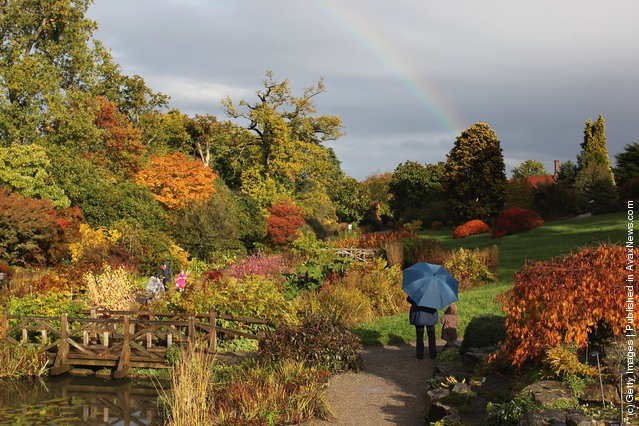
Tree leaves displaying their autumn colours at the Royal Horticultural Society Garden Wisley

Members of the public admire trees displaying their autumn colours at the Royal Horticultural Society Garden Wisley on October 26, 2011 in Wisley, England. Many deciduous trees have now changed colour as they begin to shed their leaves for Autumn. An extended period of leaf colour change has come about this year due to a warm, dry Spring prompting an early growth spurt and a premature colour change. (Photo by Oli Scarff/Getty Images)
Details
28 Oct 2011 12:41:00
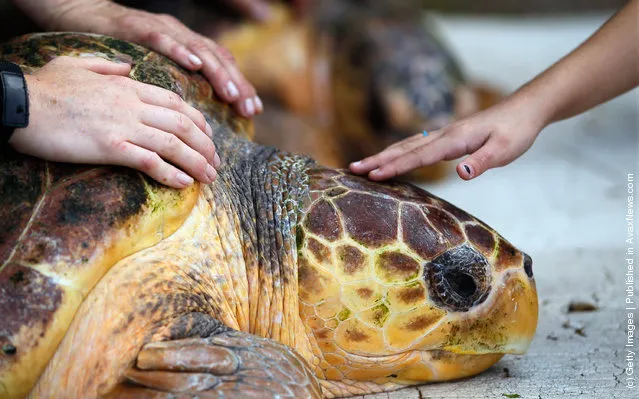
People watch as one of two loggerhead sea turtles are released back into the wild at Bill Baggs Cape Florida State Park after they underwent rehabilitation at Miami Seaquarium

A youngster with the Miami Seaquarium Spring Break Campers group gets a chance to touch one of two loggerhead sea turtles that are prepared to be released back into the wild at Bill Baggs Cape Florida State Park after undergoing rehabilitation at Miami Seaquarium March 13, 2012 in Key Biscayne, Florida. (Photo by Joe Raedle/Getty Images)
Details
14 Mar 2012 08:08:00
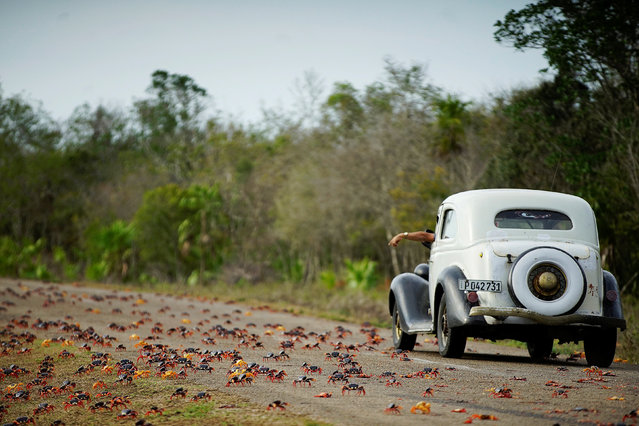
A man driving a vintage car reacts as he passes by crabs crossing a highway on their way to spawn in the sea in Playa Giron, Cuba on April 25, 2017. (Photo by Alexandre Meneghini/Reuters)

A man driving a vintage car reacts as he passes by crabs crossing a highway on their way to spawn in the sea in Playa Giron, Cuba on April 25, 2017. Each year, after the first spring rains, millions of red, yellow and black landcrabs march for days from the surrounding forests to the bay on Cuba's southern coast to spawn in the sea. (Photo by Alexandre Meneghini/Reuters)
Details
26 Apr 2017 08:40:00