Loading...
Done
John Klatt and the Air National Guard MXS (right) and Mike Wiskus and the Lucas Oil Pitts take to the skies at the Memphis Airshow, on Sat., September 26, 2016 in Millington, Tenn. (Photo by Brandon Dill/Invision for John Klatt Airshows, Inc./AP Images)

John Klatt and the Air National Guard MXS (right) and Mike Wiskus and the Lucas Oil Pitts take to the skies at the Memphis Airshow, on Sat., September 26, 2016 in Millington, Tenn. (Photo by Brandon Dill/Invision for John Klatt Airshows, Inc./AP Images)
Details
30 Sep 2015 08:01:00
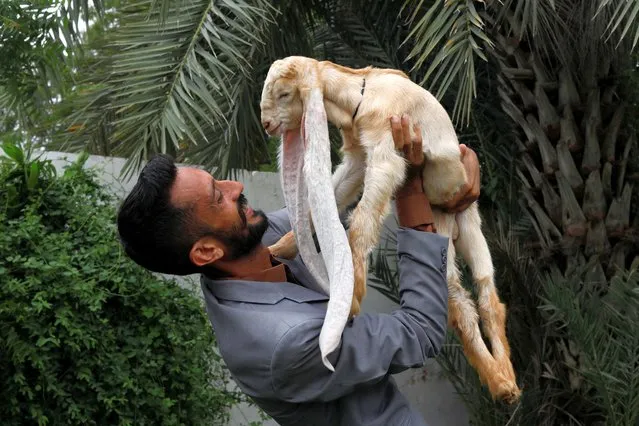
Simba, one month and four days old kid goat with 22-inch long ears, is held by his owner in Karachi, Pakistan on July 8, 2022. (Photo by Akhtar Soomro/Reuters)

Simba, one month and four days old kid goat with 22-inch long ears, is held by his owner in Karachi, Pakistan on July 8, 2022. (Photo by Akhtar Soomro/Reuters)
Details
17 Oct 2023 00:55:00
A girl receives Covid-19 vaccine as Nepal Government begins vaccinating children aged 5-12 at a school in Kathmandu on June 23, 2022. (Photo by Aryan Dhimal/ZUMA Press Wire/Rex Features/Shutterstock)

A girl receives Covid-19 vaccine as Nepal Government begins vaccinating children aged 5-12 at a school in Kathmandu on June 23, 2022. (Photo by Aryan Dhimal/ZUMA Press Wire/Rex Features/Shutterstock)
Details
17 Aug 2022 05:03:00
A man carrying buckets walks along a beach littered with piles of debris and plastic waste at the Kedonganan beach in Bali, Indonesia, 19 March 2024. Most of the trash ends up in the sea every rainy season due to the island's lack of a centralized waste management system. (Photo by Made Nagi/EPA/EFE)

A man carrying buckets walks along a beach littered with piles of debris and plastic waste at the Kedonganan beach in Bali, Indonesia, 19 March 2024. Most of the trash ends up in the sea every rainy season due to the island's lack of a centralized waste management system. (Photo by Made Nagi/EPA/EFE)
Details
04 Apr 2024 00:34:00
Hundreds of houses painted in bright colors in what organizers claim is Mexico's largest mural, is part of a government-sponsored project is called Pachuca Paints Itself, in the Palmitas neighborhood, in Pachuca, Mexico, Thursday, July 30, 2015. German Crew is the artist collective responsible for painting the mural project. Director Enrique Gomez, who goes by MYBE, said the crew has painted 1,500 square meters with 20,000 liters of paint. (Photo by Sofia Jaramillo/AP Photo)

Hundreds of houses painted in bright colors in what organizers claim is Mexico's largest mural, is part of a government-sponsored project is called Pachuca Paints Itself, in the Palmitas neighborhood, in Pachuca, Mexico, Thursday, July 30, 2015. German Crew is the artist collective responsible for painting the mural project. Director Enrique Gomez, who goes by MYBE, said the crew has painted 1,500 square meters with 20,000 liters of paint. Working hand-in-hand with residents, muralists have painted the facades of 200 homes bright lavender, lime green, incandescent orange – hues more commonly found in a bag of Skittles than in the drab, cement-and-cinderblock neighborhoods where many of Mexico's poor live. The project aims to bring the community together and rehabilitate the area. (Photo by Sofia Jaramillo/AP Photo)

Details
03 Aug 2015 12:02:00
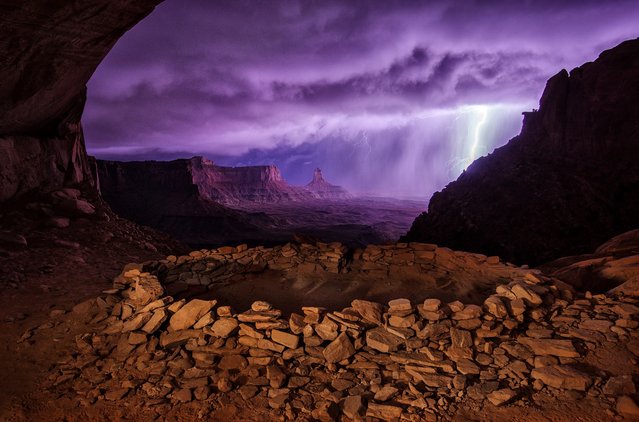
Second Place Winner: “Thunderstorm at False Kiva”. I hiked out to these ruins at night hoping to photograph them with the Milky Way, but instead a thunderstorm rolled through, creating this dramatic image. – Max Seigal. (Photo and caption by Max Seigal/National Geographic Traveler Photo Contest)

Second Place Winner: “Thunderstorm at False Kiva”. I hiked out to these ruins at night hoping to photograph them with the Milky Way, but instead a thunderstorm rolled through, creating this dramatic image. – Max Seigal. National Geographic Traveler Director of Photography Dan Westergren, one of this year's judges, shares his thoughts on the second place winner: “This photo combines two different scenes into one: the small kiva in a cliff dwelling and the grand vista of Canyonlands National Park across the valley. I really like the two different color palettes – warm inside and purple outside. This two-for-one scene was caused by the lightning storm outside the dwelling, which lit up the landscape like it was a huge electronic flash. Looking at this picture I can imagine what a wonderful sight it must have been for the ancient people who lived here. It doesn't seem too amazing now in our modern world, but might have been mind-blowing for the prehistoric residents”. Location: Utah. (Photo and caption by Max Seigal/National Geographic Traveler Photo Contest)
Details
02 Aug 2013 06:16:00
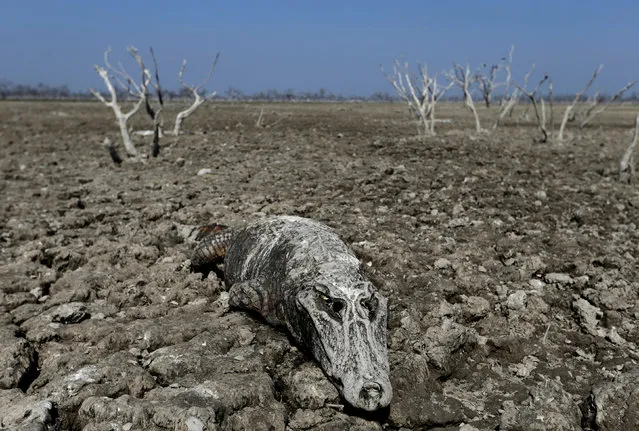
The carcass of a yacare caiman lies in the dried-up river bed of the Pilcomayo river in Boqueron, Paraguay, August 14, 2016. In Paraguay, alongside the Pilcomayo River, black vultures flew over a shrinking pond where a group of crocodilian reptiles known as yacare caimans sought refuge. Water from the river, which divides Paraguay and Argentina in the area of the Gran Chaco, was scarce. This is not an uncommon sight in the region of General Diaz, about 700 kilometres (435 miles) northwest of the country's capital Asuncion, where the Pilcomayo's waters form lakes and streams that give life to capybaras, birds and caimans. “The river's situation is critical. No water is forecast to enter the basin until December, as happens every year”, said Alcides Gonzalez, a resident of the area. (Photo by Jorge Adorno/Reuters)

The carcass of a yacare caiman lies in the dried-up river bed of the Pilcomayo river in Boqueron, Paraguay, August 14, 2016. In Paraguay, alongside the Pilcomayo River, black vultures flew over a shrinking pond where a group of crocodilian reptiles known as yacare caimans sought refuge. Water from the river, which divides Paraguay and Argentina in the area of the Gran Chaco, was scarce. This is not an uncommon sight in the region of General Diaz, about 700 kilometres (435 miles) northwest of the country's capital Asuncion, where the Pilcomayo's waters form lakes and streams that give life to capybaras, birds and caimans. (Photo by Jorge Adorno/Reuters)
Details
03 Nov 2016 12:40:00
Bulgarian Pomak (Bulgarian speaking Muslims) bride Selve Kiselova , 21, has gelina make-up applied to her face ahead of her wedding ceremony in the village of Ribnovo, on December 29, 2024. The people of this Bulgarian mountain village are famous for performing their unique wedding ceremonies in winter time only. Muslim bulgarians are descendants of Christian bulgarians who were forcibly converted to Islam by the Turks, during the 14th, 16th and the 18th century. (Photo by Nikolay Doychinov/AFP Photo)

Bulgarian Pomak (Bulgarian speaking Muslims) bride Selve Kiselova , 21, has gelina make-up applied to her face ahead of her wedding ceremony in the village of Ribnovo, on December 29, 2024. The people of this Bulgarian mountain village are famous for performing their unique wedding ceremonies in winter time only. Muslim bulgarians are descendants of Christian bulgarians who were forcibly converted to Islam by the Turks, during the 14th, 16th and the 18th century. (Photo by Nikolay Doychinov/AFP Photo)
Details
11 Apr 2026 03:17:00