Loading...
Done
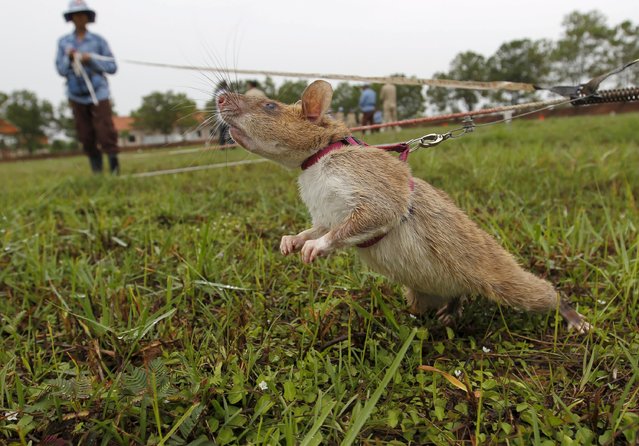
A rat being trained by the Cambodian Mine Action Centre (CMAC) is pictured on an inactive landmine field in Siem Reap province July 9, 2015. Gambian pouched rats were deployed to Cambodia from Tanzania in April by a Belgian non-profit organization, APOPO, to help clear mines. (Photo by Samrang Pring/Reuters)

A rat being trained by the Cambodian Mine Action Centre (CMAC) is pictured on an inactive landmine field in Siem Reap province July 9, 2015. Gambian pouched rats were deployed to Cambodia from Tanzania in April by a Belgian non-profit organization, APOPO, to help clear mines. They've been trained since they were 4 weeks old. Cambodia is still littered with landmines after emerging from decades of civil war, including the 1970s Khmer Rough “Killing Fields” genocide, leaving it with one of the world's highest disability rates. APOPO has used the rodents for mine-clearing projects in several countries, including Angola, Mozambique, Thailand, Laos, and Vietnam. (Photo by Samrang Pring/Reuters)
Details
14 Jul 2015 13:35:00
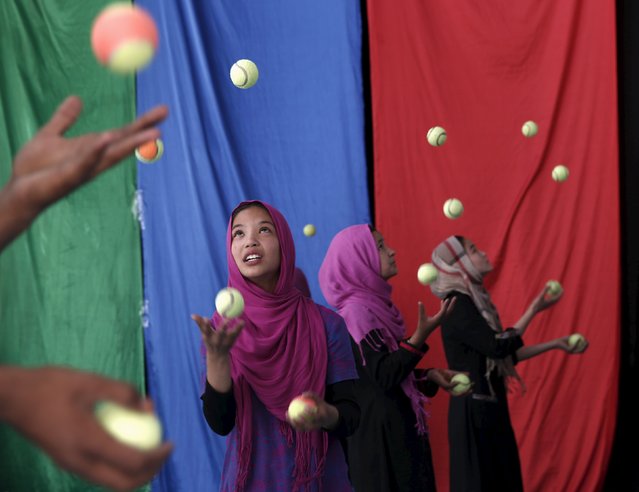
Girls, who are part of Afghan Mobile Mini Circus for Children (MMCC), participate in a juggling competition in Kabul, Afghanistan August 12, 2015. (Photo by Ahmad Masood/Reuters)

Girls, who are part of Afghan Mobile Mini Circus for Children (MMCC), participate in a juggling competition in Kabul, Afghanistan August 12, 2015. The MMCC, founded by David Mason from Denmark, teaches cooperation and creativity to children scarred by years of war in Afghanistan. Despite the dangers, the project has grown so popular that it now runs centres in ten provinces and has hundreds of regular students. The circus makes visits to internally displaced persons' camps, schools, orphanages, and holds annual festivals. The children are taught the skills of juggling clubs, walking on stilts and acrobatics. (Photo by Ahmad Masood/Reuters)
Details
01 Sep 2015 12:47:00
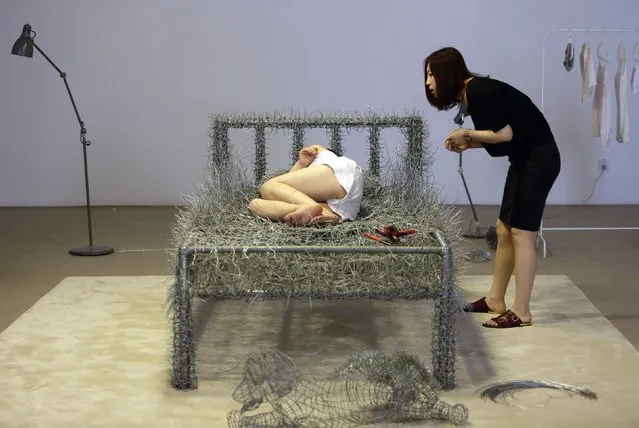
Chinese artist Zhou Jie takes a nap on an unfinished iron wire bed, one of her sculpture works, after lunch as a friend of hers looks on at Beijing Now Art Gallery, in Beijing August 11, 2014. (Photo by Jason Lee/Reuters)

Chinese artist Zhou Jie takes a nap on an unfinished iron wire bed, one of her sculpture works, after lunch as a friend of hers looks on at Beijing Now Art Gallery, in Beijing August 11, 2014. Zhou started her art project titled “36 Days” on August 9, in which she would live inside an exhibition hall with an unfinished iron wire bed, some iron wire sculptures in the shape of stuffed animal dolls, a certain amount of food and her mobile phone, for 36 days. The entire process is open to visitors and she may also interact with them, according to Zhou. (Photo by Jason Lee/Reuters)
Details
16 Aug 2014 10:37:00
Hair stylist Marcelo Avatte (R) prepares to fit Isidora Serrano, a 14-year-old who lost her hair due to chemotherapy to treat her bone cancer, with a natural hair wig in the cancer ward of the Luis Calvo Mackenna Hospital in Santiago, October 23, 2014. (Photo by Rodrigo Garrido/Reuters)

Hair stylist Marcelo Avatte (R) prepares to fit Isidora Serrano, a 14-year-old who lost her hair due to chemotherapy to treat her bone cancer, with a natural hair wig in the cancer ward of the Luis Calvo Mackenna Hospital in Santiago, October 23, 2014. The wigs, handmade by Italian-Chilean hair stylist Marcelo Avatte and his team, have helped the children regain their self-esteem and confidence during cancer treatment. Renowned for making customised wigs, Avatte has donated more than 300 wigs since 2009 and says he was motivated to begin the project by the pain he felt when his own son lost his hair during chemotherapy. (Photo by Rodrigo Garrido/Reuters)
Details
18 Nov 2014 11:33:00


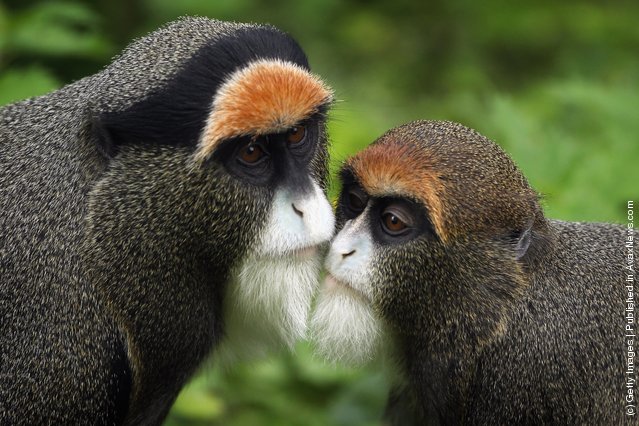
Two De Brazza's monkeys stand together at Port Lympne Wild Animal Park on June 21, 2011 in Hythe, England. Port Lympne has welcomed a host of new arrivals this year with wildebeest, colobus monkeys, gorillas and rhinos all adding to the current stock. Port Lympne and Howletts Wild Animal parks were set up by the late John Aspinall to protect and breed rare and endangered species and, where possible, return them to safe areas in the wild. The Aspinall Foundation which runs the parks also manages two gorilla rescue and rehabilitation projects in the central African countries of Gabon and Congo where they have successfully reintroduced over 50 gorillas to the wild. (Photo by Dan Kitwood/Getty Images)
Details
24 Jun 2011 10:12:00
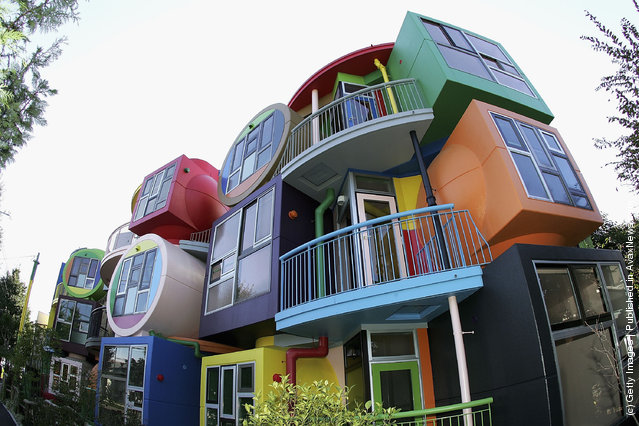
Concept Design Home Reversible Destiny Lofts MITAKA: In Memory Of Helen Keller By Reversible Destiny Foundation and Shusaku Arakawa

“The Reversible Destiny Lofts – Mitaka (In Memory of Helen Keller) is a nine-unit multiple dwelling. It was first completed example of procedural architecture put to residential use. These lofts reflexively articulate the residents’ operative tendencies and coordinating skills essential to and determinative of human thought and behavior; which means to say, the lofts manage, by virtue of how they are constructed, to reveal to their residents the ins and outs of what makes a person, in this case the resident. This is the same set of tendencies and skills to which Arakawa and Madeline Gins gave diagrammatic form in their decades-long research project The Mechanism of Meaning”. – Wikipedia

Photo: The exterior of the concept design home “Reversible Destiny Lofts MITAKA: In Memory of Helen Keller” is seen on October 27, 2005 in Tokyo, Japan. (Photo by Koichi Kamoshida/Getty Images)
Details
30 Nov 2011 11:58:00
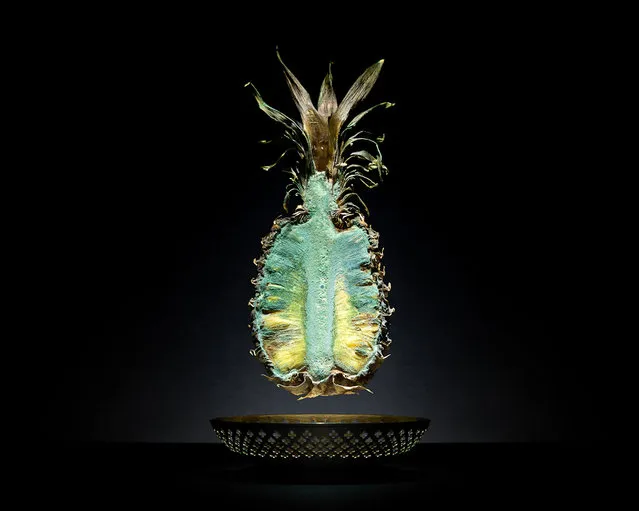
Pineapple

“One Third” – a project on food waste by an Austrian photography Klaus Pichler. According to a UN study one third of the world's food goes to waste – the largest part thereof in the industrialized nations of the global north. Equally, 925 million people around the world are threatened by starvation. The series “One Third” describes the connection between individual wastage of food and globalized food production.

Photo: Pineapple. Place of production: Guayaquil, Ecuador. Cultivation method: Outdoor plantation • Time of harvest: All- season. Transporting distance: 10.666 km (linear distance) • Means of transportation: Aircraft, truck. Carbon footprint (total) per kg: 11,94 kg • Water requirement (total) per kg: 360 l. Price: 2,10 € / kg. (Photo by Klaus Picher)
Details
02 May 2012 11:01:00
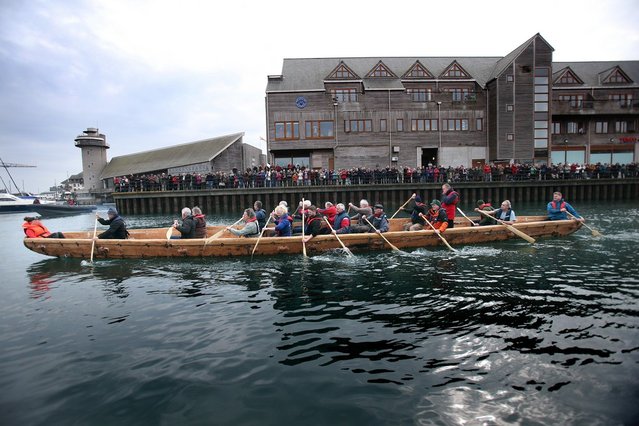
Crew in Britain's first ever full-size reconstructed sea-going Bronze Age boat, paddle out to sea near to the National Maritime Museum as it makes its maiden voyage on March 6, 2013 in Falmouth, England. With a crew of of 18, equipped with Bronze-Age-style wooden paddles, the 15 metre long experimental vessel – a replica of the sort of craft used for long-distance trade between Britain and the continent 4000 years ago – will be used to test prehistoric seafaring methods in a project in collaboration with the University of Exeter and the Falmouth-based National Maritime Museum Cornwall. (Photo by Matt Cardy)

Crew in Britain's first ever full-size reconstructed sea-going Bronze Age boat, paddle out to sea near to the National Maritime Museum as it makes its maiden voyage on March 6, 2013 in Falmouth, England. (Photo by Matt Cardy)
Details
07 Mar 2013 08:48:00