Loading...
Done
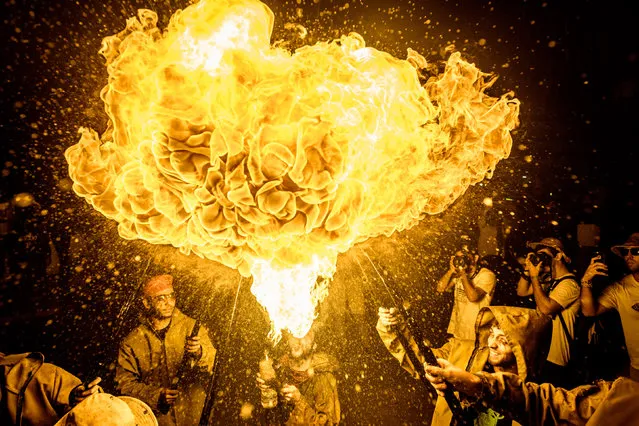
A fire-eater of the “Diables de Terrassa” performs during Sitges' little “Festa Major”, “Santa Tecla” in Sitges, Spain on September 19, 2016. This celebration brings together some of Catalonia’s most emblematic festive traditions. The central axis of the celebrations is the traditional parade, made up of “big-head” carnival figures and characters who dance to music played on different traditional instruments. One of the most popular events is the Correfoc or fire-running, which is also the closing event of the fiesta. The people run and jump over characters dressed up as devils and dragons, carrying fire. (Photo by Matthias Oesterle/ZUMA Press/Splash News)

A fire-eater of the “Diables de Terrassa” performs during Sitges' little “Festa Major”, “Santa Tecla” in Sitges, Spain on September 19, 2016. This celebration brings together some of Catalonia’s most emblematic festive traditions. The central axis of the celebrations is the traditional parade, made up of “big-head” carnival figures and characters who dance to music played on different traditional instruments. One of the most popular events is the Correfoc or fire-running, which is also the closing event of the fiesta. The people run and jump over characters dressed up as devils and dragons, carrying fire. (Photo by Matthias Oesterle/ZUMA Press/Splash News)
Details
20 Sep 2016 09:28:00
Artists perform during a “Yandu Story” Show performance, in Yancheng, Jiangsu province, China, 20 September 2022. The story dates back to some 100 years when – according to the organizers – two prominent local families, Gu and Ling, were committed to get out of a predicament, but parted due to different development concepts and ended in a turmoil. The large-scale immersive series of performances took more than a year of careful planning and consists of two parts: a daytime performance and a 90-minute night performance, they added. (Photo by Alex Plavevski/EPA/EFE/Rex Features/Shutterstock)

Artists perform during a “Yandu Story” Show performance, in Yancheng, Jiangsu province, China, 20 September 2022. The story dates back to some 100 years when – according to the organizers – two prominent local families, Gu and Ling, were committed to get out of a predicament, but parted due to different development concepts and ended in a turmoil. The large-scale immersive series of performances took more than a year of careful planning and consists of two parts: a daytime performance and a 90-minute night performance, they added. (Photo by Alex Plavevski/EPA/EFE/Rex Features/Shutterstock)
Details
29 Sep 2022 03:41:00
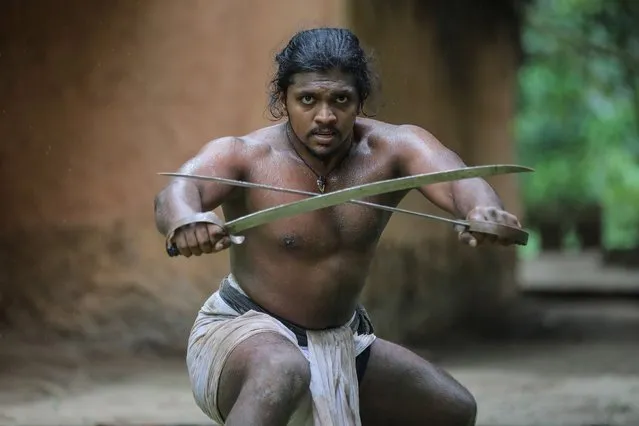
A student of the Sri Lankan ancient martial art “Angampora” performs during a practice session at the angam maduwa or fighting field, in Korathota, a suburb of Colombo, Sri Lanka, 07 September 2022. Sri Lanka's ancient martial art, Angampora, is thought to be thousands of years old. Anga translates to “body parts” and Angampora is a fighting art that uses body parts. Martial arts practitioners in Angampora were mostly in the king's service, and they were tasked with protecting the king and his kingdom. Angampora was practiced in secret for most centuries because the British, who colonized Sri Lanka, banned it in 1818 after seeing it as a threat. (Photo by Chamila Karunarathne/EPA/EFE)

A student of the Sri Lankan ancient martial art “Angampora” performs during a practice session at the angam maduwa or fighting field, in Korathota, a suburb of Colombo, Sri Lanka, 07 September 2022. Sri Lanka's ancient martial art, Angampora, is thought to be thousands of years old. Anga translates to “body parts” and Angampora is a fighting art that uses body parts. Martial arts practitioners in Angampora were mostly in the king's service, and they were tasked with protecting the king and his kingdom. Angampora was practiced in secret for most centuries because the British, who colonized Sri Lanka, banned it in 1818 after seeing it as a threat. (Photo by Chamila Karunarathne/EPA/EFE)
Details
14 Oct 2022 04:47:00
Sand-Washing Operation Of Yellow River Held At Xiaolangdi Reservoir

Water gushes out from the Xiaolangdi Reservoir on the Yellow River during a sand-washing operation on June 20, 2012 in Luoyang, China. The sand-washing operation, which started on June 19 and will last for about 20 days, is conducted to clear out the silt deposits at the dam. (Photo by China Foto Press)
Details
23 Jun 2012 09:04:00
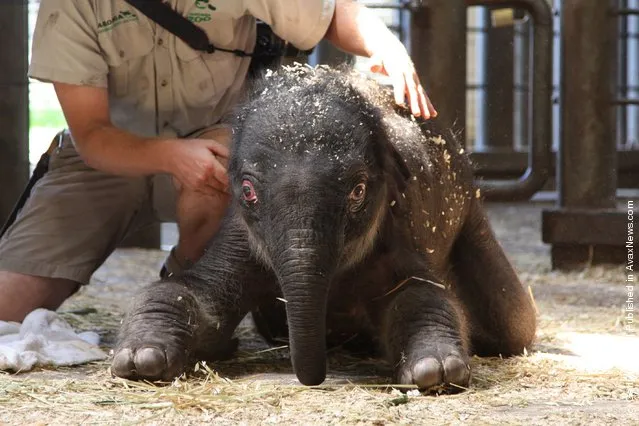
Baby Elephant

Taronga Zoo's elephant baby, as yet unnamed, is seen at Taronga Zoo on March 12, 2010 in Sydney, Australia. The Asian Elephant calf has continued to make progress following a protracted labour that spanned six days. The calf was originally believed to have died in the womb during labour but surprised veterinarians and zoo staff with an unexpected delivery early Wednesday morning. (Photo by Bobby-Jo Vial/Taronga Zoo via Getty Images)
Details
13 Sep 2011 13:22:00
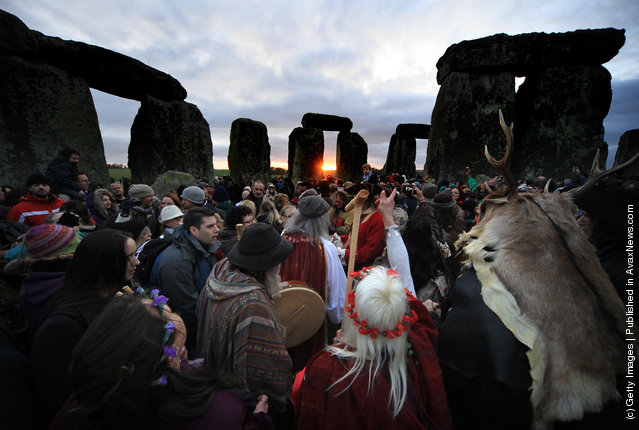
Druids Celebrate Winter Solstice At Stonehenge

Druids, pagans and revellers cheer as the sun rises at Stonehenge on December 22, 2011 in Wiltshire, England. The unseasonable warm weather encouraged a larger than normal crowd to gather at the famous historic stone circle to celebrate the sunrise closest to the Winter Solstice, the shortest day of the year. (Photo by Matt Cardy/Getty Images)
Details
23 Dec 2011 12:17:00
Animal Enthusiasts Enjoy The UK's Rabbit Grand National

English Lop Eared Rabbits on the judging table on January 28, 2012 in Harrogate, England. Approximately 3,000 animals attend the annual show, which runs over two days and was first held in 1921. The Rabbit Grand National, attracts competitors from as far afield as Sweden to Yorkshire. (Photo by Bethany Clarke/Getty Images)
Details
30 Jan 2012 09:25:00


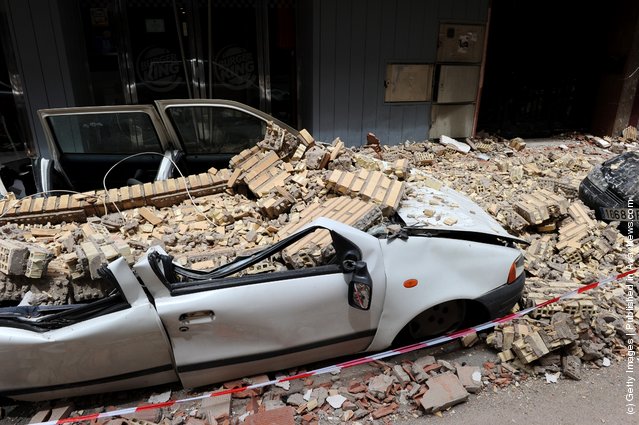
A car stands destroyed by debris, one day after a magnitude 5.1 quake killed at least 9 people, on May 12, 2011 in Lorca, Spain. After spending the night outside, residents of the historic Spanish town are awaiting the safety assessment of their houses to see wether they can return home or not. (Photo by Jasper Juinen/Getty Images)
Details
13 May 2011 07:20:00