A protester gestures as he holds a dog before a burning barricade during protests in Harare, Zimbabwe on January 15, 2019. (Photo by Philimon Bulawayo/Reuters)
As if pulled from a Disney film, a fox is mesmerised by a butterfly hovering in front of its nose in a field in Taplow, Berkshire, South East England in the second decade of July 2023. (Photo by Ann Aveyard/Animal News Agency)
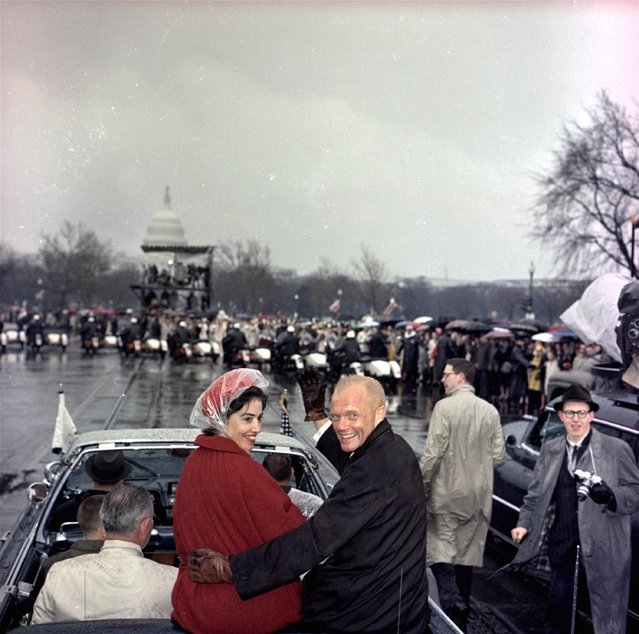
In this February 26, 1962 file photo, Mercury astronaut John Glenn, and his wife, Annie, ride in the back of an open car with Vice-President Johnson during a parade in Glenn's honor in Washington. The Capitol is seen in the background. Glenn, the first American to orbit Earth who later spent 24 years representing Ohio in the Senate, died Thursday, Dec. 8, 2016, at the age of 95. (Photo by AP Photo)
Caroline Wozniacki of Denmark serves in her match against Kaia Kanepi of Estonia during day four of the Toray Pan Pacific Open at Ariake Colosseum on September 28, 2011 in Tokyo, Japan. (Photo by Koji Watanabe/Getty Images)
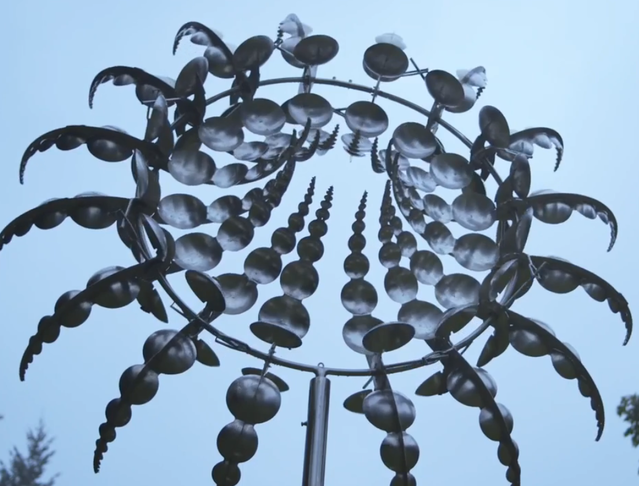
The kinetic sculptures created by Anthony Howe are nothing short of a miracle. You simply cannot wrap your mind around the fact that these creations are real. The magic comes from the fact that all the creations of Anthony Howe were first digitally modeled and only then wrought from metal. The resulting pieces of art are mystifying, entrancing, and sometimes even terrifying. For example, one of the earlier creations of Howe is an installation called “About Face”. It is a human face, pieces of which move from side to side, even if there is just a gentle breeze. However, most of his creations are mesmerizing, capturing your mind, as you marvel at their intricacy.
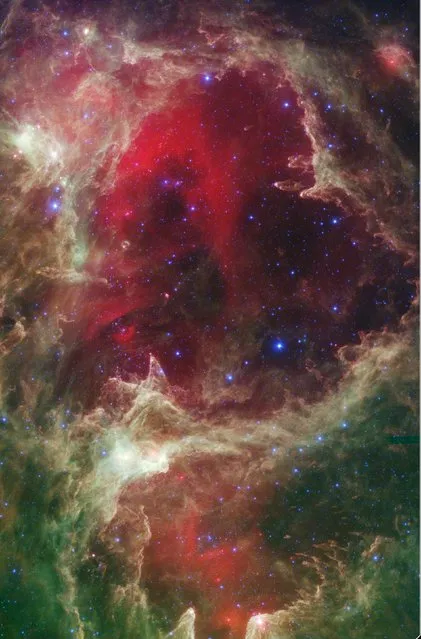
An infrared portrait from NASA's Spitzer Space Telescope which shows generations of stars is seen in this undated NASA handout image released February 14, 2013. In this wispy star-forming region, called W5, the oldest stars can be seen as blue dots in the centers of the two hollow cavities (other blue dots are background and foreground stars not associated with the region). Red shows heated dust that pervades the region's cavities, while green highlights dense clouds. (Photo by NASA/Reuters/JPL-Caltech/Harvard-Smithsonian/Handout)