Loading...
Done
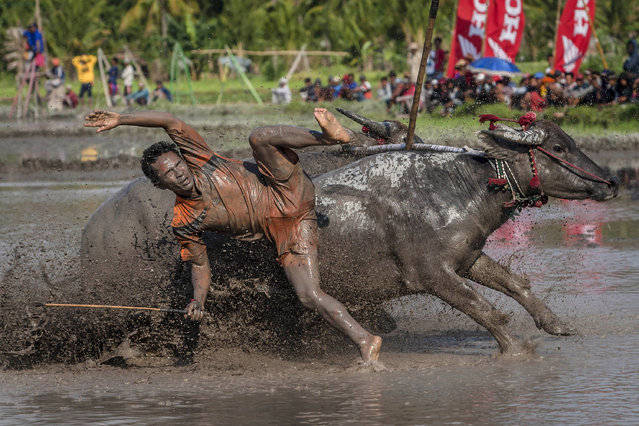
A jockey falls from his buffalos during Barapan Kebo or buffalo races as part of the Moyo festival on September 30, 2014 in Sumbawa Island, West Nusa Tenggara, Indonesia. (Photo by Ulet Ifansasti/Getty Images)

A jockey falls from his buffalos during Barapan Kebo or buffalo races as part of the Moyo festival on September 30, 2014 in Sumbawa Island, West Nusa Tenggara, Indonesia. The traditional Buffalo races, known as Barapan Kebo, are held by Samawa tribes in muddy rice fields to celebrate and provide entertainment ahead of the annual planting season. Jockeys secure themselves on a wooden structure attached to the buffalo, and maneuver across the mud in a race to the finish line. The jockeys weild long sticks, in a similar style to jousting, and direct them towards targets called “Saka”. (Photo by Ulet Ifansasti/Getty Images)
Details
04 Oct 2014 11:58:00
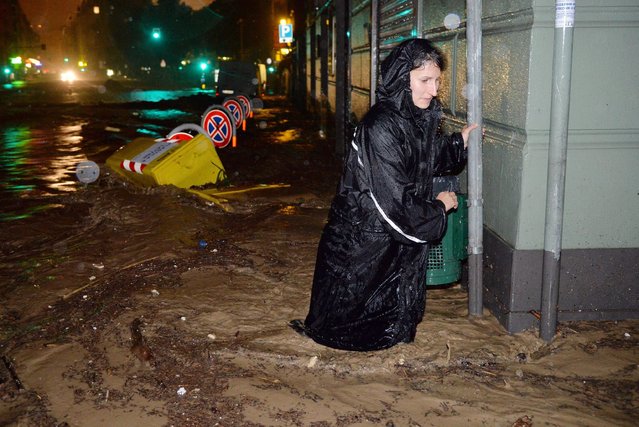
A woman walks through flood water during heavy downpour at a street in Genoa, Italy, 10 October 2014. At least one person died due to flooding after heavy rains caused the Bisagno river, which runs through Genoa city to overflow. Part of the city was in black-out with flooded streets and parked cars dragged away by the water's force. (Photo by Luca Zennaro/EPA)

A woman walks through flood water during heavy downpour at a street in Genoa, Italy, 10 October 2014. At least one person died due to flooding after heavy rains caused the Bisagno river, which runs through Genoa city to overflow. Part of the city was in black-out with flooded streets and parked cars dragged away by the water's force. (Photo by Luca Zennaro/EPA)
Details
11 Oct 2014 13:41:00
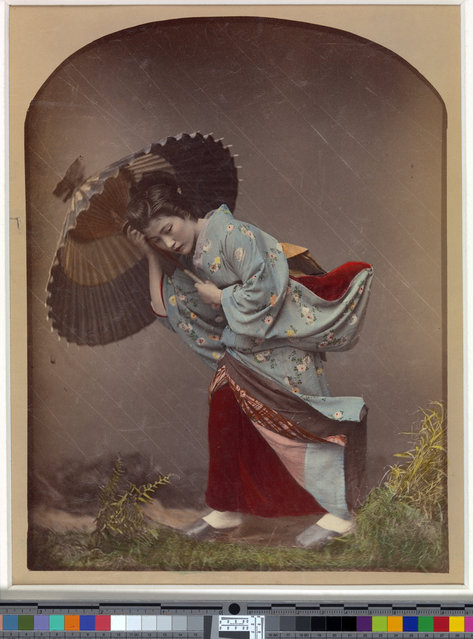
“Woman with Umbrella in Rain” by Raimund von Stillfried. Artist: Kusakabe Kimbei (Japanese, 1841–1934), 1870s. (Photo courtesy of The Metropolitan Museum of Art)

“Woman with Umbrella in Rain” by Raimund von Stillfried. Artist: Kusakabe Kimbei (Japanese, 1841–1934), 1870s. Commercial photography studios in Meiji-era Japan were renowned for the subtlety and refinement of their coloring techniques. This hand-tinted image of a young woman caught in a heavy rainstorm achieved its naturalistic effect by knitting together multiple strands of artifice: the greenery in the foreground was a studio prop; the flaps of the kimono were suspended by thin wires to create the impression of a strong wind; and long, diagonal marks were made on the negative to suggest streaks of rain. (Photo courtesy of The Metropolitan Museum of Art)
Details
12 May 2013 10:13:00
Emma White, of Team Cyclocrossworld, hits the dirt hard during the USA Cycling Cyclo-cross National Championship Elite Women's race at the Valmont Bike Park in Boulder, Colorado, on January 12, 2014. (Photo by Jeremy Papasso/The Daily Camera)

Emma White, of Team Cyclocrossworld, hits the dirt hard during the USA Cycling Cyclo-cross National Championship Elite Women's race at the Valmont Bike Park in Boulder, Colorado, on January 12, 2014. (Photo by Jeremy Papasso/The Daily Camera)
Details
18 Jan 2014 13:43:00
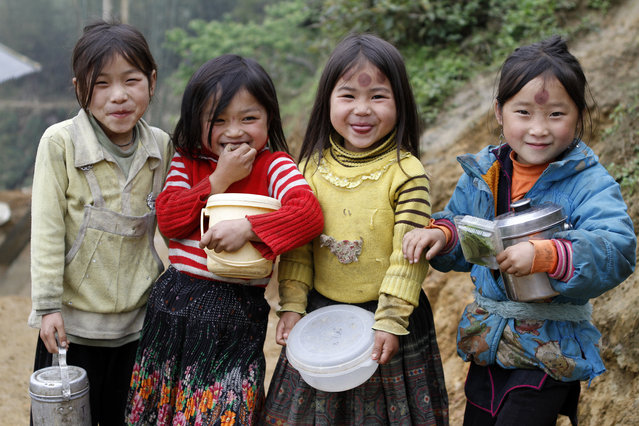
“Kids of Sapa”. Four little beautiful Hmong girls from Lao Chai Village, near Sapa, Vietnam. (Photo and caption by Felipe Hanower/National Geographic Traveler Photo Contest)

“Kids of Sapa”. Four little beautiful Hmong girls from Lao Chai Village, near Sapa, Vietnam. (Photo and caption by Felipe Hanower/National Geographic Traveler Photo Contest)
Details
15 Jul 2013 09:14:00
On August 31, 2012, a long filament of solar material that had been hovering in the sun's atmosphere, the corona, erupted out into space at 4:36 p.m. EDT. The coronal mass ejection, or CME, traveled at over 900 miles per second. The CME did not travel directly toward Earth, but did connect with Earth's magnetic environment, or magnetosphere, causing aurora to appear on the night of Monday, September 3. (Photo by NASA/GSFC/SDO)

On August 31, 2012, a long filament of solar material that had been hovering in the sun's atmosphere, the corona, erupted out into space at 4:36 p.m. EDT. The coronal mass ejection, or CME, traveled at over 900 miles per second. The CME did not travel directly toward Earth, but did connect with Earth's magnetic environment, or magnetosphere, causing aurora to appear on the night of Monday, September 3. (Photo by NASA/GSFC/SDO via The Atlantic)
Details
14 Sep 2012 09:01:00
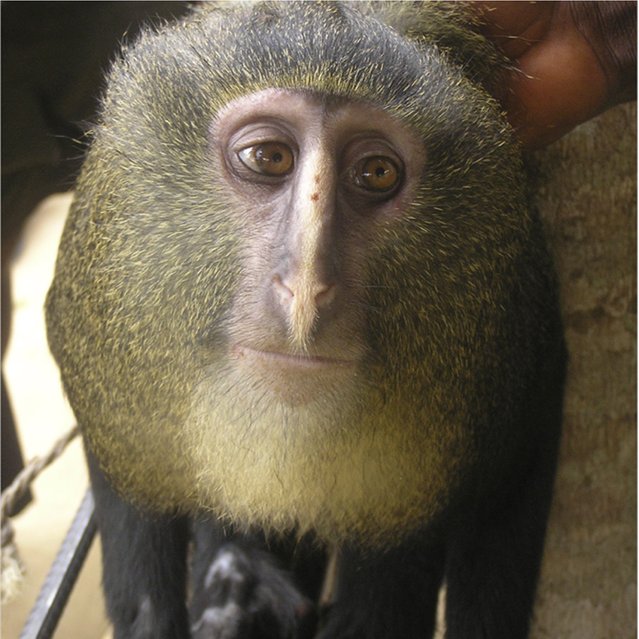
A new species of monkey found in the Democratic Republic of the Congo and identified as Lesula (Cercopithecus lomamiensis) is seen in this undated photograph from an article published September 12, 2012 in the science journal PLOS One. (Photo by Hart J. A., Detwiler K. M., Gilbert C. C./Reuters)

A new species of monkey found in the Democratic Republic of the Congo and identified as Lesula (Cercopithecus lomamiensis) is seen in this undated photograph from an article published September 12, 2012 in the science journal PLOS One. The monkey was first seen in 2007 by researchers John and Terese Hart of the Peabody Museum of Natural History at Yale Research Project. The finding of C. lomamiensis represents only the second new species of African monkey to be discovered in the past 28 years, according to the research article. (Photo by Hart J. A., Detwiler K. M., Gilbert C. C./Reuters)
Details
27 Sep 2012 08:17:00
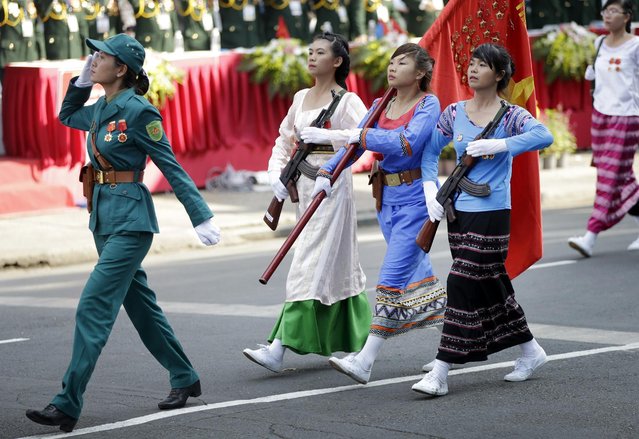
Vietnamese military personnel in traditional dress take part in a parade celebrating the 40th anniversary of the end of the Vietnam War which is also remembered as the fall of Saigon, in Ho Chi Minh City, Vietnam, Thursday, April 30, 2015. (Photo by Dita Alangkara/AP Photo)

Vietnamese military personnel in traditional dress take part in a parade celebrating the 40th anniversary of the end of the Vietnam War which is also remembered as the fall of Saigon, in Ho Chi Minh City, Vietnam, Thursday, April 30, 2015. (Photo by Dita Alangkara/AP Photo)
Details
01 May 2015 13:47:00