Loading...
Done
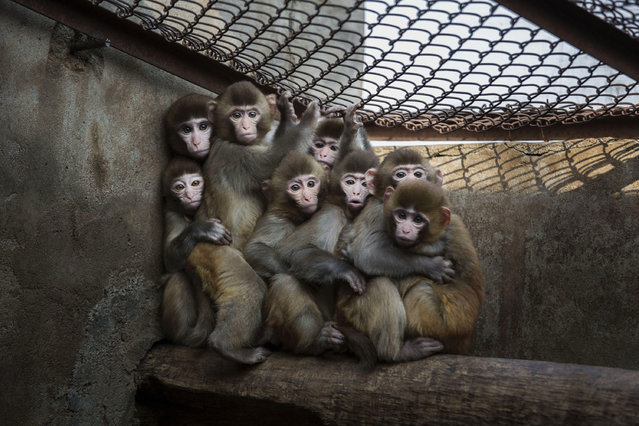
Macaque monkeys crowd together in their cage at a monkey farm on February 3, 2016 in Xinye county, Henan province, China. The area boasts a centuries-long and lucrative history of raising and training monkeys for performance. In Xinye, villagers are seeing an increase in business with the lunar calendar's “Year of the Monkey”. Farmers say most of the monkeys are bred and raised for domestic zoos, circuses, and performing groups, but add that some are also sold for medical research in China and the United States. Despite the popularity of the tradition, critics contend the training methods and conditions constitute animal cruelty. (Photo by Kevin Frayer/Getty Images)

Macaque monkeys crowd together in their cage at a monkey farm on February 3, 2016 in Xinye county, Henan province, China. The area boasts a centuries-long and lucrative history of raising and training monkeys for performance. In Xinye, villagers are seeing an increase in business with the lunar calendar's “Year of the Monkey”. Farmers say most of the monkeys are bred and raised for domestic zoos, circuses, and performing groups, but add that some are also sold for medical research in China and the United States. Despite the popularity of the tradition, critics contend the training methods and conditions constitute animal cruelty. (Photo by Kevin Frayer/Getty Images)
Details
31 Dec 2016 09:56:00
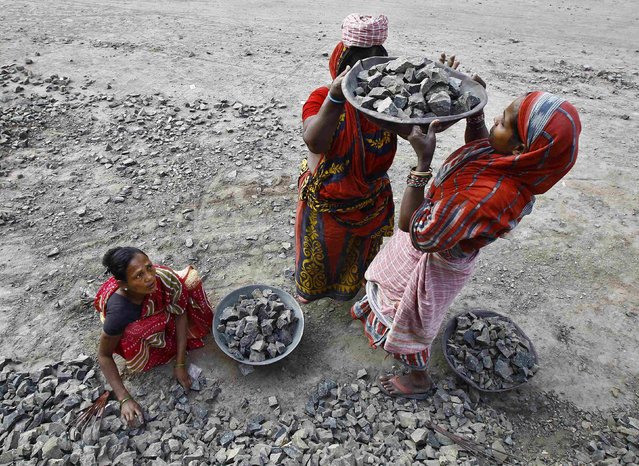
Women labourers work at the construction site of a road in Kolkata January 8, 2015. Across towns and cities in India, it is not uncommon to see women cleaning building sites, carrying bricks and or shoveling gravel - helping construct the infrastructure necessary for the country's economic and social development. (Photo by Rupak De Chowdhuri/Reuters)

Women labourers work at the construction site of a road in Kolkata January 8, 2015. Across towns and cities in India, it is not uncommon to see women cleaning building sites, carrying bricks and or shoveling gravel – helping construct the infrastructure necessary for the country's economic and social development. They help build roads, railway tracks, airports, and offices. They lay pipes for clean water supplies, cables for telecommunications, and dig the drains for sewage systems. But although women make up at least 20 percent of India's 40 million construction workers, they are less recognized than male workers with lower pay and often prone to safety hazards and sexual harassment. They are often unaware of their rights or scared to complain, say activists now trying to campaign for better treatment of women in the construction industry. (Photo by Rupak De Chowdhuri/Reuters)
Details
15 Jan 2015 13:47:00
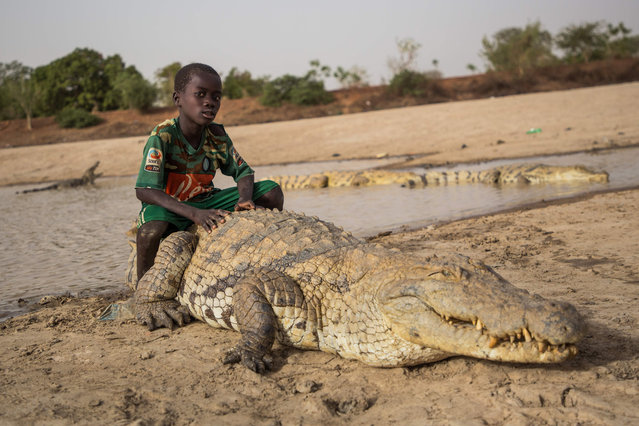
A boy sits on the back of a crocodile on May 19, 2018 at a pond in Bazoule in Burkina Faso, a village which happily shares its local pond with “sacred” crocodiles. Crocodiles may be one of the deadliest hunters in the animal kingdom, but in a small village in Burkina Faso it is not unusual to see someone sitting atop one of the fearsome reptiles. According to local legend, the startling relationship with the predators dates back to at least the 15 th century. The village was in the grip of an agonising drought until the crocodiles led women to a hidden pond where the population could slake their thirst. (Photo by Olympia de Maismont/AFP Photo)

A boy sits on the back of a crocodile on May 19, 2018 at a pond in Bazoule in Burkina Faso, a village which happily shares its local pond with “sacred” crocodiles. Crocodiles may be one of the deadliest hunters in the animal kingdom, but in a small village in Burkina Faso it is not unusual to see someone sitting atop one of the fearsome reptiles. According to local legend, the startling relationship with the predators dates back to at least the 15 th century. The village was in the grip of an agonising drought until the crocodiles led women to a hidden pond where the population could slake their thirst. (Photo by Olympia de Maismont/AFP Photo)
Details
17 Jul 2018 00:01:00
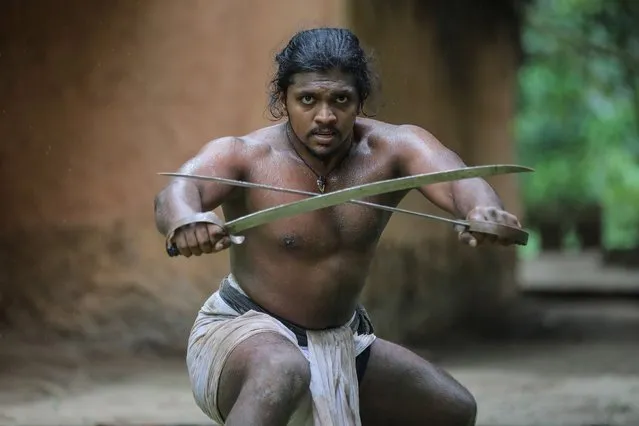
A student of the Sri Lankan ancient martial art “Angampora” performs during a practice session at the angam maduwa or fighting field, in Korathota, a suburb of Colombo, Sri Lanka, 07 September 2022. Sri Lanka's ancient martial art, Angampora, is thought to be thousands of years old. Anga translates to “body parts” and Angampora is a fighting art that uses body parts. Martial arts practitioners in Angampora were mostly in the king's service, and they were tasked with protecting the king and his kingdom. Angampora was practiced in secret for most centuries because the British, who colonized Sri Lanka, banned it in 1818 after seeing it as a threat. (Photo by Chamila Karunarathne/EPA/EFE)

A student of the Sri Lankan ancient martial art “Angampora” performs during a practice session at the angam maduwa or fighting field, in Korathota, a suburb of Colombo, Sri Lanka, 07 September 2022. Sri Lanka's ancient martial art, Angampora, is thought to be thousands of years old. Anga translates to “body parts” and Angampora is a fighting art that uses body parts. Martial arts practitioners in Angampora were mostly in the king's service, and they were tasked with protecting the king and his kingdom. Angampora was practiced in secret for most centuries because the British, who colonized Sri Lanka, banned it in 1818 after seeing it as a threat. (Photo by Chamila Karunarathne/EPA/EFE)
Details
14 Oct 2022 04:47:00
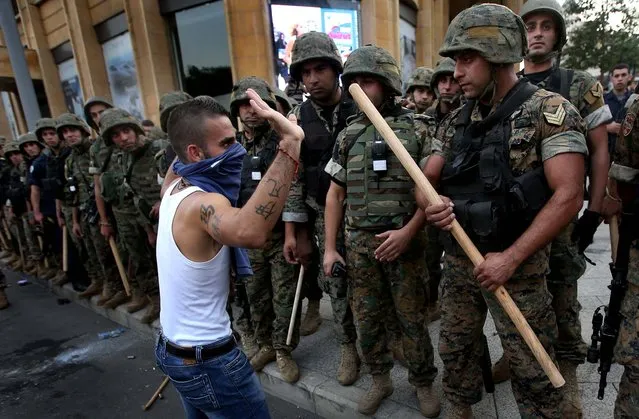
A masked protester talks to a soldier during clashes after the funeral of Brig. Gen. Wissam al-Hassan October 21, 2012. Lebanese soldiers fired guns and tear gas to push back hundreds of protesters who broke through a police cordon and tried to storm the government headquarters in Beirut. (Photo by Hussein Malla/Associated Press)

A masked protester talks to a soldier during clashes after the funeral of Brig. Gen. Wissam al-Hassan October 21, 2012. Lebanese soldiers fired guns and tear gas to push back hundreds of protesters who broke through a police cordon and tried to storm the government headquarters in Beirut. (Photo by Hussein Malla/Associated Press)
Details
27 Oct 2012 12:03:00
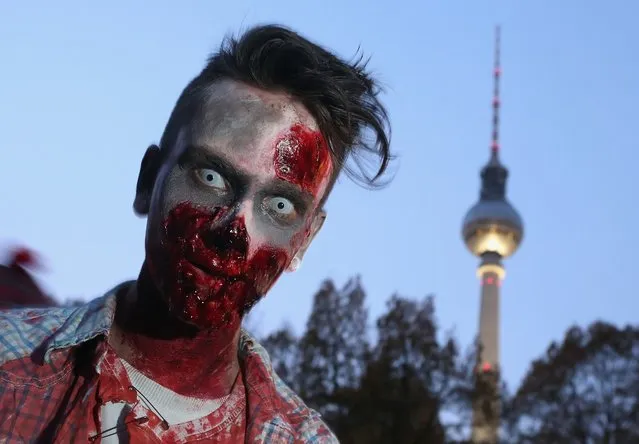
Zombie enthiusiasts gather near the broadcast tower at Alexanderplatz before setting out on a “Zombie Walk” in the city center on October 27, 2012 in Berlin, Germany. Approximately 150 zombies, who had organized themselves through Facebook, walked and limped across Alexanderplatz, growled and moaned at passersby and performed their jerking dances. (Photo by Sean Gallup)

Zombie enthiusiasts gather near the broadcast tower at Alexanderplatz before setting out on a “Zombie Walk” in the city center on October 27, 2012 in Berlin, Germany. Approximately 150 zombies, who had organized themselves through Facebook, walked and limped across Alexanderplatz, growled and moaned at passersby and performed their jerking dances. (Photo by Sean Gallup)
Details
28 Oct 2012 11:01:00


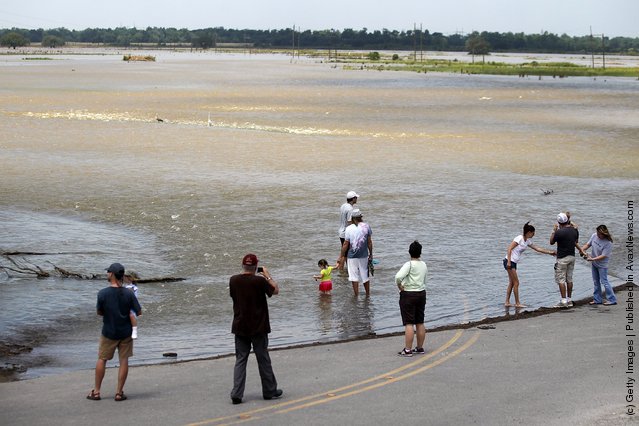
People look on as water from the rising Mississippi River is released through the Bonnet Carre Spillway while washing out a road May 9, 2011 in Norco, Louisiana. The Army Corps of Engineers began redirecting part of the Mississippi River through the spillway today to lower river levels and reduce pressure on levees in order to avoid a catastrophic failure. The water will flow nearly 6 miles north before emptying into Lake Pontchartrain as the Mississippi rises close to the highest level ever upriver in Memphis. (Photo by Mario Tama/Getty Images)
Details
11 May 2011 10:11:00
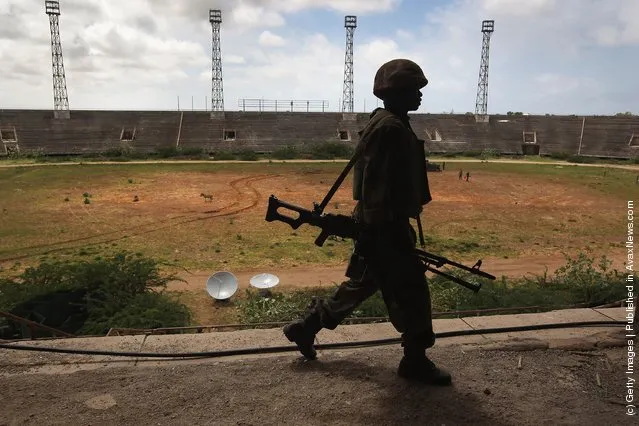
A Ugandan soldier, part of the 9,000-strong African Union Mission in Somalia, (AMISOM) walks through the Banadir soccer stadium in Mogadishu, Somalia

A Ugandan soldier, part of the 9,000-strong African Union Mission in Somalia, (AMISOM) walks through the Banadir soccer stadium on August 15, 2011 in Mogadishu, Somalia. The stadium, Somalia's largest soccer facility, had been under control by Islamic extremist Shabab militants for the past two years until they withdrew from the capital more than a week ago. (Photo by John Moore/Getty Images)
Details
18 Aug 2011 10:56:00