Loading...
Done
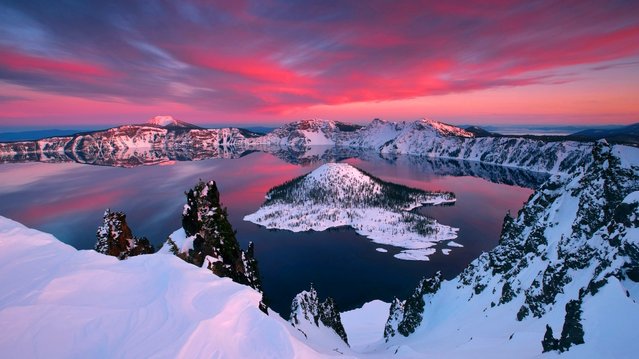
Crater Lake In Oregon

As you look at the majestic Crater Lake, located in south-central Oregon, United States, it is hard to imagine that thousands of years ago this place was one giant crater with scorching hot lava spilling over the sides. Those were the times of turmoil. Now, however, this place is the essence of tranquility. The lake that was formed, after the volcano died down, is amazingly clear due to the fact that the water isn’t moving at all. No rivers go in or out of the Crater Lake, and the water lost through evaporation is compensated by the rain and snowfall. This lake is also frighteningly deep – 1,943 feet (592 m) at its deepest point – making it the deepest lake in the United States. If you love nature and if you ever come to Oregon, this is truly a sight to behold.
Details
19 Nov 2014 14:14:00
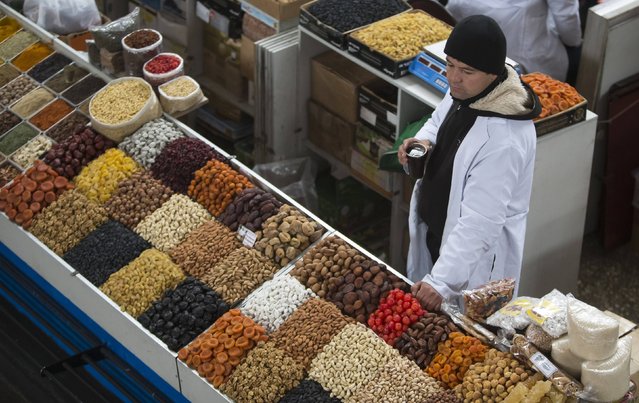
A vendor sells fruits and nuts at the Green Bazaar in Almaty January 23, 2015. Kazakhstan is spending billions of dollars of its reserves to keep devaluation of its currency gradual and reduce inflationary risks of the sort thrown up in Russia by the rouble's slide, analysts and former central bank officials say. (Photo by Shamil Zhumatov/Reuters)

A vendor sells fruits and nuts at the Green Bazaar in Almaty January 23, 2015. Kazakhstan is spending billions of dollars of its reserves to keep devaluation of its currency gradual and reduce inflationary risks of the sort thrown up in Russia by the rouble's slide, analysts and former central bank officials say. Kazakhstan, Central Asia's largest economy, is closely tied to Russia through trade and, like other ex-Soviet states, has been feeling the pain of the crisis which has driven the rouble down 50 percent against the dollar since the start of 2014. (Photo by Shamil Zhumatov/Reuters)
Details
28 Jan 2015 11:57:00
A masked man in military fatigues brings a blindfolded Irma Krat, arrested and held by pro-Russian protestors before her meeting with journalists near of occupied police station in Slaviansk, Ukraine, 21 April 2014. Pro-Russian activists are demanding broader autonomy from Kiev and closer ties to Russia. (Photo by Roman Pilipey/EPA)

A masked man in military fatigues brings a blindfolded Irma Krat, arrested and held by pro-Russian protestors before her meeting with journalists near of occupied police station in Slaviansk, Ukraine, 21 April 2014. Pro-Russian activists are demanding broader autonomy from Kiev and closer ties to Russia. Pro-Russian activists continued occupying government, police and other administrative buildings in eastern Ukrainian cities, in defiance of an ultimatum by the Ukrainian government to lay down their weapons. Russia, the United States, the European Union and Ukraine on 17 April had agreed on steps to de-escalate the crisis in Ukraine during talks in Geneva, Switzerland. (Photo by Roman Pilipey/EPA)
Details
26 Apr 2014 12:00:00
Rangoli Folk Art From India

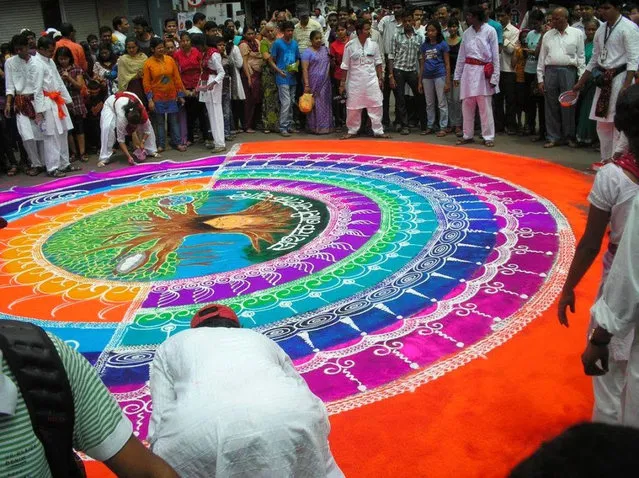
Rangoli, also known as kolam or Muggu, is a folk art from India in which patterns are created on the floor in living rooms or courtyards using materials such as colored rice, dry flour, colored sand or flower petals. It is usually made during Diwali, Onam, Pongal and other Indian festivals. They are meant to be sacred welcoming areas for the Hindu deities. The ancient symbols have been passed down through the ages, from each generation to the next, keeping both the art form and the tradition alive. Similar practices are followed in different Indian states: in Tamil Nadu, there is Kolam in Tamil Nadu; Mandana in Rajasthan; Chaookpurna in Chhattisgarh; Alpana in West Bengal; Aripana in Bihar; Chowk pujan in Uttar Pradesh; Muggu in Andhra Pradesh and others.
Details
16 Jun 2014 10:37:00
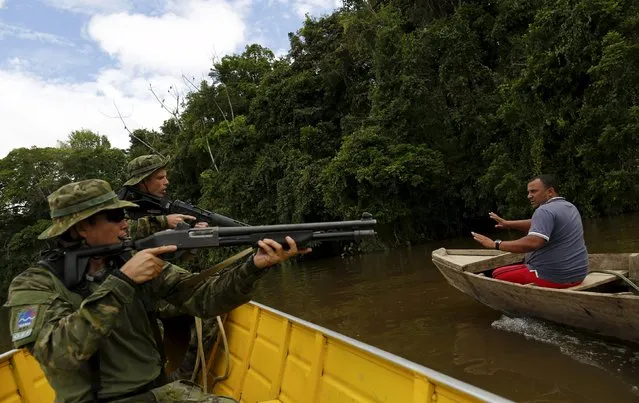
A gold prospector is detained by agents of Brazil’s environmental agency on the Uraricoera River during an operation against illegal gold mining on indigenous land, in the heart of the Amazon rainforest, in Roraima state, Brazil April 15, 2016. (Photo by Bruno Kelly/Reuters)

A gold prospector is detained by agents of Brazil’s environmental agency on the Uraricoera River during an operation against illegal gold mining on indigenous land, in the heart of the Amazon rainforest, in Roraima state, Brazil April 15, 2016. At over 9.5 million hectares, the Yanomami territory is twice the size of Switzerland and home to around 27,000 indians. The land has legally belonged to the Yanomami since 1992, but illegal miners continue to plague the area, sawing down trees and poisoning rivers with mercury in their lust for gold. (Photo by Bruno Kelly/Reuters)
Details
27 Apr 2016 10:01:00
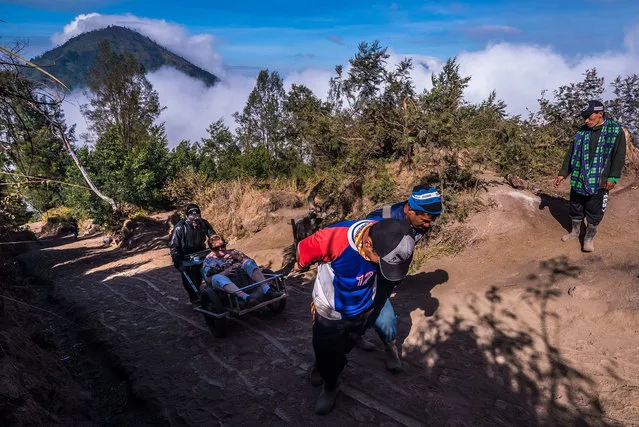
Miners pulling up lazy tourists to the rim of Kawah Ijen (Ijen Volcano), East Java, Indonesia on September 21, 2017. They will earn as much as they would bring down a load of sulfur. Nomadic Explorer, Cultural Lifestyle Photographer Claudio Sieber captured striking images of miners working at Ijen volcanic range in East Java, Indonesia. The sulphur miners risk their lives daily as they climb the active volcano carrying heavy loads, which they sell to sugar refineries. Shortly after midnight curious tourists are flocking in hundreds through the gate of Ijen's foothills to be right on time, driven by the images others took before them. Kawah Ijen is the one of the world's largest acidic volcanic crater lake; famous for its turquoise color as well as the unreal atmosphere it offers during darkness. A dusty path zigzags 3 kilometers up to the crater rim. This doesn't mean anything challenging; in particular, special sights have to be deserved anyway. The irritating smell of sulfur announces the near of the crater's existence. Arriving on the crater's rim the reward for the torture becomes visible. Blue fire darts its tongues through the fumes of sulfur dioxide. Somehow, the spectacle isn't as romantic as expected, since it is also the rough working space of approx. 150 sulfur miners who start their shift at 1 am. Lately, harvesting the abundance of devil's gold received international attention. This did obviously not really improve a miner's lifestyle; neither did it contribute to a better wage. (Photo by Claudio Sieber/Barcroft Images)

Miners pulling up lazy tourists to the rim of Kawah Ijen (Ijen Volcano), East Java, Indonesia on September 21, 2017. They will earn as much as they would bring down a load of sulfur. Nomadic Explorer, Cultural Lifestyle Photographer Claudio Sieber captured striking images of miners working at Ijen volcanic range in East Java, Indonesia. The sulphur miners risk their lives daily as they climb the active volcano carrying heavy loads, which they sell to sugar refineries. (Photo by Claudio Sieber/Barcroft Images)
Details
02 Oct 2017 08:31:00
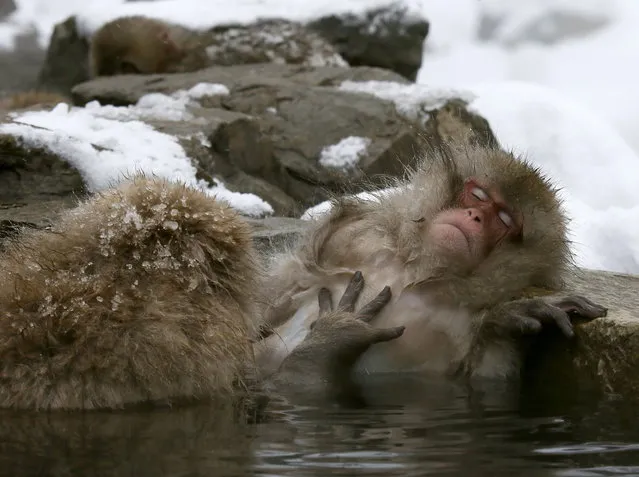
Japanese Macaque monkeys soak in the warmth of mountain hotsprings at Jigokudani Monkey Park, in Yamanouchi, central Japan, 19 January 2014. The Japanese Macaques (Macaca fuscata), also referred to as Snow Monkeys, live freely in this area that is covered by snow one third of the year. (Photo by Kimimasa Mayama/EPA)

Japanese Macaque monkeys soak in the warmth of mountain hotsprings at Jigokudani Monkey Park, in Yamanouchi, central Japan, 19 January 2014. The Japanese Macaques (Macaca fuscata), also referred to as Snow Monkeys, live freely in this area that is covered by snow one third of the year. Jigokudani is the only known place in the world where monkeys bathe in natural hot springs. As a habit, they come down from the mountains where they spend the night and bath during the day. (Photo by Kimimasa Mayama/EPA)
Details
21 Jan 2014 11:36:00
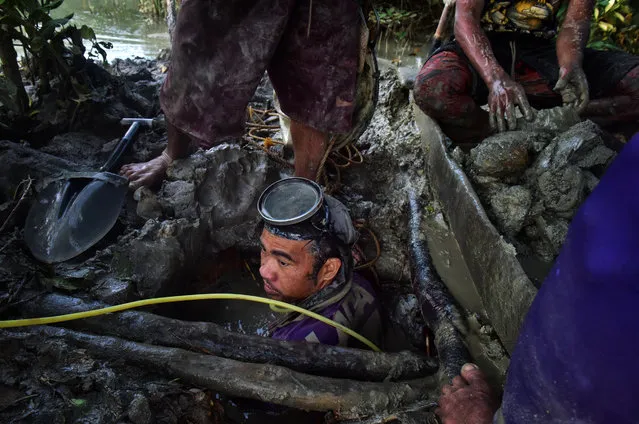
Christian Balderosdasco, 31, is being pulled up a mud pit after diving for 3 hours to look for gold on March 22, 2017 in Paracale, Philippines. (Photo by Jes Aznar/Getty Images)

Christian Balderosdasco, 31, is being pulled up a mud pit after diving for 3 hours to look for gold on March 22, 2017 in Paracale, Philippines. Apart from tunneling and sifting sand, locals dive down murky swamps with the aid of a compressor with air flowing in a small tube for breathing, as they blindly swim under the mud for up to four hours to look for tiny rocks containing gold particles. For decades, local residents at Paracale town work in hazardous conditions scavenging under the earth and diving into tunnels filled with mud using only makeshift tools to mine for gold, often placing their health and lives at risk. (Photo by Jes Aznar/Getty Images)
Details
06 Apr 2017 09:21:00