Loading...
Done
The Lun-class Ekranoplane was used by the Soviet Navy starting in 1987, and wasn't retired until the late 1990s, after the Soviet Union's fall. (Igor113)

“The Lun-class ekranoplan (NATO reporting name Duck) was a ground effect vehicle (GEV) designed by Rostislav Evgenievich Alexeev and used by the Soviet and Russian navies from 1987 until sometime in the late 1990s. It “flew” using the lift generated by the ground effect of its large wings when close to the surface of the water – about four metres or less. Although they might look similar and/or have related technical characteristics, ekranoplans like the Lun are not aircraft, seaplanes, hovercraft, or hydrofoils – ground effect is a separate technology altogether. The International Maritime Organization classifies these vehicles as maritime ships. The name Lun comes from the Russian for harrier”. – Wikipedia (Photo by Igor113)
Details
08 Aug 2014 10:51:00
This photographer has a long love affair with lady liberty – and has captured it on film. The amazing pictures show the Statue of Liberty silhouetted against an array of beautiful backdrops, In some photographs she appears to be supporting the moon, in others celebrating with fireworks in the background. The pictures were taken by fine art photographer Peter Alessandria from New Jersey. He started taking the pictures of the statue in 2013 as part of his work capturing New Yorks famous landmarks. Here: The statue of liberty in New York City, New York. (Photo by Peter Alessandria/Caters News)

This photographer has a long love affair with lady liberty – and has captured it on film. The amazing pictures show the Statue of Liberty silhouetted against an array of beautiful backdrops. In some photographs she appears to be supporting the moon, in others celebrating with fireworks in the background. Here: The statue of liberty in New York City, New York. (Photo by Peter Alessandria/Caters News)
Details
31 Jan 2017 10:09:00
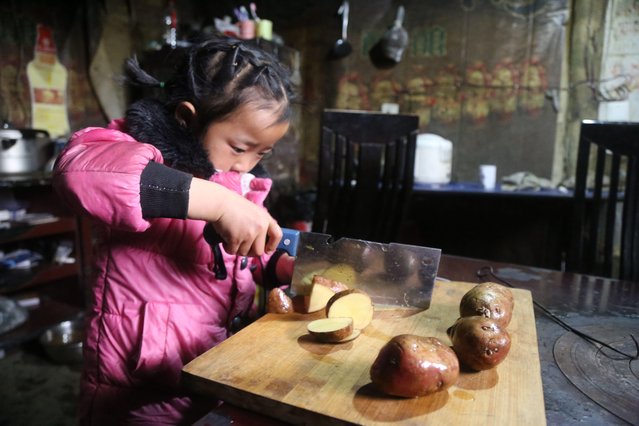
5-year-old Chinese girl Wang Anna prepares meals for her grandmother and great-grandmother at home in Zhuyuan village, Guizhou province, China on March 3, 2017. (Photo by Imaginechina/Rex Features/Shutterstock)

5-year-old Chinese girl Wang Anna prepares meals for her grandmother and great-grandmother at home in Zhuyuan village, Guizhou province, China on March 3, 2017. Chinese girl called Wang Anna, 5, takes care of her ill grandmother and 92-year-old great-grandmother on her own every day in a mountainous village in Zhima town, Zunyi city, southwest China's Guizhou province. Her father went to jail before she was born and her mother remarried after gave birth to her. Although she is just five years old, she started to shoulder the responsibility to look after ill grandmother and elderly great-grandmother. (Photo by Imaginechina/Rex Features/Shutterstock)
Details
09 Mar 2017 00:05:00
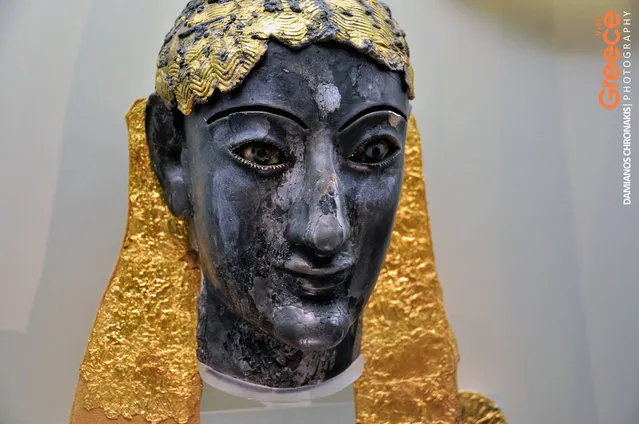
Delfoi Museum

Delfoi Museum by Damianos Chronakis
Details
12 Jun 2012 07:10:00
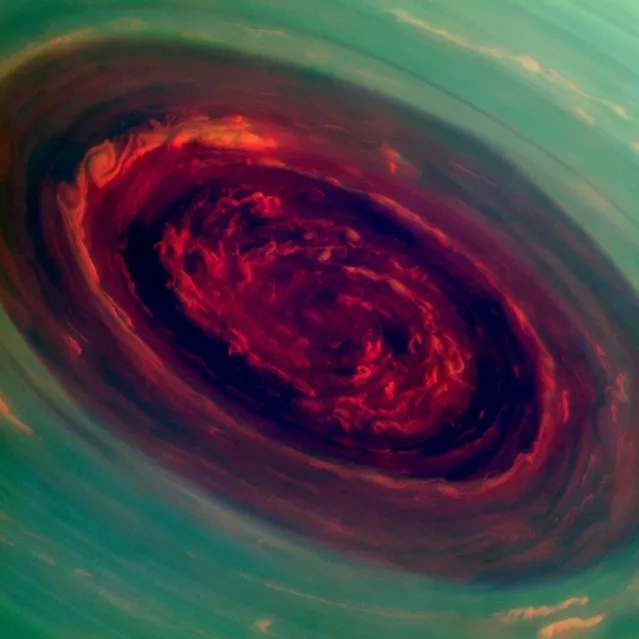
The spinning vortex of Saturn's north polar storm resembles a deep red rose of giant proportions surrounded by green foliage in this false-color image from NASA's Cassini spacecraft. (Photo by NASA/JPL-Caltech/SSI)

NASA's Cassini spacecraft has provided scientists the first close-up, visible-light views of a behemoth hurricane swirling around Saturn's north pole. In high-resolution pictures and video, scientists see the hurricane's eye is about 1,250 miles (2,000 kilometers) wide, 20 times larger than the average hurricane eye on Earth. Thin, bright clouds at the outer edge of the hurricane are traveling 330 mph(150 meters per second). The hurricane swirls inside a large, mysterious, six-sided weather pattern known as the hexagon. Photo: The spinning vortex of Saturn's north polar storm resembles a deep red rose of giant proportions surrounded by green foliage in this false-color image from NASA's Cassini spacecraft. (Photo by NASA/JPL-Caltech/SSI)
Details
31 May 2015 09:11:00
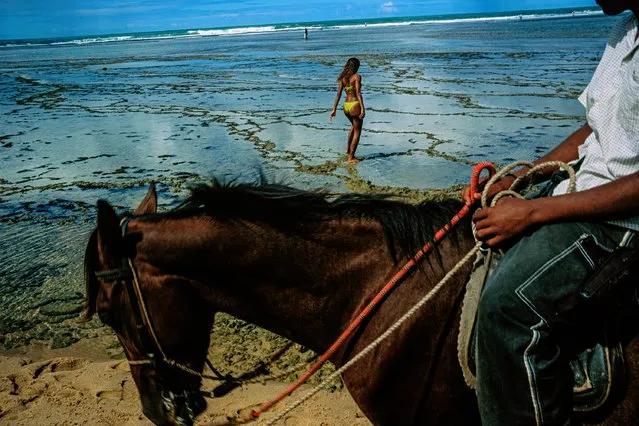
Praia du Forte, Bahia. “This was the lead picture for a National Geographic story on Bahia, because it was both mysterious as well as a “geography” picture showing where the slaves arrived from Nigeria. Beach pictures seem like they should be easy to take, but for me they are actually quite difficult. Too easy to fall into cliche. When I saw the kid coming on the horse, I quickly ran to see if I could make something with a woman in a bikini that was not a bikini shot”. (Photo by David Alan Harvey/The Guardian)

Praia du Forte, Bahia. “This was the lead picture for a National Geographic story on Bahia, because it was both mysterious as well as a “geography” picture showing where the slaves arrived from Nigeria. Beach pictures seem like they should be easy to take, but for me they are actually quite difficult. Too easy to fall into cliche. When I saw the kid coming on the horse, I quickly ran to see if I could make something with a woman in a bikini that was not a bikini shot”. (Photo by David Alan Harvey/The Guardian)
Details
20 Aug 2016 11:35:00
A wounded student is transported by first-aid workers during riots on the Boulevard Saint-Michel, Paris, France, May 6, 1968. (Photo by Gökşin Sipahioğlu/SIPA Press)

Fifty years ago, as France exploded in mass protests, words scrawled on the walls of the Sorbonne summed up the revolutionary zeal of the time: “Run free, comrade, we’ve left the old world behind!”. Sexual liberation, artistic creativity and anti-capitalism were the order of the day. For those who were there, it was an unforgettable time. Here: A wounded student is transported by first-aid workers during riots on the Boulevard Saint-Michel, Paris, France on May 6, 1968. (Photo by Gökşin Sipahioğlu/SIPA Press)
Details
25 May 2018 00:06:00
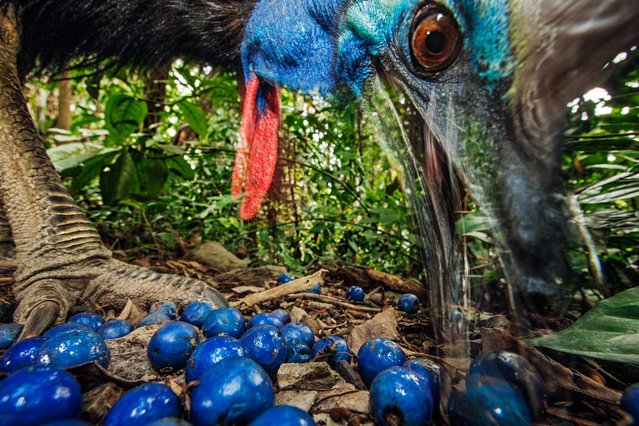
“Cassowaries are large, flightless birds related to emus and (more distantly) to ostriches, rheas, and kiwis”, writes Olivia Judson in the September issue of National Geographic magazine. (Photo by Christian Ziegler/National Geographic)

“Cassowaries are large, flightless birds related to emus and (more distantly) to ostriches, rheas, and kiwis”, writes Olivia Judson in the September issue of National Geographic magazine. How large? People-size: Adult males stand well over five foot five and top 110 pounds. Females are even taller, and can weigh more than 160 pounds. Dangerous when roused, they’re shy and peaceable when left alone. But even birds this big and tough are prey to habitat loss. The dense New Guinea and Australia rain forests where they live have dwindled. Today cassowaries might number 1,500 to 2,000. And because they help shape those same forests – by moving seeds from one place to another – “if they vanish”, Judson writes, “the structure of the forest would gradually change” too. (Photo by Christian Ziegler/National Geographic)
Details
06 Jan 2014 12:21:00