Loading...
Done
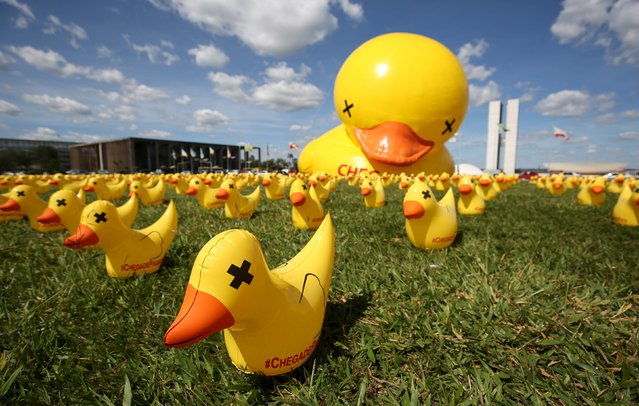
Inflatable dolls in the shape of ducks are seen in front of the National Congress during a protest against tax increases in Brasilia, Brazil, March 29, 2016. The campaign “I will not pay the Duck” is organized by the Federation of Industries of Sao Paulo (FIESP) and uses the duck symbol in reference to industries that pay high taxes. (Photo by Gregg Newton/Reuters)

Inflatable dolls in the shape of ducks are seen in front of the National Congress during a protest against tax increases in Brasilia, Brazil, March 29, 2016. The campaign “I will not pay the Duck” is organized by the Federation of Industries of Sao Paulo (FIESP) and uses the duck symbol in reference to industries that pay high taxes. (Photo by Gregg Newton/Reuters)
Details
30 Mar 2016 11:27:00
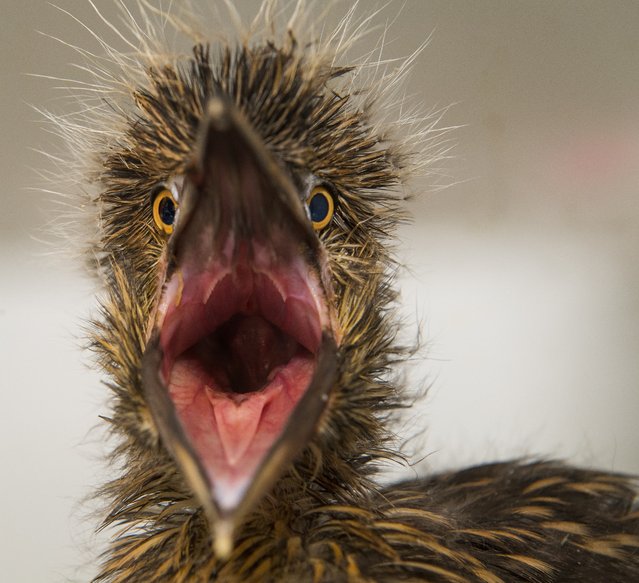
A baby Black-crowned Night Heron squawks in its incubator while being cared for at City Wildlife rescue and rehabilitation center in Washington, DC on May 31, 2017. The heron is one of several that have been brought to CW by the staff at The National Zoo over the past few years. The heron is a native bird and has made an established rookery inside the zoo grounds over a hundred years ago.  Every year at this time, some of the chicks get pushed or fall out of the nest and require human care.  Because the birds are native and not part of the Smithsonian collection, they partnered with CW to rehabilitate the herons for re-release back to the flock inside Zoo. They're reintroduced back to their flock so that they can migrate together in the Fall. The Black-crowned heron usually migrates from the DC area down to southeast North Carolina, some going as far as Jacksonville, FL in winter. The Black-crowned heron is the species of greatest conservation need in the District of Columbia because their numbers are in such rapid decline due to habitat loss. (Photo Linda Davidson/The Washington Post)

A baby Black-crowned Night Heron squawks in its incubator while being cared for at City Wildlife rescue and rehabilitation center in Washington, DC on May 31, 2017. The heron is one of several that have been brought to CW by the staff at The National Zoo over the past few years. (Photo Linda Davidson/The Washington Post)
Details
04 Jun 2017 08:04:00
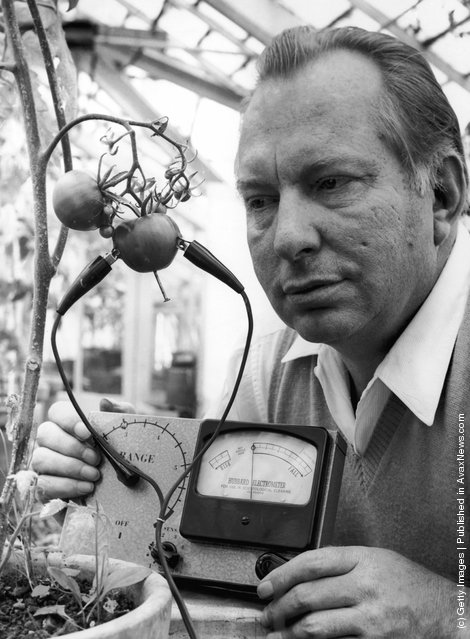
American science fiction writer L. Ron Hubbard, founder of the Church of Scientology, uses his Hubbard Electrometer

“Lafayette Ronald Hubbard (March 13, 1911 – January 24, 1986), better known as L. Ron Hubbard (and often referred to by his initials, LRH), was an American pulp fiction author and religious leader who founded the Church of Scientology. After establishing a career as a writer, becoming best known for his science fiction and fantasy stories, he developed a self-help system called Dianetics which was first published in May 1950. He subsequently developed his ideas into a wide-ranging set of doctrines and rituals as part of a new religious movement that he called Scientology. His writings became the guiding texts for the Church of Scientology and a number of affiliated organizations that address such diverse topics as business administration, literacy and drug rehabilitation”. – Wikipedia

Photo: American science fiction writer L. Ron Hubbard, founder of the Church of Scientology, uses his Hubbard Electrometer (patent pending) to determine whether tomatoes experience pain, 1959. His work led him to the conclusion that tomatoes “scream when sliced”. (Photo by Scott Lauder/Evening Standard/Hulton Archive/Getty Images)
Details
09 Sep 2011 09:34:00
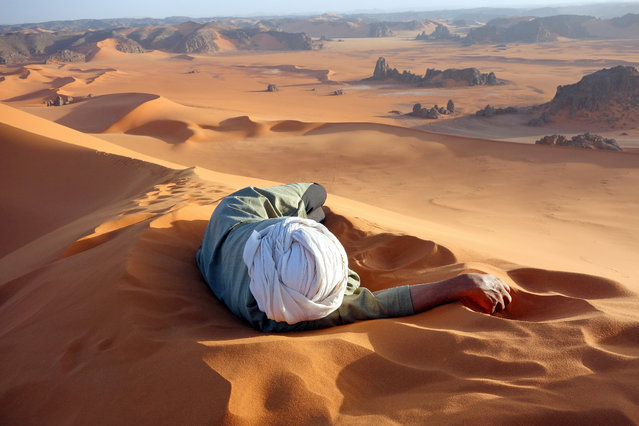
“A Well Earned Rest in the Sahara”. This photo of Moussa Macher, our Tuareg guide, was taken at the summit of Tin-Merzouga, the largest dune (or erg) in the Tadrat region of the Sahara desert in southern Algeria. Moussa rested while waiting for us to finish our 45-minute struggle to the top. Photo location: Summit of Tin-Merzouga, Tadrat, Tassili N'Ajjer National Park, Algeria. (Photo and caption by Evan Cole/National Geographic Photo Contest)

Merit Prize Winner: “A Well Earned Rest in the Sahara”. This photo of Moussa Macher, our Tuareg guide, was taken at the summit of Tin-Merzouga, the largest dune (or erg) in the Tadrat region of the Sahara desert in southern Algeria. Moussa rested while waiting for us to finish our 45-minute struggle to the top. It only took ten minutes of rolling, running, and jumping to get back down. The Tadrat is part of the Tassili N'Ajjer National Park World Heritage area, famous for its red sand and engravings and rock paintings of cattle, elephants, giraffes, and rhinos that lived there when the climate was milder. Photo location: Summit of Tin-Merzouga, Tadrat, Tassili N'Ajjer National Park, Algeria. (Photo and caption by Evan Cole/National Geographic Photo Contest)
Details
01 Aug 2014 11:38:00
Contestant Nathalie De Oliveira of Brazil prepares backstage before the final show of the Miss International Queen 2016 transgender/transsexual beauty pageant in Pattaya, Thailand, March 10, 2017. Thai contestant Jiratchaya Sirimongkolnawin was crowned Miss International Queen 2016 on Friday at a contest billed as the world's largest and most popular transgender pageant. (Photo by Athit Perawongmetha/Reuters)

Contestant Nathalie De Oliveira of Brazil prepares backstage before the final show of the Miss International Queen 2016 transgender/transsexual beauty pageant in Pattaya, Thailand, March 10, 2017. Thai contestant Jiratchaya Sirimongkolnawin was crowned Miss International Queen 2016. The 2016 show was postponed from November last year due to Thailand's mourning period of its late King Bhumibol Adulyadej who died at age 88 on October 13, 2016. (Photo by Athit Perawongmetha/Reuters)
Details
12 Mar 2017 09:57:00
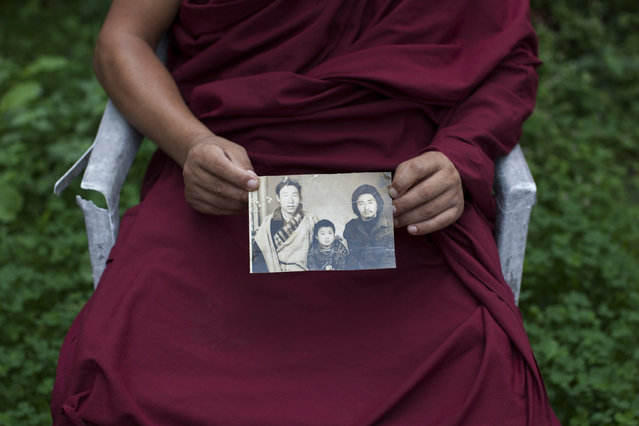
In this Saturday, September 27, 2014 photo, Tibetan monk Dorjee, 38, displays a photograph of his father, left, and himself, center, taken in Tibet, in Dharamsala, India. Dorjee said he held back his tears when he spoke with his parents on the phone after a separation period of 27 years. He exchanged a few words with his father but said his mother fainted on hearing his voice. (Photo by Tsering Topgyal/AP Photo)

“When I was 8 years old, my parents paid a smuggler to take me across the Himalayas, a weekslong walk over the mountains from Tibet to India. It was a trek that tens of thousands of other Tibetans have taken since the Dalai Lama fled a failed 1959 uprising against Chinese rule. My parents must have had their reasons to send me here; they must have had the best of intentions. But 18 years later, I still don't know why they did it. They are not political people. They are small farmers who raise barley and a few yak in a rural area not far from Lhasa, the Tibetan capital. I have not seen them since I left...”. – Tsering Topgyal via The Associated Press. (Photo by Tsering Topgyal/AP Photo)
Details
05 Nov 2014 12:27:00
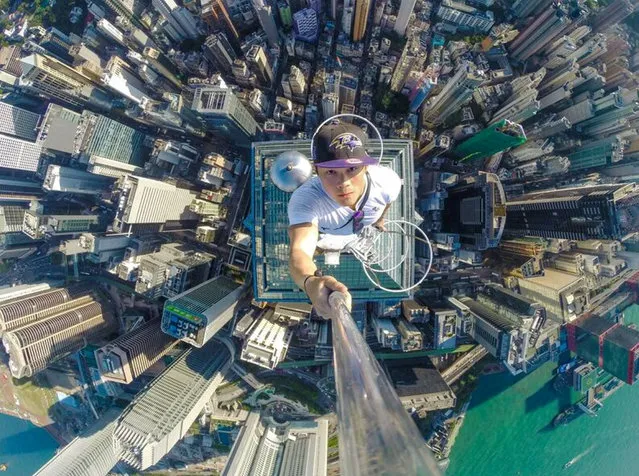
Roof-topping enthusiast Daniel Lau takes a selfie with high-rise buildings down below as he stands on the top of a skyscraper in Hong Kong, China on August 15, 2017. Welcome to “roof-topping”, where daredevils take pictures of themselves standing on the tops of tall buildings, or in some cases even dangling from them, without any safety equipment. A craze that began in Russia has now taken hold in Hong Kong, one of the world's most vertical cities, with dramatic results. “I'm an explorer”, said Daniel Lau, one of the three who climbed to the top of The Center. A student, he said roof-topping was “a getaway from my structured life”. “Before doing this, I lived like an ordinary person, having a boring life”, he said. “I wanted to do something special, something memorable. I want to let people see Hong Kong, the place they are living, from a new perspective”. Mr Lau said he had been inspired by Russian climbers and that he was unafraid of the vertiginous heights he scales. (Photo by ImagineChina/Rex Features/Shutterstock)

Roof-topping enthusiast Daniel Lau takes a selfie with high-rise buildings down below as he stands on the top of a skyscraper in Hong Kong, China on August 15, 2017. A craze that began in Russia has now taken hold in Hong Kong, one of the world's most vertical cities. Mr Lau said he had been inspired by Russian climbers and that he was unafraid of the vertiginous heights he scales. (Photo by ImagineChina/Rex Features/Shutterstock)
Details
16 Aug 2017 07:23:00
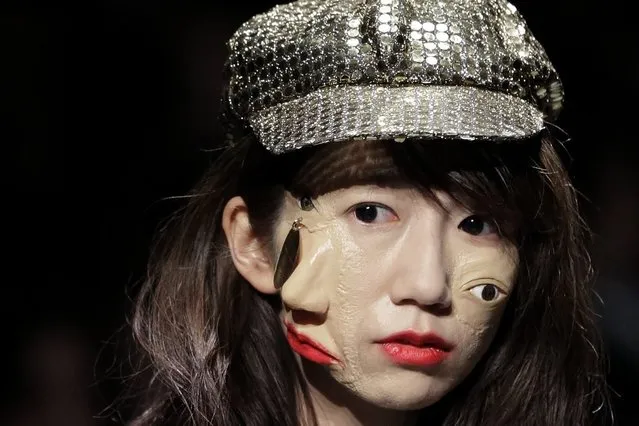
A model presents a creation by Japanese designer Yoshikazu Yamagata for his label writtenafterwards during the Mercedes-Benz Fashion Week in Tokyo, Japan, 16 March 2016. The presentation of the Autumn/Winter 2016 collections runs from 14 to 19 March. (Photo by Kiyoshi Ota/EPA)

A model presents a creation by Japanese designer Yoshikazu Yamagata for his label writtenafterwards during the Mercedes-Benz Fashion Week in Tokyo, Japan, 16 March 2016. The presentation of the Autumn/Winter 2016 collections runs from 14 to 19 March. (Photo by Kiyoshi Ota/EPA)
Details
17 Mar 2016 15:45:00