Loading...
Done
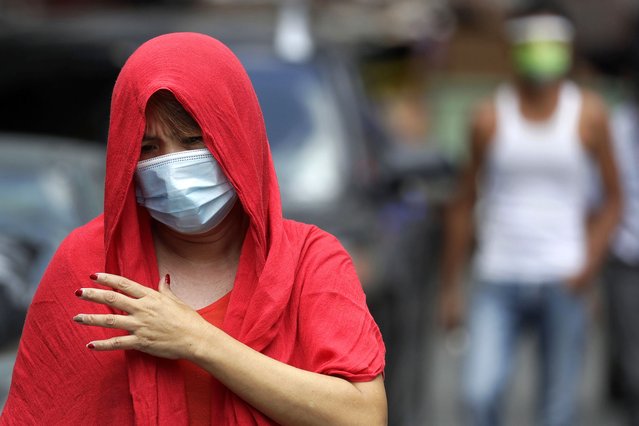
A woman wearing a protective mask walks outside a village that was placed under lockdown due to the number of COVID-19 cases among residents in Manila, Philippines on Thursday, March 11, 2021. (Photo by Aaron Favila/AP Photo)

A woman wearing a protective mask walks outside a village that was placed under lockdown due to the number of COVID-19 cases among residents in Manila, Philippines on Thursday, March 11, 2021. The Philippine capital placed two villages and two hotels on lockdown Thursday and police have renewed warnings against kissing and other “public display of affection” after a new surge in coronavirus infections. (Photo by Aaron Favila/AP Photo)
Details
12 Mar 2021 10:12:00
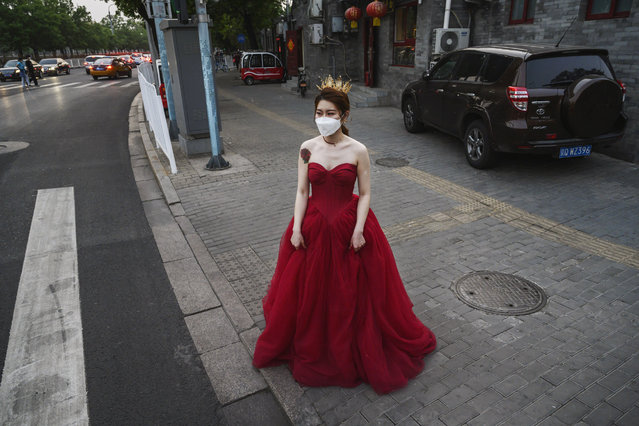
A Chinese woman wears her dress and a protective mask as she waits to change after taking pictures in advance of her wedding near the Forbidden City, on April 30, 2020 in Beijing, China. Beijing lowered its risk level after more than three months Thursday in advance of the May holiday, allowing most domestic travellers arriving in the city to do so without having to do 14 days of quarantine. The Forbidden City will open to a limited number of visitors as of Thursday morning. After decades of growth, officials said China's economy had shrunk in the latest quarter due to the impact of the coronavirus epidemic. The slump in the world's second largest economy is regarded as a sign of difficult times ahead for the global economy. While industrial sectors in China are showing signs of reviving production, a majority of private companies are operating at only 50% capacity, according to analysts. With the pandemic hitting hard across the world, officially the number of coronavirus cases in China is dwindling, ever since the government imposed sweeping measures to keep the disease from spreading. Officials believe the worst appears to be over in China, though there are concerns of another wave of infections as the government attempts to reboot the world's second largest economy. Since January, China has recorded more than 81,000 cases of COVID-19 and at least 3,200 deaths, mostly in and around the city of Wuhan, in central Hubei province, where the outbreak first started. (Photo by Kevin Frayer/Getty Images)

A Chinese woman wears her dress and a protective mask as she waits to change after taking pictures in advance of her wedding near the Forbidden City, on April 30, 2020 in Beijing, China. Beijing lowered its risk level after more than three months Thursday in advance of the May holiday, allowing most domestic travellers arriving in the city to do so without having to do 14 days of quarantine. (Photo by Kevin Frayer/Getty Images)
Details
03 May 2020 00:07:00
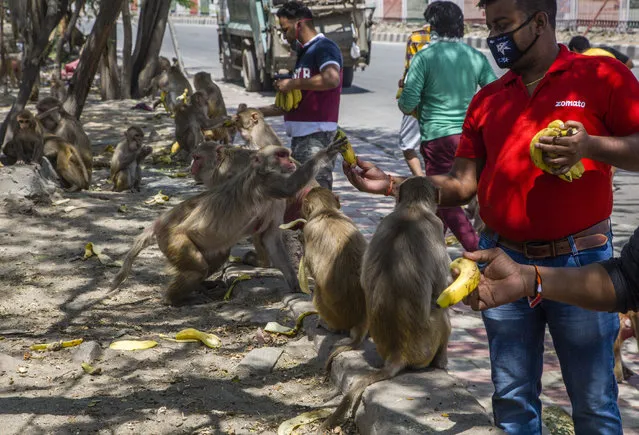
Men give bananas to monkeys gathered on the side of the road as India remains under an unprecedented lockdown over the highly contagious coronavirus (COVID-19) on April 08, 2020 in New Delhi, India. Wild animals, including monkeys, are roaming human settlements in India as people are staying indoors due to the 21-day lockdown. With India's 1.3 billion population and tens of millions of cars off the roads, wildlife is moving towards areas inhabited by humans. Wild animals in many countries have been seen roaming streets. A study says some 60 percent of the new diseases found around the globe every year are zoonotic, meaning they originate in animals and are passed on to humans. COVID-19 is a zoonotic disease that is suspected to have come from the wet markets of Wuhan, China. (Photo by Yawar Nazir/Getty Images)

Men give bananas to monkeys gathered on the side of the road as India remains under an unprecedented lockdown over the highly contagious coronavirus (COVID-19) on April 08, 2020 in New Delhi, India. Wild animals, including monkeys, are roaming human settlements in India as people are staying indoors due to the 21-day lockdown. (Photo by Yawar Nazir/Getty Images)
Details
12 Apr 2020 00:05:00
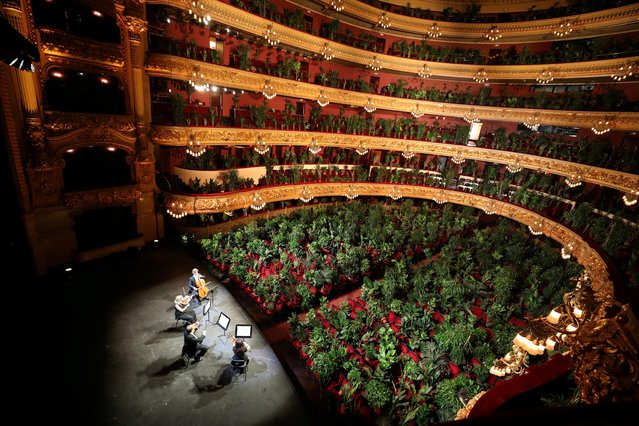
Nursery plants are seen placed in people's seats during a rehearsal as Barcelona's Gran Teatre del Liceu opera reopens its doors with a concert for plants, to raise awareness about the importance of an audience after the coronavirus lockdown, in Barcelona, Spain on June 22, 2020. The Gran Teatre del Liceu reopens its doors, in which the 2,292 seats of the auditorium will be occupied on this occasion by plants. It will be on 22 June, broadcast live online, when the UceLi Quartet string quartet performs Puccini's “Crisantemi” for this verdant public, brought in from local nurseries. (Photo by Nacho Doce/Reuters)

Nursery plants are seen placed in people's seats during a rehearsal as Barcelona's Gran Teatre del Liceu opera reopens its doors with a concert for plants, to raise awareness about the importance of an audience after the coronavirus lockdown, in Barcelona, Spain on June 22, 2020. The Gran Teatre del Liceu reopens its doors, in which the 2,292 seats of the auditorium will be occupied on this occasion by plants. It will be on 22 June, broadcast live online, when the UceLi Quartet string quartet performs Puccini's “Crisantemi” for this verdant public, brought in from local nurseries. (Photo by Nacho Doce/Reuters)
Details
24 Jun 2020 00:07:00
In this file photo taken on Sunday, August 2, 2020, Sviatlana Tsikhanouskaya, candidate for the presidential elections greets people waving old Belarus flags during a meeting to show her support, in Brest, 326 km (203,7 miles) southwest of Minsk, Belarus. Belarus’ authoritarian President Alexander  Lukashenko faces a perfect storm as he seeks a sixth term in the election held Sunday, Aug. 9, 2020 after 26 years in office. Mounting public discontent over the worsening economy and his government’s bungled handling of the coronavirus pandemic has fueled the largest opposition rallies since the Soviet collapse. (Photo by Sergei Grits/AP Photo)

In this file photo taken on Sunday, August 2, 2020, Sviatlana Tsikhanouskaya, candidate for the presidential elections greets people waving old Belarus flags during a meeting to show her support, in Brest, 326 km (203,7 miles) southwest of Minsk, Belarus. Belarus’ authoritarian President Alexander Lukashenko faces a perfect storm as he seeks a sixth term in the election held Sunday, Aug. 9, 2020 after 26 years in office. Mounting public discontent over the worsening economy and his government’s bungled handling of the coronavirus pandemic has fueled the largest opposition rallies since the Soviet collapse. (Photo by Sergei Grits/AP Photo)
Details
10 Aug 2020 00:01:00
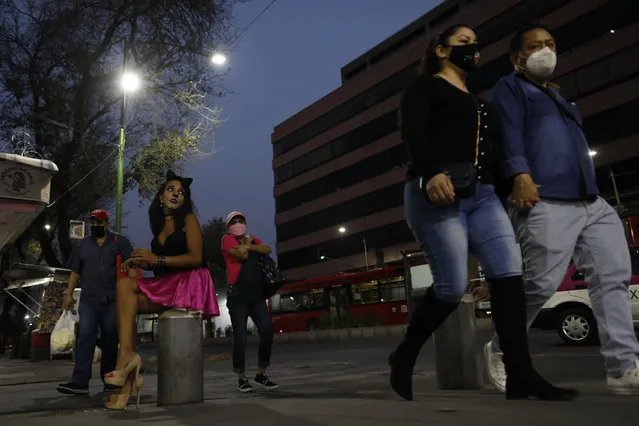
Sеx worker Geraldine wearing cat make-up sits on her usual corner as she waits for clients outside the Revolution subway station, in Mexico City, Saturday, March 13, 2021. Geraldine, 30, a sеx worker since age 15, says many of her regular clients have stopped coming amid the coronavirus pandemic and that seeing new clients presents new health and security risks. She is most concerned about the risk of bringing COVID-19 home to her partner, who has diabetes. (Photo by Rebecca Blackwell/AP Photo)

Sеx worker Geraldine wearing cat make-up sits on her usual corner as she waits for clients outside the Revolution subway station, in Mexico City, Saturday, March 13, 2021. Geraldine, 30, a sеx worker since age 15, says many of her regular clients have stopped coming amid the coronavirus pandemic and that seeing new clients presents new health and security risks. She is most concerned about the risk of bringing COVID-19 home to her partner, who has diabetes. (Photo by Rebecca Blackwell/AP Photo)
Details
24 Jan 2022 05:17:00
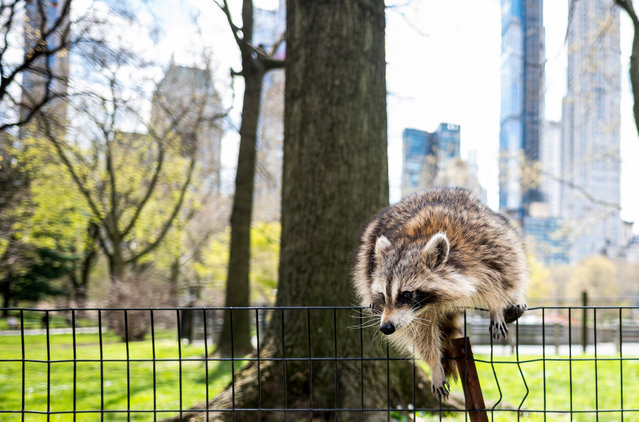
A racoon jumps over a fence in almost deserted Central Park in Manhattan on April 16, 2020 in New York City. Gone are the softball games, horse-drawn carriages and hordes of tourists. In their place, pronounced birdsong, solitary walks and renewed appreciation for Central Park's beauty during New York's coronavirus lockdown. The 843-acre (341-hectare) park – arguably the world's most famous urban green space – normally bustles with human activity as winter turns to spring, but this year due to Covid-19 it's the wildlife that is coming out to play. (Photo by Johannes Eisele/AFP Photo)

A racoon jumps over a fence in almost deserted Central Park in Manhattan on April 16, 2020 in New York City. Gone are the softball games, horse-drawn carriages and hordes of tourists. In their place, pronounced birdsong, solitary walks and renewed appreciation for Central Park's beauty during New York's coronavirus lockdown. The 843-acre (341-hectare) park – arguably the world's most famous urban green space – normally bustles with human activity as winter turns to spring, but this year due to Covid-19 it's the wildlife that is coming out to play. (Photo by Johannes Eisele/AFP Photo)
Details
14 Dec 2025 07:04:00
Mayu adjusts Koiku’s kimono, as Koiku wears a protective face mask while posing for a photograph, before they work at a party where they will entertain with other geisha at Japanese luxury restaurant Asada in Tokyo, Japan, June 23, 2020. The coronavirus pandemic has made Tokyo's geisha fear for their centuries-old profession as never before. Though the number of geisha - famed for their witty conversation, beauty and skill at traditional arts - has been falling for years, they were without work for months due to Japan's state of emergency and now operate under awkward social distancing rules. Engagements are down 95 percent, and come with new rules: no pouring drinks for customers or touching them even to shake hands, and sitting 2 meters apart. Masks are hard to wear with their elaborate wigs, so they mostly don't. “I was just full of anxiety”, said Mayu, 47. “I went through my photos, sorted my kimonos ... The thought of a second wave is terrifying”. (Photo by Kim Kyung-Hoon/Reuters)

Mayu adjusts Koiku’s kimono, as Koiku wears a protective face mask while posing for a photograph, before they work at a party where they will entertain with other geisha at Japanese luxury restaurant Asada in Tokyo, Japan, June 23, 2020. (Photo by Kim Kyung-Hoon/Reuters)
Details
23 Jul 2020 00:03:00