Loading...
Done
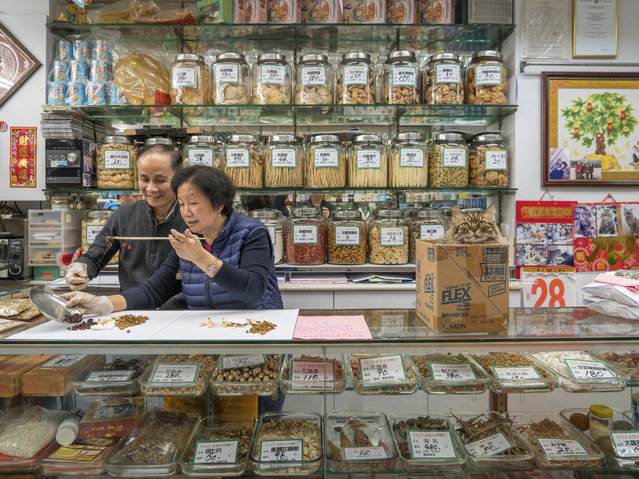
Hong Kong Shop Cats #17. Marcel Heijnen returned to Hong Kong in 2015 and found himself living without a cat for the first time in decades. Soon, though, he was indulging in what he calls “re-tail therapy” and found himself on a first-name basis with a number of cats in his neighbourhood, Sai Ying Pun. (Photo by Marcel Heijnen/Blue Lotus)

When Dutch photographer Marcel Heijnen moved to Hong Kong, the territory’s shop cats instantly caught his eye. While the “feline emperors” are the stars, his shots also offer insights into Hong Kong’s wares, from dried fish to paper. Here: Hong Kong Shop Cats #17. (Photo by Marcel Heijnen/Blue Lotus)
Details
03 Jan 2017 11:04:00
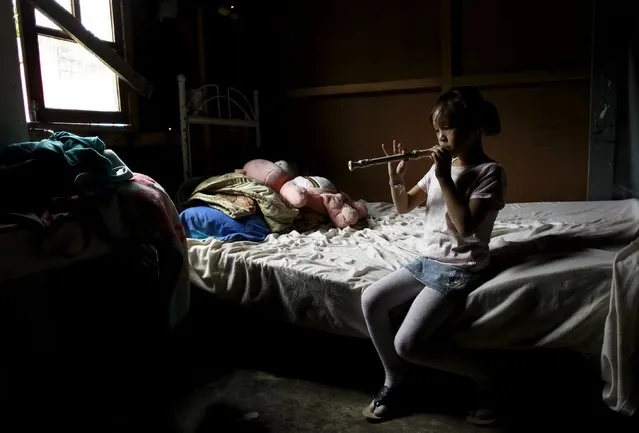
Lisandra Perez, 7, practices in his house before his flute lesson at the Integral System of Artistic Education for Social Inclusion (SIFAIS) center in the poor neighborhood of La Carpio, Costa Rica October 8, 2015. (Photo by Juan Carlos Ulate/Reuters)

Lisandra Perez, 7, practices in his house before his flute lesson at the Integral System of Artistic Education for Social Inclusion (SIFAIS) center in the poor neighborhood of La Carpio, Costa Rica October 8, 2015. SIFAIS center is developing a social program with the help of 156 volunteers who teach art, music, sports and education, for children and youth living in La Carpio, known for being the home to gangs, violence, drugs and social vulnerability, according to the centre. (Photo by Juan Carlos Ulate/Reuters)
Details
15 Oct 2015 08:02:00
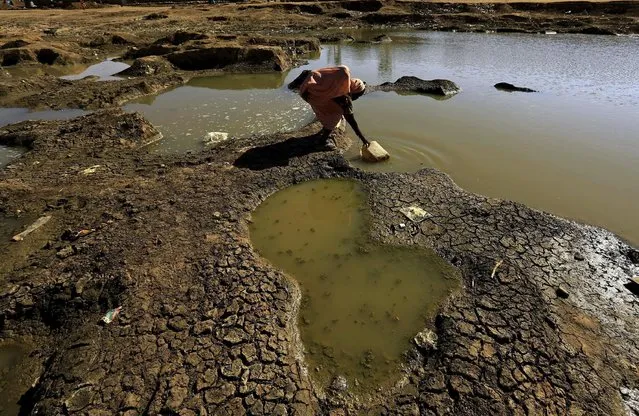
An internally displaced woman collects water from a pond to construct a mud-house at the Aboushok camp in El Fasher, North Darfur, Sudan, November 17, 2015. (Photo by Mohamed Nureldin Abdallah/Reuters)

An internally displaced woman collects water from a pond to construct a mud-house at the Aboushok camp in El Fasher, North Darfur, Sudan, November 17, 2015. The conflict in Sudan's Darfur region that erupted 12 years ago shows no sign of ending. But it hasn't stopped displaced youngsters, some of whom have spent their entire lives in refugee camps, from dreaming big. Twelve children aged 12 explain their hopes and dreams for the future; ambitions include becoming a doctor, an engineer and a teacher. (Photo by Mohamed Nureldin Abdallah/Reuters)
Details
13 Dec 2015 08:00:00
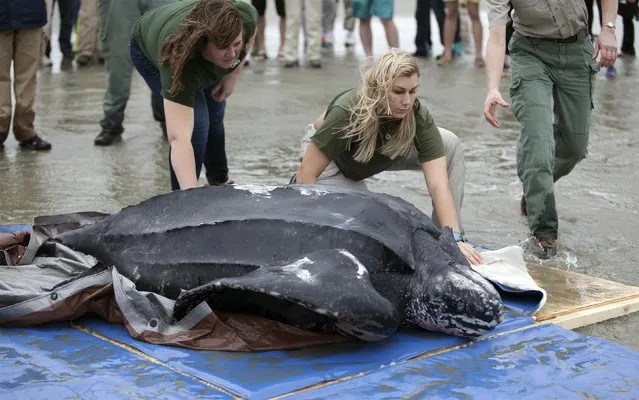
Biologists Jenna Cormany (L) and Lauryn Wright of the South Carolina Department of Natural Resources help to release a leatherback turtle in Isle of Palms, South Carolina March 12, 2015. (Photo by Randall Hill/Reuters)

Biologists Jenna Cormany (L) and Lauryn Wright of the South Carolina Department of Natural Resources help to release a leatherback turtle in Isle of Palms, South Carolina March 12, 2015. The 475-pound turtle was the first living leatherback turtle to be recovered in South Carolina and one of only a handful ever treated at rehabilitation facilities in the United States. It was found March 7 on the beach on Yawkey-South Island Reserve, a 3.5-mile-long (5.6-km-long) barrier island and wildlife preserve near Georgetown, South Carolina. (Photo by Randall Hill/Reuters)
Details
14 Mar 2015 13:32:00
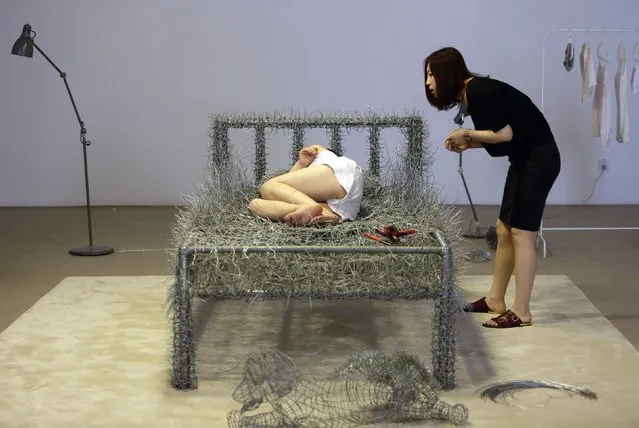
Chinese artist Zhou Jie takes a nap on an unfinished iron wire bed, one of her sculpture works, after lunch as a friend of hers looks on at Beijing Now Art Gallery, in Beijing August 11, 2014. (Photo by Jason Lee/Reuters)

Chinese artist Zhou Jie takes a nap on an unfinished iron wire bed, one of her sculpture works, after lunch as a friend of hers looks on at Beijing Now Art Gallery, in Beijing August 11, 2014. Zhou started her art project titled “36 Days” on August 9, in which she would live inside an exhibition hall with an unfinished iron wire bed, some iron wire sculptures in the shape of stuffed animal dolls, a certain amount of food and her mobile phone, for 36 days. The entire process is open to visitors and she may also interact with them, according to Zhou. (Photo by Jason Lee/Reuters)
Details
16 Aug 2014 10:37:00
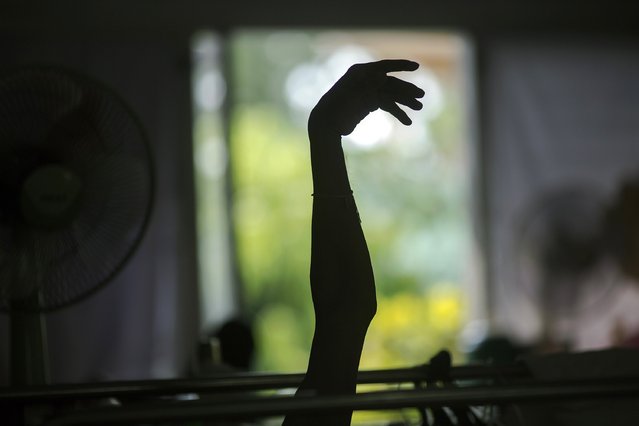
A terminally ill patient raises his arm in a hospice for those dying of AIDS at the Buddhist temple Wat Prabat Nampu in Lopburi province, north of Bangkok November 30, 2014. From 1992, the temple has provided housing for HIV positive patients and palliative care for those in the final stages of the AIDS disease. (Photo by Damir Sagolj/Reuters)

A terminally ill patient raises his arm in a hospice for those dying of AIDS at the Buddhist temple Wat Prabat Nampu in Lopburi province, north of Bangkok November 30, 2014. From 1992, the temple has provided housing for HIV positive patients and palliative care for those in the final stages of the AIDS disease. Data from 2013 estimates Thailand has 450,000 people living with HIV/AIDS, but only 353,000 have access to life-saving antiretroviral drugs. (Photo by Damir Sagolj/Reuters)
Details
08 Dec 2014 11:52:00
The eruption of Cordon Caulle began on June 4, 2011, located in the Region of Los Rios in Chile. For about 12 months, people and animals became accustomed to living with the daily fall of ash, which also caused problems in the air traffic in South America. The explosions and lightning during first days of the eruption could be seen from hundreds of miles around. This photograph was taken on the second night of eruption from the town of Lago Ranco. (Photo and caption by Francisco Negroni/National Geographic Traveler Photo Contest)

The eruption of Cordon Caulle began on June 4, 2011, located in the Region of Los Rios in Chile. For about 12 months, people and animals became accustomed to living with the daily fall of ash, which also caused problems in the air traffic in South America. The explosions and lightning during first days of the eruption could be seen from hundreds of miles around. This photograph was taken on the second night of eruption from the town of Lago Ranco. (Photo and caption by Francisco Negroni/National Geographic Traveler Photo Contest)

ATTENTION! All pictures are presented in high resolution. To see Hi-Res images – just TWICE click on any picture. In other words, click small picture – opens the BIG picture. Click BIG picture – opens VERY BIG picture.
Details
23 Jun 2013 11:24:00
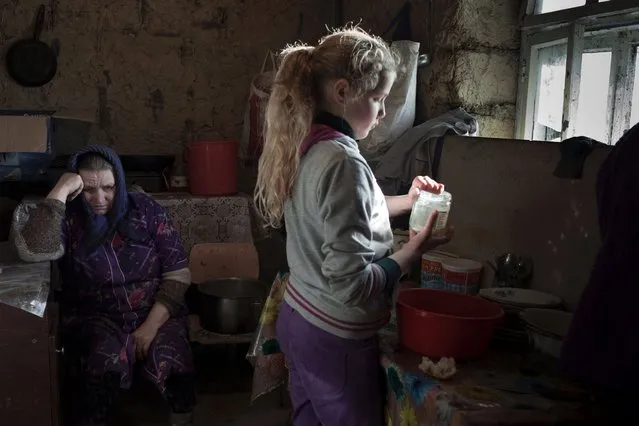
According to the U.S. government, Moldova, one of the poorest countries in Europe, depends on about $1.6 billion annually sent back from the roughly one million Moldovans who left for work in in Europe, Russia, and other former Soviet Bloc countries. Photographer Myriam Meloni went to Moldova to document what she refers to as “social orphans” – children whose parents have emigrated to another country in search of a job and a better future for their families. Here: Lulia is seen washing dishes in her grandmother's house, where she lives. (Photo by Myriam Meloni)

According to the U.S. government, Moldova, one of the poorest countries in Europe, depends on about $1.6 billion annually sent back from the roughly one million Moldovans who left for work in in Europe, Russia, and other former Soviet Bloc countries. Photographer Myriam Meloni went to Moldova to document what she refers to as “social orphans” – children whose parents have emigrated to another country in search of a job and a better future for their families. Here: Lulia is seen washing dishes in her grandmother's house, where she lives. (Photo by Myriam Meloni)
Details
12 Mar 2016 14:57:00