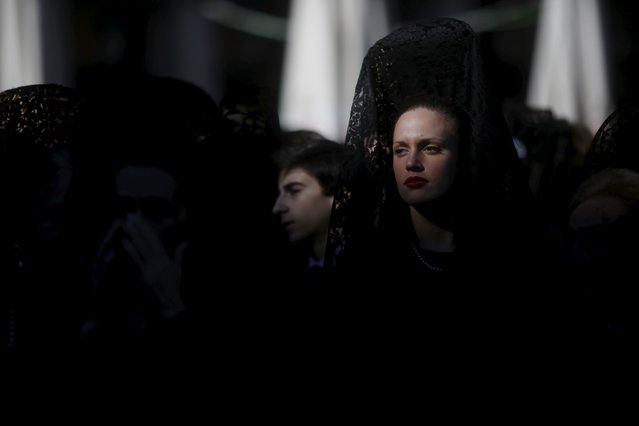
A woman wearing a traditional "mantilla" dress takes part in an open-air mass to celebrate Madrid's patron saint La Almudena Virgin in Madrid, Spain, November 9, 2015. (Photo by Susana Vera/Reuters)
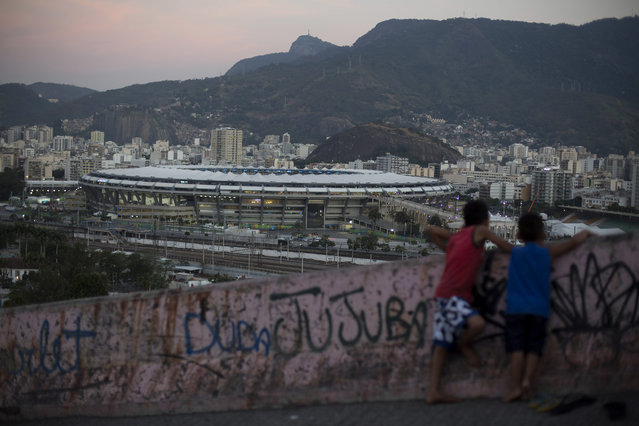
Two boys look out from the Mangueira slum towards the Maracana Stadium that is hosting the Rio's 2016 Summer Olympics opening ceremonies, in Rio de Janeiro, Brazil, Friday, August 5, 2016. (Photo by Leo Correa/AP Photo)
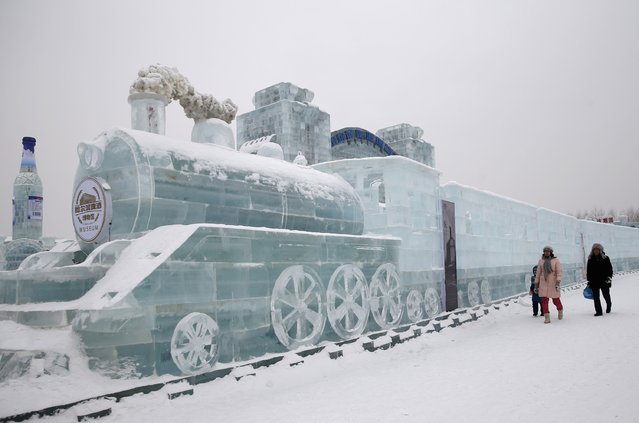
Visitors walk past a train-shaped ice sculpture ahead of the 31st Harbin International Ice and Snow Festival in the northern city of Harbin, Heilongjiang province, January 4, 2015. The winter festival will be officially opened on January 5, 2015. (Photo by Kim Kyung-Hoon/Reuters)
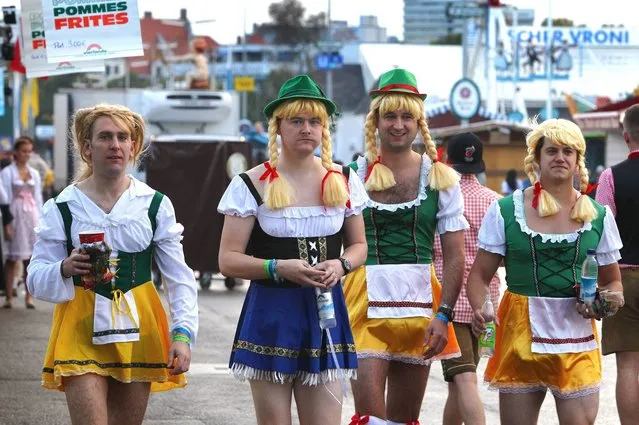
British visitors wearing Bavarian costumes walk ahead the opening of the traditional Bavarian Oktoberfest festival at the Theresienwiese in Munich, southern Germany, on September 20, 2014. Germany's world-famous Oktoberfest kicks off with millions of revellers set to soak up the frothy atmosphere in a 16-day extravaganza of lederhosen, oompah music and, of course, beer. (Photo by Karl-Josef Hildenbrand/AFP Photo/DPA)
A Brazil fan waits for the start of the group A World Cup soccer match between Brazil and Croatia, the opening game of the tournament, in the Itaquerao Stadium in Sao Paulo, Brazil, Thursday, June 12, 2014. (Photo by Felipe Dana/AP Photo)
Men dressed as soldiers pose with models before the opening of the Gamescom 2013 fair in Cologne,Germany, on August 23, 2013. The Gamescom convention is Europe's largest video games trade fair. (Photo by Ina Fassbender/Reuters)
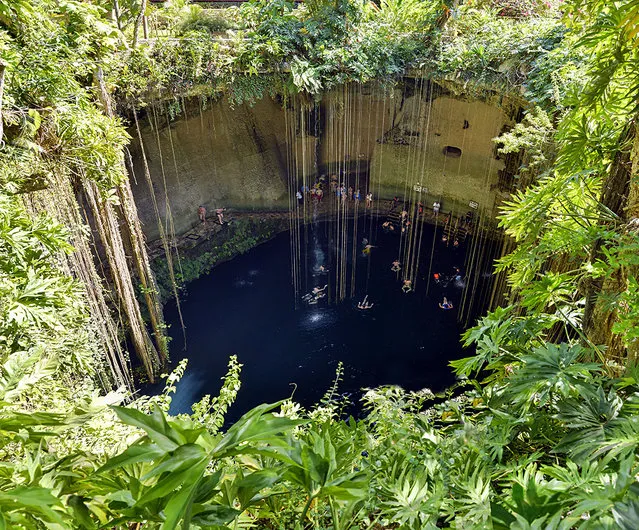
A cenote is a natural phenomenon, a sinkhole in the Earth’s surface. The Yucatan Peninsula in Mexico has an estimated 7,000 cenotes because it is primarily made up of porous limestone. For millions of years, rainfall slowly ate away at the limestone and a huge system of underground caves and caverns was formed. Many filled with water from rain or from the underground water table. When the roof of a water filled cave collapses, a cenote is born. The water found in a cenote may be fresh water, salt water, or both. Structurally it may be completely open, like a lake, almost completely closed with just a small opening at the top, or somewhere in between.
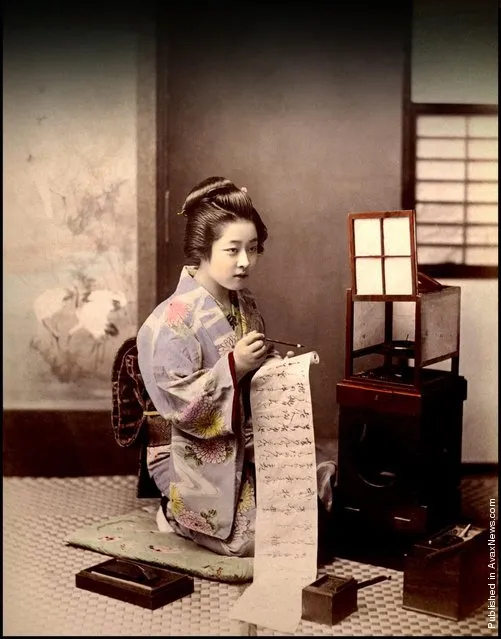
“Kusakabe Kimbei (1841 – 1934) was a Japanese photographer. He usually went by his given name, Kimbei, because his clientele, mostly non-Japanese-speaking foreign residents and visitors, found it easier to pronounce than his family name. Kusakabe Kimbei worked with Felice Beato and Baron Raimund von Stillfried as a photographic colourist and assistant before opening his own workshop in Yokohama in 1881 in the Benten-dōri quarter, and from 1889 operating in the Honmachi quarter. He also opened a branch in the Ginza quarter of Tokyo”. – Wikipedia