Loading...
Done
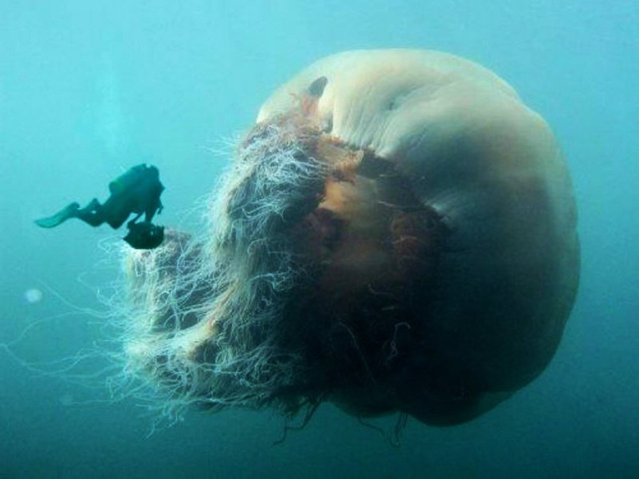
Giant Jellyfish Cyanea capillata

Cyanea capillata is the largest known species of jellyfish. Its range is confined to cold, boreal waters of the Arctic, northern Atlantic, and northern Pacific Oceans, seldom found farther south than 42°N latitude. Similar jellyfish, which may be the same species, are known to inhabit seas near Australia and New Zealand. The largest recorded specimen found, washed up on the shore of Massachusetts Bay in 1870, had a bell (body) with a diameter of 7 feet 6 inches (2.29 m) and tentacles 120 feet (37 m) long.Lion's mane jellyfish have been observed below 42°N latitude for some time—specifically in the larger bays of the east coast of the United States.
Details
24 Jul 2012 12:00:00
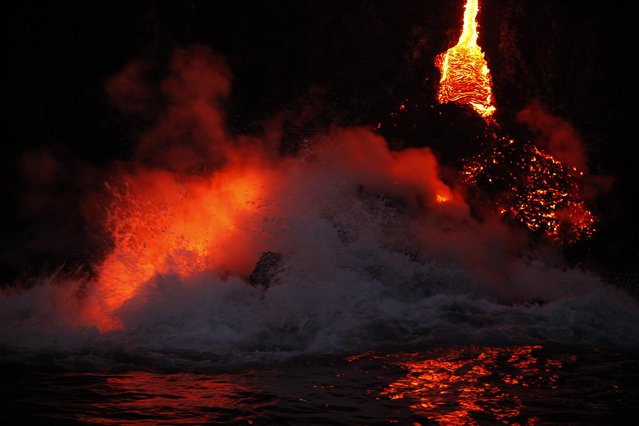
Waves crash over lava as it flows into the ocean near Volcanoes National Park in Kalapana, Hawaii on November 27, 2012. A volcano on Hawaii's largest island is spilling lava into the ocean, creating a rare and spectacular fusion of steam and waves that officials said on Tuesday could attract thrill seeking visitors if it continues. (Photo by Hugh Gentry/Reuters)

Waves crash over lava as it flows into the ocean near Volcanoes National Park in Kalapana, Hawaii on November 27, 2012. A volcano on Hawaii's largest island is spilling lava into the ocean, creating a rare and spectacular fusion of steam and waves that officials said on Tuesday could attract thrill seeking visitors if it continues. (Photo by Hugh Gentry/Reuters)
Details
29 Nov 2012 10:00:00
Beautiful Sunset in Cornwall

The sun sets over the sea looking towards Lands End viewed from Gwenver beach near Sennen Cove on February 7, 2011 in Cornwall, England. (Photo by Matt Cardy/Getty Images)
Details
22 Sep 2011 12:34:00
A model presents a creation from Andres Sarda's Fall/Winter 2017 collection during the Mercedes-Benz Fashion Week in Madrid, Spain February 18, 2017. (Photo by Javier Barbancho/Reuters)

A model presents a creation from Andres Sarda's Fall/Winter 2017 collection during the Mercedes-Benz Fashion Week in Madrid, Spain February 18, 2017. (Photo by Javier Barbancho/Reuters)
Details
20 Feb 2017 00:02:00
A police officer lies on the street after being run over by a bus during a protest against the increase in the price of public transport in San Cristobal, Venezuela March 29, 2016. (Photo by Carlos Eduardo Ramirez/Reuters)

A police officer lies on the street after being run over by a bus during a protest against the increase in the price of public transport in San Cristobal, Venezuela March 29, 2016. (Photo by Carlos Eduardo Ramirez/Reuters)
Details
30 Mar 2016 11:10:00
A U.S. Army crew chief flying on board a CH-47F Chinook helicopter observes the successful test of flares during a training flight in Afghanistan, March 14, 2018. (Photo by Tech. Sgt. Gregory Brook/Reuters/U.S. Air Force)

A U.S. Army crew chief flying on board a CH-47F Chinook helicopter observes the successful test of flares during a training flight in Afghanistan, March 14, 2018. (Photo by Tech. Sgt. Gregory Brook/Reuters/U.S. Air Force)
Details
11 Apr 2018 00:05:00
“JOKER” movie production tries to hide Joaquin Phoenix's clown make-up and green hair with umbrella and a long black cloth over his head as he was walking with the help of assistant and bodyguard to the set of “JOKER” filming at a Bronx train station on September 22, 2018. (Photo by The Mega Agency)

“Joker” movie production tries to hide Joaquin Phoenix's clown make-up and green hair with umbrella and a long black cloth over his head as he was walking with the help of assistant and bodyguard to the set of “Joker” filming at a Bronx train station on September 22, 2018. (Photo by The Mega Agency)
Details
09 Oct 2018 00:05:00
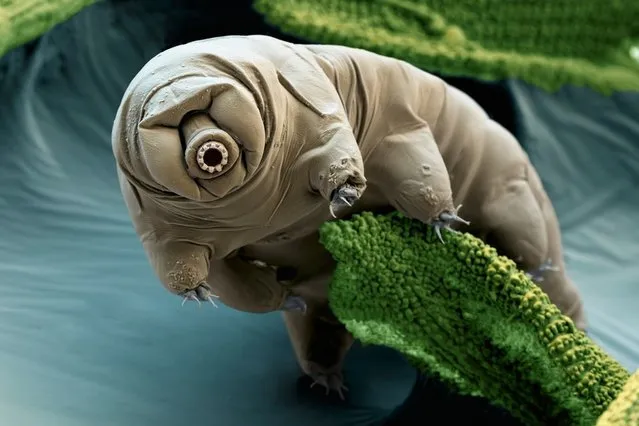
Tardigrades (commonly known as waterbears or moss piglets). (Photo by SPL/East News)

“Tardigrades (commonly known as waterbears or moss piglets) are small, water-dwelling, segmented animals with eight legs. Tardigrades were first discovered in 1773 by Johann August Ephraim Goeze, who called them kleiner Wasserbär, meaning “little water bear” in German. The name Tardigrada means “slow walker” and was given by Lazzaro Spallanzani in 1777. The name water bear comes from the way they walk, reminiscent of a bear's gait. The biggest adults may reach a body length of 1.5 millimetres (0.059 in), the smallest below 0.1 mm. Freshly hatched tardigrades may be smaller than 0.05 mm”. – Wikipedia. Photo: Tardigrades. (Photo by SPL/East News)
Details
26 Sep 2012 09:55:00