Loading...
Done
Base jumpers leap from the 300-metre high skydeck of Malaysia's landmark Kuala Lumpur Tower against the backdrop of the city's skyline on October 3, 2016 during the annual International KL Tower Base-Jump event. (Photo by Manan Vatsyayana/AFP Photo)

Base jumpers leap from the 300-metre high skydeck of Malaysia's landmark Kuala Lumpur Tower against the backdrop of the city's skyline on October 3, 2016 during the annual International KL Tower Base-Jump event. (Photo by Manan Vatsyayana/AFP Photo)
Details
04 Oct 2016 11:01:00
Tiger Airways, Singapore, 2006. (Photo by Brian Finke/The Washington Post)

Photographer Brian Finke spent nearly two years traversing the friendly skies, following the life of flight attendants in the air and on the ground, from Delta and Hawaiian Air, to Hooters Air, Southwest, Air France, British Airways, Air Asia, and dozens more. His images of flight attendants waving, applying makeup and deboarding plans while smiling appear as if they were ripped from an advertisement in a glossy magazine. Here: Tiger Airways, Singapore, 2006. (Photo by Brian Finke/The Washington Post)
Details
30 Sep 2015 08:02:00
An older model Ford Mustang sits on cinder blocks with missing wheels near an abandoned apartment building in Detroit, Michigan January 7, 2015. Detroit, also known as the Motor City, is the historic hub of automobile manufacturing in the United States. (Photo by Joshua Lott/Reuters)

An older model Ford Mustang sits on cinder blocks with missing wheels near an abandoned apartment building in Detroit, Michigan January 7, 2015. Detroit, also known as the Motor City, is the historic hub of automobile manufacturing in the United States. A federal judge in December 2013 formally declared the city bankrupt but it won court approval to exit bankruptcy last November. Once the proud symbol of U.S. industrial strength, Detroit fell on hard times after decades of population loss, rampant debt and financial mismanagement left it struggling to provide basic services to residents. (Photo by Joshua Lott/Reuters)
Details
14 Jan 2015 12:48:00
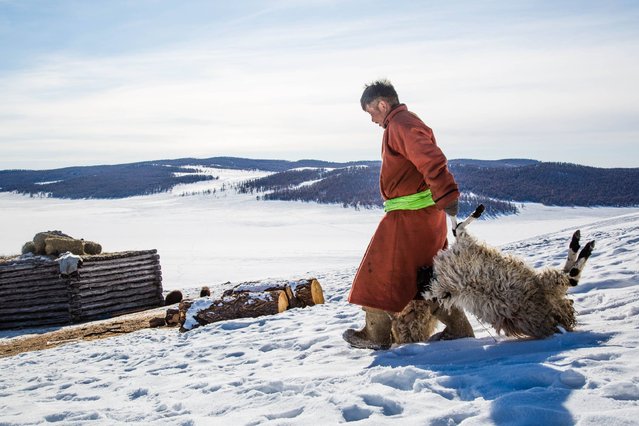
This handout photo taken on February 12, 2017 and released on February 16 by the International Federation of Red Cross and Red Crescent Societies (IFRC) shows Mongolian herder Munkhbat Bazarragchaa (C) dragging two sheep – which recently died due to the weather - to a pile of dead animals behind his “ger” in Khuvsgul province, northern Mongolia. Thousands of Mongolian herders face disastrous livestock losses from dreaded severe weather  known as the “dzud”, the Red Cross said on February 16, 2017 in launching an international emergency aid appeal. (Photo by Mirva Helenius/AFP Photo/IFRC)

This handout photo taken on February 12, 2017 and released on February 16 by the International Federation of Red Cross and Red Crescent Societies (IFRC) shows Mongolian herder Munkhbat Bazarragchaa (C) dragging two sheep – which recently died due to the weather - to a pile of dead animals behind his “ger” in Khuvsgul province, northern Mongolia. Thousands of Mongolian herders face disastrous livestock losses from dreaded severe weather known as the “dzud”, the Red Cross said on February 16, 2017 in launching an international emergency aid appeal. (Photo by Mirva Helenius/AFP Photo/IFRC)
Details
17 Feb 2017 11:40:00
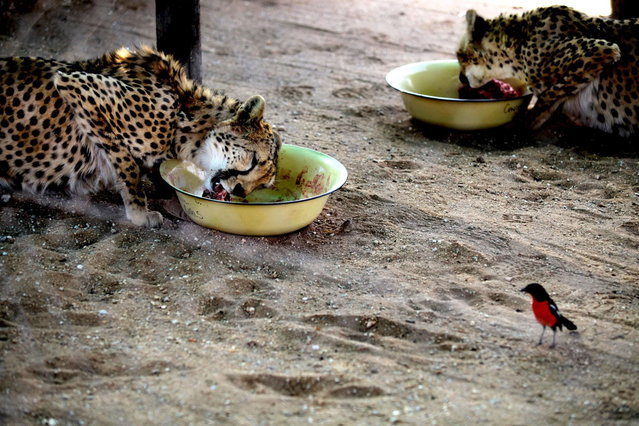
Young cheetahs eat meat at The Cheetah Conservation Fund (CCF) center in Otjiwarongo, Namibia, on August 13, 2013. The CCF started breeding Anatolian livestock dogs to promote cheetah-friendly farming after some 10,000 big cats – the current total worldwide population – were killed or moved off farms in the 1980s.  Up to 1,000 cheetahs were being killed a year, mostly by farmers who saw them as livestock killers. But the use of dogs has slashed losses for sheep and goat farmers and led to less retaliation against the vulnerable cheetah. (Photo by Jennifer Bruce/AFP Photo)

Young cheetahs eat meat at The Cheetah Conservation Fund (CCF) center in Otjiwarongo, Namibia, on August 13, 2013. The CCF started breeding Anatolian livestock dogs to promote cheetah-friendly farming after some 10,000 big cats – the current total worldwide population – were killed or moved off farms in the 1980s. Up to 1,000 cheetahs were being killed a year, mostly by farmers who saw them as livestock killers. But the use of dogs has slashed losses for sheep and goat farmers and led to less retaliation against the vulnerable cheetah. (Photo by Jennifer Bruce/AFP Photo)
Details
29 Aug 2013 10:56:00
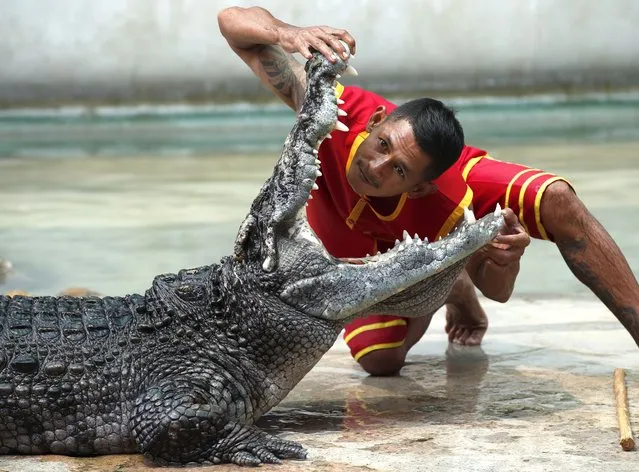
A Thai performer puts his head inside a crocodile's mouth during a media preview performance as part of preparation to reopen Samutprakarn Crocodile Farm and Zoo in Samut Prakan province, Thailand, 19 March 2024. Thailand's famous tourist attraction Samutprakan Crocodile Farm and Zoo is scheduled to reopen to welcome tourists on 01 April 2024 after a temporary closure in 2020 due to the loss of visitors caused by the COVID-19 pandemic which resulted in the zoo suffering financial loss and going into liquidation. The Samutprakan Crocodile Farm and Zoo established in 1950 claims to be Thailand's first and the world's largest crocodile farm with more than 60,000 freshwater and marine crocodiles offering crocodile shows to attract tourists as well as housing various other animal showcases including tigers, chimpanzees, elephants. (Photo by Rungroj Yongrit/EPA)

A Thai performer puts his head inside a crocodile's mouth during a media preview performance as part of preparation to reopen Samutprakarn Crocodile Farm and Zoo in Samut Prakan province, Thailand, 19 March 2024. (Photo by Rungroj Yongrit/EPA)
Details
06 Apr 2024 04:17:00
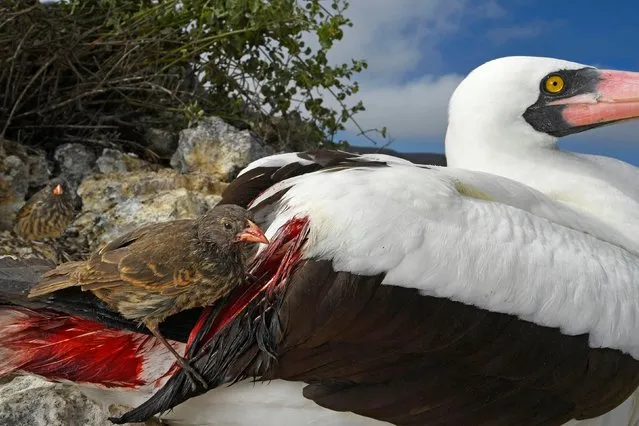
Bloodthirsty by Thomas P Peschak, Germany/South Africa — winner, Behaviour: birds. When rations run short on Wolf Island, in the remote northern Galápagos, the sharp-beaked ground finches become vampires. Their sitting targets are Nazca boobies and other large birds. The finches rely on a scant diet of seeds and insects, which regularly dries up, so they drink blood to survive. ‘I’ve seen more than half a dozen finches drinking from a single Nazca booby,’ says Tom. Rather than leave their nests the boobies tolerate the vampires, and the blood loss doesn’t seem to cause permanent harm. (Photo by Thomas P Peschak/2018 Wildlife Photographer of the Year)

Bloodthirsty by Thomas P. Peschak, Germany/South Africa — winner, Behaviour: birds. When rations run short on Wolf Island, in the remote northern Galápagos, the sharp-beaked ground finches become vampires. Their sitting targets are Nazca boobies and other large birds. The finches rely on a scant diet of seeds and insects, which regularly dries up, so they drink blood to survive. ‘I’ve seen more than half a dozen finches drinking from a single Nazca booby,’ says Tom. Rather than leave their nests the boobies tolerate the vampires, and the blood loss doesn’t seem to cause permanent harm. (Photo by Thomas P. Peschak/2018 Wildlife Photographer of the Year)
Details
19 Oct 2018 00:05:00
A model walks down the runway at the 13th China International Young Fashion Designers Contest during China Fashion Week

A model walks down the runway at the 13th China International Young Fashion Designers Contest during China Fashion Week on March 25, 2005 in Beijing, China. (Photo by China Photos/Getty Images)
Details
27 Feb 2012 12:13:00